
Pool Aiming Systems Compared: Ghost Ball to CTE
Pool aiming systems come in two families. Exact methods (ghost ball, contact point to contact point, double the distance) point you at the geometrically correct aim and leave the seeing to you. Reference systems (fractional-ball aiming, Hal Houle's three angles, CTE and Pro One, 90/90) start every shot from a fixed alignment that gets you close, and you adjust from there by feel. None of them corrects for squirt or throw, and all of them need a straight stroke.
Below: how each system works in plain steps, what it gets right, where its geometry runs out, and which one to learn first.
Pool aiming systems compared
| System | Family | The idea | Where it shines | Weak spot |
|---|---|---|---|---|
| Ghost ball | Exact | Aim the cue ball's center at a phantom ball touching the object ball opposite the pocket | Learning; any cut | The ghost is invisible; ignores throw |
| Contact point to contact point (parallel lines) | Exact | Join the contact points on both balls, then shift that line to the cue ball's center | Players who see points better than a whole ball | Several lines to picture at once |
| Double the distance | Exact (nearly) | Double the gap from the object ball's center to the contact point | Thin cuts, using the gap to the edge | Small built-in error when the balls are close |
| Fractional-ball | Reference | Memorize the cut angles of fixed overlaps (3/4, 1/2, 1/4) | Fast reads; checking your eye | Shots between fractions need feel |
| Hal Houle's 3 angles | Reference | Three aims for all cuts, about 15, 30 and 45 degrees | Simplicity | Same gaps as fractional aiming |
| CTE (center to edge) | Pivot | Sight cue ball center to object ball edge, offset the cue, pivot to center | A strict, repeatable routine | Fixed pivots give fixed angles; users adjust |
| Pro One | Pivot | Stan Shuffett's CTE version with more alignments and half-tip pivots | Committed CTE students | Long to learn; same geometric limits |
| 90/90 | Pivot | Line up the outer edges of both balls, then pivot to center | Players who like edge-to-edge sighting | Same pivot limits |
| Feel (no system) | Intuitive | See the angle from practice, with a solid pre-shot routine | How most top players aim | Takes years of table time |
The family split comes from Patrick Johnson's summary on Dr. Dave Alciatore's site. Exact techniques give the right answer in theory and are limited by how well you see. Align-and-adjust techniques give the same starting point every time and are limited by how well you adjust.
Ghost ball, parallel lines and double the distance
These three aim at the same spot by different routes. Dr. Dave lists the other two as variations on the ghost ball.
Ghost ball
Aim the cue ball's center at a phantom ball frozen against the object ball opposite the pocket. Method and drills: ghost ball aiming.
Contact point to contact point (parallel lines)
- Picture a line through the object ball's center toward the pocket. Where it leaves the back of the ball is the object ball's contact point.
- Shift that line sideways, keeping it parallel, until it runs through the cue ball's center. Where it meets the front of the cue ball is the cue ball's contact point.
- Picture a line joining the two contact points.
- Shift that line parallel until it runs through the cue ball's center. That's your aim line.
Double the distance
Picture the distance from the object ball's center to the contact point. Lay the same distance again on the far side of the contact point: that's where the aim line passes. For thin cuts it's easier to use the small gap from the contact point to the ball's outer edge and double that instead. Analyses posted on Dr. Dave's double-the-distance page show a small built-in error when the cue ball is close to the object ball (under about a diamond) that grows on thin cuts, so close, thin shots need a touch of correction.
Fractional-ball aiming
Fractional aiming sorts cuts by how much of the object ball the cue ball covers at contact. Seen from behind the cue ball, the overlap sets the cut angle by a simple rule: the sine of the cut angle equals one minus the overlap fraction. That gives these numbers:
| Hit | Aim the cue ball's center at | Cut angle |
|---|---|---|
| Full ball | The object ball's center | 0 (straight in) |
| 7/8 ball | A quarter of the way from center to edge | About 7 degrees |
| 3/4 ball | Halfway between center and edge | About 14.5 degrees |
| 5/8 ball | Three quarters of the way to the edge | About 22 degrees |
| 1/2 ball | The object ball's edge | 30 degrees |
| 3/8 ball | An eighth of a ball outside the edge | About 38.7 degrees |
| 1/4 ball | A quarter ball outside the edge | About 48.6 degrees |
| 1/8 ball | Three eighths of a ball outside the edge | About 61 degrees |
Most players learn just three: 3/4, 1/2 and 1/4. The half-ball hit is the anchor because it's center to edge, the easiest alignment on the table to see. Dr. Dave's May 2026 column describes the quarter-ball cut as between 45 and 50 degrees and the three-quarter as about 15.
Two shortcuts from Patrick Johnson, published on Dr. Dave's fractional page, help you read which fraction a shot needs:
- Spread your hand. With thumb and little finger at 90 degrees, your three middle fingers fall roughly on the 15, 30 and 45 degree cuts.
- Count slopes. A line that rises one unit for every one unit across is a 45-degree cut (about a quarter ball). One for every two is about 30 degrees (half ball). One for every four is about 15 degrees (three-quarter ball).
The limit is the gaps. Most shots fall between the reference fractions, and Dr. Dave's point is that any system with a small number of aim lines makes you miss those in-between shots unless you adjust, consciously or not.
Hal Houle's three angles
Hal Houle taught that there are only three aims for all cut shots: a 15-degree cut, a 30-degree cut and a 45-degree cut. Dr. Dave's technical proof (TP A.11) shows these three aims are the same as 3/4, 1/2 and 1/4-ball hits, and that the 15 and 45-degree labels aren't exact. His verdict: it's easy to see and gives good reference aims for ranges of cuts, but shots between the references still have to be adjusted. Houle also taught an early version of CTE, below.
CTE (center to edge) and Pro One
CTE stands for center to edge. It's an align-and-pivot routine built on one reference line: from the cue ball's center through the outer edge of the object ball (the edge away from the cut). There are several versions. The early one taught by Hal Houle, as written up on Dr. Dave's CTE page, goes like this for a cut to the left:
- Thick cut (under about 15 degrees): line the cue up one tip right of the cue ball's center, through the object ball's right edge. Put the bridge down, pivot the cue to the cue ball's center, stroke.
- Half-ball cut (about 30 degrees): sight center to edge and shoot along that line.
- Thin cut (over about 45 degrees): line the cue up one tip left of center through the same edge, bridge down, pivot to center, stroke.
A later clarification posted on the same page says Houle had players pivot on every shot, and that the number of tips of offset depended on the player's pivot length. Stan Shuffett's Pro One, the best-known modern version, uses more starting alignments. In Dr. Dave's reading of the first Pro One DVD there are six per cut direction, built from object ball reference points Shuffett labels A, B and C, half-tip offsets and a pivot to center, with bridge length set by the distance between the balls; Shuffett later added more visuals. Shuffett's site, justcueit.com, bills itself as the home of center-to-edge aiming and sells his book and videos. If CTE interests you, learn it there, from the source.
90/90
90/90 is a pivot system developed by Ron Vitello. In Andrew Cleary's description (on Dr. Dave's 90/90 page), you split each ball into 10% slices and line up the last 10% of the cue ball with the last 10% of the object ball, an edge-to-edge alignment, then pivot your hips until the cue points at the cue ball's center. If you pivot past center, you stand up and start over rather than fix it while down. Descriptions vary from teacher to teacher, and it shares the pivot limits below.
The catch with every pivot system
A fixed pivot around a fixed bridge turns the cue through a fixed angle, so the cut you get depends on how far apart the balls are and how long your bridge is. Dr. Dave's Billiards Digest diagrams show that with one alignment and one pivot, changing only the distance between the balls changes the cut a lot, and no single pivot length sends three shots at different distances to the same pocket.
He turns this into a test. Take three thick cuts of about 10, 15 and 20 degrees at the same distance. They all fall in CTE's thick-cut category. What do you do differently to make all three? The honest answers are the ways CTE users really adjust:
- shift the starting alignment a little, often by moving the eyes;
- offset the cue a bit less or more than the full edge;
- pivot slightly short of center or slightly past it;
- change the effective pivot length by moving the bridge length, shifting the bridge during the pivot, or pivoting before the bridge goes down (an "air pivot").
That isn't a knock on players who make CTE work; it's where their feel goes. Dr. Dave's bottom line: any align-and-pivot system needs changes in alignment or effective pivot length as the cut and distance change.
Why systems still help some players
If the geometry doesn't close, why do people improve with a system? Dr. Dave's system-benefits page collects the reasons, and they tell you what to keep even if you drop the system:
- It forces you to aim on purpose. Dr. Dave's list of why people miss starts with not focusing on the aim at all.
- A fixed routine is repeatable, and Colin Colenso argues that a player who trusts the line strokes straight through it instead of steering.
- Finishing on the cue ball's center cuts down accidental sidespin, and with it squirt and throw.
- Mike Page points to quiet-eye research in aiming sports, where experts held their gaze on the target longer before the shot (he cites roughly 2.5 seconds against 1.5). A routine that makes you lock onto a target buys that time.
If a system helps you, keep it. Just know which part is doing the helping.
What top players actually do
Dr. Dave's answer, from his "How Pros Aim" column (February 2024): they don't use procedural cut-shot systems. They aim intuitively while standing, line up their vision center, drop straight into the shot, check the cue's alignment, and lock their eyes on the target. He named that routine DAM, partly as a joke on aiming-system marketing. The routine is laid out in how to aim in pool.
Some pros are blunter. On a TAR podcast with Corey Deuel, transcribed on Dr. Dave's systems page, John Schmidt called aiming systems overrated and pointed out that none of them tells you what to do once you put english on the ball and it squirts. That's the gap every system shares.
Which aiming system should you learn?
- New to the game: ghost ball, with the half-ball hit as your first reference. Dr. Dave considers ghost ball the faster way to develop because it builds the real skill.
- You can make balls but miss the same cuts: add the 3/4, 1/2 and 1/4 references as a check on what your eye says.
- Your aiming feels random and you have no routine: a structured system such as CTE gives you a routine. Learn it from the source, commit for a month, and expect to adjust.
- You already shoot well by feel: don't switch. Use fractions or the ghost ball as a second opinion on unusual shots.
- You use a lot of english: no aiming system covers squirt and swerve. Learn back-hand and front-hand english from how to use english.
Whatever you pick, calibrate it on your own table. Shoot the same medium cut twenty times, note whether misses are thick or thin, adjust your picture, then repeat at longer distances. Switching systems every week resets that work to zero.
Systems for kicks and banks
Rail shots are where systems earn their reputation; even Dr. Dave, skeptical of cut-shot systems, calls kick and bank systems very useful. See the diamond system explained, kick shots and how to bank shots.
Sources
- Dr. Dave Alciatore: aiming systems index and how different people aim
- Dr. Dave: fractional-ball aiming
- Dr. Dave: contact point and parallel lines and double the distance
- Dr. Dave: CTE versions, CTE evaluation and Pro One
- Dr. Dave: 90/90 and pivot-system issues
- Dr. Dave: benefits of aiming systems
- Dr. Dave, How Pros Aim (Billiards Digest, February 2024, PDF) and Aim Visualization Techniques (May 2026, PDF)
- Stan Shuffett: CTE Pro One
Our picks
Links open the current selection and price on Amazon so you can compare real reviews before buying.
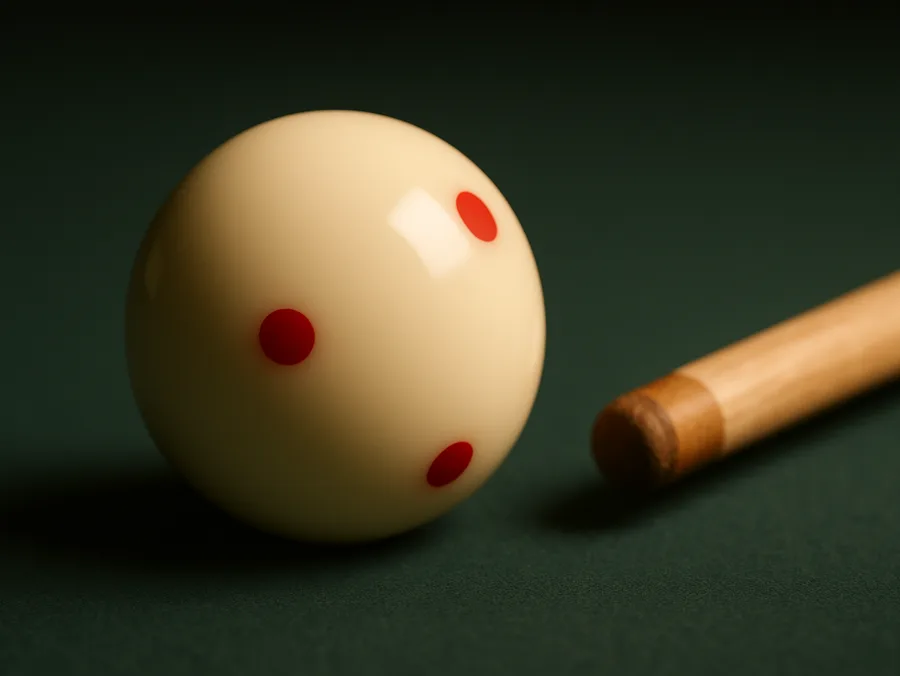
MOOCY 6-Dot Measle Training Cue Ball
Seeing overlaps and center-ball hitsEvery system on this page assumes you hit the cue ball where you meant to. This 2-1/4 inch, 6 oz phenolic ball has six embedded red dots, which make an accidental off-center hit easy to spot. Dr. Dave also suggests lining up the dots with the shot line while you practice.
Check price on Amazon
Billiards Angle Trainer Ghost Ball Aiming Aid
Checking your ghost-ball picture early onA patented table trainer sold for ghost-ball and angle practice, which the listing says also sets up combination and bank shots. Reviews are mixed. Use it to check the picture you're building in the first weeks, then take it off the table and shoot the same shots cold.
Check price on Amazon
Pool Table Marker Dots, 240 Pack
Calibrating a system on your tableCalibration means shooting the same shot twenty times. These 35mm peel-and-stick spots mark the ball positions so every attempt is identical, and they peel off the cloth clean. Mark the 3/4, 1/2 and 1/4 setups once and you can come back to them all season.
Check price on Amazon
Play Your Best Pool by Phil Capelle
Aiming inside a complete gameA full instruction book from Phil Capelle. A book like this puts aiming where it belongs, next to the stroke and position play, which makes it a better long-term buy than any single-system course. Our billiards book guide compares it with the other standards.
Check price on AmazonFrequently asked questions
What is the best aiming system in pool?
For most players, ghost ball, with the 3/4, 1/2 and 1/4-ball hits as references. It trains you to see the true aim line. Pivot systems like CTE help some players by giving them a strict routine, but they still need adjustment between shots.
What does CTE stand for in pool?
Center to edge. You start by sighting a line from the cue ball's center to the outer edge of the object ball, then offset the cue and pivot it to the cue ball's center. Stan Shuffett's Pro One is the best-known version.
Does CTE aiming really work?
It works for the players who learn to adjust within it. Dr. Dave's analysis shows a fixed alignment and fixed pivot produce one cut angle, which changes with ball distance and bridge length, so users vary the alignment or pivot by feel. The routine itself is a real benefit.
What is the 90/90 aiming system?
A pivot system developed by Ron Vitello. You line up the outer edges of the cue ball and object ball (the last 10% of each), then pivot your hips until the cue points at the cue ball's center.
What aiming system do professional pool players use?
Mostly none in the step-by-step sense. Dr. Dave describes pros aiming by feel built from practice, with a consistent routine: aim while standing, drop straight into the shot, check alignment, then lock their eyes on the target.
What angle does a half-ball hit make?
30 degrees. Aim the center of the cue ball at the edge of the object ball. A 3/4-ball hit makes about 14.5 degrees and a 1/4-ball hit about 48.6.
Do aiming systems work when I use english?
No system handles it on its own. English makes the cue ball squirt and swerve and adds throw. Find the center-ball aim with your system, then correct for spin with back-hand or front-hand english.
Related guides
LeaguePool is reader-supported. When you buy through links on this site we may earn an affiliate commission at no extra cost to you. As an Amazon Associate we earn from qualifying purchases.