Best Pool Practice Drills
A good pool drill has three parts: a fixed setup, a pass mark, and a score you write down. Without the score it's just hitting balls. The drills below come from instructor material (Bob Jewett and Dr. Dave Alciatore's practice series, the PBIA instructor drills, and the Billiard University exams), and each one has a clear way to tell whether you passed.
Mark ball positions with paper hole reinforcements or marker dots so every rep starts from the same spot. For the overall plan of what to work on, see how to get better at pool.
Pool drills at a glance
| Drill | Level | Trains | Score or pass mark |
|---|---|---|---|
| Straight-in stop shot | Beginner | Stroke, center-ball hit | Cue ball stops within one ball of contact; 10 in a row |
| Stop/follow/draw | Beginner | Basic cue ball control | 3 of 5 on each shot before moving on |
| 3-ball runout | Beginner | Position, planning | Runs out of 20; add a ball at 18 |
| Progressive draw | Intermediate | Draw distance | Final cue ball position after 10 to 15 shots |
| Progressive angles | Intermediate | Cut shots | Farthest angle reached |
| Spot shot challenge | Intermediate | Long shots, draw and speed | Longest run |
| Softly to the side | All | Soft speed | Four or more strokes to sink it |
| 6-ball pocket drill | Intermediate | Short position, sequencing | Clear all six; then move balls out |
| Line-up drill | Intermediate | Position, rhythm | Balls run before a miss |
| Wagon wheel | Intermediate to advanced | Cue ball direction | 3, 2 or 1 points per target, 11 targets |
| Target practice | Intermediate to advanced | Cue ball landing spot | Points per target hit |
| Kicks only | Intermediate | One-rail and two-rail kicks | Hits in a row |
| BU safety challenge | Advanced | Safety play | Out of 40, scaled to 100 |
| Draw and follow matrix | Advanced | Precise distance control | Shots made out of 48 or 75 |
Stroke-check drills (cue ball up and back to your tip, the rail line, golf-tee gate) are in our stroke guide. Scored practice games like the ghost and equal offense are in solo pool games.
Pool drills for beginners
1. Straight-in stop shot
Put an object ball about a diamond from a corner pocket and the cue ball two or three diamonds behind it on a straight line. Pocket the ball and make the cue ball stop dead where it hit. A slight drift sideways tells you the stroke or the hit was off center. Work up to 10 in a row, then move the cue ball farther back. This is the drill everything else stands on, and it's also the one players most often skip because it's dull.
2. Stop/follow/draw drill
Dr. Dave's version uses the same setups for all three shots. From one cue ball position, hit a stop shot, then a follow shot where the cue ball rolls into the pocket after the object ball, then a draw shot that brings the cue ball back into a second pocket. Do that on two object balls, then on a third ball from a new cue ball position. The rule that makes it work: don't move to the next shot until you succeed on at least 3 of 5, and a stop shot counts only if the cue ball stops within one ball of the contact spot. Our guides to the stop shot, follow and draw cover the technique.
3. 3-ball runout
Toss the 1, 2 and 3 onto the table at random (respot any that drop), take ball in hand, and run them in order. Do 20 layouts and count how many you run. Dr. Dave's progression: when you're running 18 to 20 out of 20, add a fourth ball, then a fifth. It's the simplest drill that makes you plan ahead instead of just making balls.
Progressive drills: the difficulty adjusts to you
Bob Jewett's progressive practice idea solves the main problem with drills, which is that they're either too easy or too hard. You start easy, make the shot harder each time you succeed, and back off a little each time you fail. Where you end up is your score.
Progressive draw
Object ball near a corner pocket, cue ball one diamond up the table. Pocket the ball and draw the cue ball back past the first diamond. On a success, move the cue ball one diamond farther from the object ball. Once you've failed, move in half-diamond steps: back half a diamond on each miss, forward half a diamond on each success. After 10 to 15 shots, the cue ball's position is your score. Jewett and Dr. Dave's series adds harder levels: draw back to the starting spot, then to within two diamonds of it, and so on.
Progressive angles
From the PBIA instructor drills: object ball a short way from a side pocket, cue ball near the center of the table on a straight line. Each time you pocket it, move the cue ball to make the cut a little thinner. The angle where you start missing is the edge of your comfort zone. That's where practice pays the most.
Spot shot challenge
Object ball on the foot spot, cue ball in hand in the kitchen. Pocket the ball and bring the cue ball back behind the head string. Respot the object ball and shoot again from wherever the cue ball stopped. Your run ends on a miss or when the cue ball doesn't make it back into the kitchen. Score is your longest run. It tests long shots and draw speed at the same time.
Speed control drills
Most players have two speeds: firm and harder. These two fix that.
Softly to the side, from Bob Jewett's five-minute lessons in the BCA instructor's manual: object ball on the center spot, cue ball near one side pocket. The goal is to sink the object ball in the opposite side pocket, but it must take at least four strokes. Leave the balls where they stop after each shot and hit nearly full each time. Ideally the object ball moves only an inch or two per stroke. It's harder than it sounds.
Lag to the rail: shoot the cue ball the length of the table and back, trying to stop it as close to the head rail as you can without touching it. Ten lags, and measure the average distance by eye in ball widths. Our speed control guide has more.
Position drills
6-ball pocket drill
From the PBIA drills: put one object ball about five inches out from each of the six pockets. Ball in hand. Before each shot, name the ball you're shooting and the one you'll play position on next. Any miss or bad position means you reset all six and start again. When you can clear it, move the balls out from the pockets in three- or four-inch steps, or require the cue ball to stop in a set area.
Line-up drill
Lay a row of balls (start with 8 or 10, work up to all 15) along the long string down the middle of the table, spaced about a ball apart. Ball in hand on the first ball, then run them in any order. Because the balls sit in a row, you can't just roll forward along the line; each shot forces you to move the cue ball to a new angle. Count how many you run before a miss. For a variation, lay them in an L: a row along the long string and a short row across the table. The bend in the line forces a change of direction.
Wagon wheel
Billiards writer Ted Brown first used the name, according to Dr. Dave's Billiards Digest article on the drill. One object ball sits near a pocket; target balls are set along the rails in an arc. With ball in hand each time, pocket the object ball and send the cue ball to tap each target, one by one, by changing the cut angle and using follow, stun or draw. Dr. Dave's scoring: three attempts per target, 3 points for a hit on the first try, 2 on the second, 1 on the third. With 11 targets, 33 is perfect.
Target practice
Pick a spot for the object ball and a spot for the cue ball to finish, and put a target there (a sheet of paper works). Pocket the ball and land the cue ball on the target. Dr. Dave's trick for random setups is to deal two playing cards for each ball position, using the card values as a grid across and along the table, so you don't keep practicing the shots you like. Count hits out of 10 and shrink the target as you improve. For the principles behind these, see position play basics.
Kick and safety drills
Kicks only, another of Jewett's five-minute drills: just the cue ball and one object ball. The cue ball must hit one or more rails, then the object ball, and the object ball must then hit a rail. Play every shot from where the last one left the balls. For soft kicks, the object ball must not reach a rail. Count hits in a row. Our kick shots guide covers the aiming.
For safeties, the Billiard University Safety Challenge is the best structured test we've found: 20 common safety layouts, two attempts each, a point for each success (cue ball hidden from the object ball), 40 points total, multiplied by 2.5 for a score out of 100. The diagrams are free on billiarduniversity.org. See how to play safeties.
Pool drills for advanced players
When the drills above get easy, these will humble you:
- Billiard University Exam I and Exam II. Exam I covers fundamentals; your score (0 to 49, 50 to 69, or 70 to 100) places you into the Bachelors, Masters or Doctorate version of Exam II, which adds position, rail shots, safeties, kicks, banks, jumps and the break.
- The Runout Drill System, 16 break-and-run challenges that get harder level by level.
- The Draw Matrix: 48 draw shots at four cue-ball-to-object-ball distances and four draw distances, three shots each.
- The Follow Matrix: 75 follow shots at five distances each way.
- The Placement Pool Challenge: 18 run-out layouts in a row, starting at 100 points and losing points for balls not pocketed.
All of them are free to download with score sheets, and all of them give you a number you can track for years.
How to build a practice routine
Don't do every drill every time. Rotate them, and spend most of each session on whatever is costing you games. Three templates:
| Session | Warm-up | Main drill | Finish |
|---|---|---|---|
| 30 minutes (beginner) | 10 straight-in stop shots | Stop/follow/draw, 3 of 5 rule | Five 3-ball runouts |
| 60 minutes (league player) | Stop shots and one stroke check | Your weakest area: progressive draw, 6-ball or target practice | A scored game: ghost race or equal offense |
| 90 minutes (advanced) | Stroke checks, lag drill | One BU exam section or the draw or follow matrix | Safety challenge or Runout Drill System level |
Change the main drill week to week so you don't get good at one setup and nothing else. Write the date and score in a notebook or phone note every session. Dr. Dave's advice is to make sure drills push you just past your comfort zone, so if you pass something every time, make it harder. For practice you can do at home, see practicing pool without a table.
Sources
- Dr. Dave Alciatore: drill resources, 3-ball runout drill and spot shot challenge
- Dr. Dave: stop/follow/draw drill (PDF)
- Billiards Digest, May 2012: progressive practice and draw drills (PDF), June 2012: wagon wheel drills, July 2012: target practice
- Bob Jewett, Five Minute Lessons (BCA Instructor's Manual, PDF)
- PBIA Instructor Guide Drills (PDF)
- Billiard University Playing Ability Exams
Our picks
Links open the current selection and price on Amazon so you can compare real reviews before buying.

Aramith Jim Rempe Training Cue Ball
Feedback on every drillA regulation 2 1/4-inch Aramith cue ball printed with rings and targets. During stop, follow and draw drills the chalk mark shows exactly where you hit, so you know whether a failed rep was the stroke or the aim. It comes with an instruction manual of drills.
Amazon price: $52.14 as of 11:00 AM EDT. Price and availability can change; Amazon’s price at purchase applies.
Check price on Amazon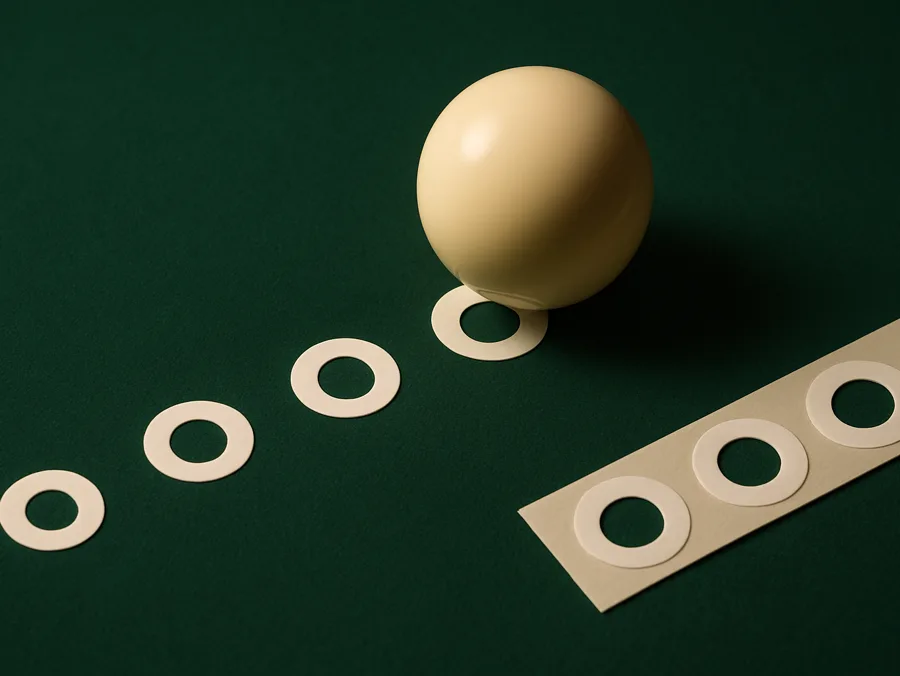
Avery Hole Reinforcement Labels, 1,000 Pack
Marking ball positions cheaplyThe paper donut is the standard tool instructors use to spot balls for drills. Stick one under each ball position and every rep starts from the same place, which is what makes a score mean something.
Check price on Amazon
YUXMU Pool Table Marker Dots, 240 Pack
Larger, more visible spotsPeel-and-stick 35mm dots made of synthetic paper, ten sheets in the pack. They're bigger than a hole reinforcement, so they're easier to see from the far end of the table when you're marking targets for wagon wheel or target practice.
Check price on Amazon
Capelle's Practicing Pool drill book
A full practice programIf you want more drills than one page can hold, Phil Capelle's book on practice is organized around how to practice, not just what to shoot. Good for players who've done the basics and want structure.
Check price on AmazonFrequently asked questions
What is the best pool drill for beginners?
The straight-in stop shot. Pocket a ball straight into a corner and make the cue ball stop where it hit. It trains a straight stroke, a center-ball hit and speed at once. After that, do the stop/follow/draw drill and the 3-ball runout.
How long should I practice drills?
Thirty to sixty minutes per session is plenty for most players, with a short warm-up, one main drill aimed at your weakest area, and a scored game at the end. Write the scores down.
What drills do pros practice?
Structured, scored tests like the Billiard University exams, the Runout Drill System and draw and follow matrix drills, plus position drills like the wagon wheel. What sets them apart is that they keep score and push past their comfort zone.
What is a progressive drill in pool?
A drill whose difficulty adjusts to you. Each success makes the next shot harder, each failure makes it a little easier, and where you end up after a set number of shots is your score. Bob Jewett developed the approach.
What is the wagon wheel drill?
A position drill where you pocket the same object ball repeatedly with ball in hand and send the cue ball to different targets spread around the table like spokes on a wheel, by changing the cut angle and using follow, stun or draw.
Should I practice drills or play games?
Both. Drills fix specific skills; scored games like the ghost make you put them together under a little pressure. A good session has some of each.
How do I set up drills the same way every time?
Mark ball positions with paper hole reinforcements or marker dots on the cloth. Instructors use them for exactly this, and they peel off when you're done.
Related guides
LeaguePool is reader-supported. When you buy through links on this site we may earn an affiliate commission at no extra cost to you. As an Amazon Associate we earn from qualifying purchases.