
How to Practice Pool Without a Table
You can practice most of the pool stroke without a table: your grip, bridge, stance, alignment and whole pre-shot routine. Instructor Steve Sherman's home setup, which Dr. Dave Alciatore links from his FAQ, is an ironing board raised to 30 inches (the height of a pool table bed), a strip of painter's tape with a line down the middle, a towel to catch the cue ball, and a mirror. What you can't practice at home is speed, position and the feel of real balls on real cloth, so save your table time for those.
This page covers the home stroke station, the bottle drill and better alternatives, mirror and video work, and the study you can do from the couch.
What you can and can't practice without a table
| Skill | At home? | How |
|---|---|---|
| Straight stroke | Yes | Tape line, bottle or stroke trainer, mirror |
| Grip pressure and bridge shapes | Yes | Countertop reps |
| Stance and head position | Yes | Mirror in front and to the side, tape on the floor |
| Pre-shot routine | Yes | Full walk-in and set-pause-finish at the station |
| Tip contact point | Partly | Practice cue ball into a towel, check the chalk mark |
| Pattern play and shot choice | Partly | Watching matches, simulators, books |
| Mental game | Yes | Routine rehearsal, visualization, reading |
| Speed control, position, reading the cloth and rails | No | Only on a real table |
Not everyone thinks home practice is worth much. Some experienced players on the AzBilliards forum argue it barely helps anyone past beginner level, because you never see a ball react. That's a fair warning, not a reason to skip it. Home work fixes the mechanics; table time tests them. If you do the mechanics at home, your limited table time can go to the things only a table can teach.
Build a home stroke station
Steve Sherman's guide lists everything you need, and it's all cheap:
- An adjustable ironing board set to 30 inches, the height of a pool table's bed. A kitchen or dining table works too; those usually run around 29 inches. Put a pad down so you don't mark the table.
- A strip of painter's tape down the middle, with a center line drawn on it in marker. Your cue should stay over that line through the whole stroke.
- A paper hole reinforcement stuck on the tape where the cue ball sits, so it's always in the same place.
- A rolled bath towel at the far end to catch the cue ball.
- A standing mirror, placed first to your side and then straight in front of you.
- A practice cue ball with printed markings.
Tape a line on the floor too, along the shot line, so you can check where your feet land when you step in. Then use the station for the whole shot, not just the arm: walk in, drop into your stance, set at the ball, pause, finish, and freeze. Sherman's point is that you can practice your entire routine this way, and watch the tip to see whether it finishes on the line or drifts off it.
The bottle drill, and better alternatives
The classic home drill: lay an empty bottle on its side on a table at about pool-table height, get into your stance, and stroke the tip in and out of the neck without touching the glass. Any wobble and you hear it. It works, and plenty of players swear by it.
It has limits. Posters on the AzBilliards forum point out that the bottle stops your tip from finishing down toward the cloth the way a natural follow-through does, and it favors a stroke that pushes straight through rather than a pendulum swing. A plastic bottle is easier on your tip than glass if you keep at it. Three alternatives fix those problems:
- Tape line: stroke along the taped center line on your station and watch the tip, without any ball. Nothing blocks your follow-through.
- Golf-tee gate: stand six golf tees upside down in two parallel rows, slightly wider than your shaft and an inch or two apart. Stroke through the gap with a full finish. A crooked stroke knocks one over. Narrow the gap as you improve.
- A clear stroke trainer: an acrylic disc with a hole about the size of a shaft, which you can set on any table. It's the bottle drill without glass, and it travels in a cue case.
For what a straight stroke should look like, and the elbow and wrist faults these drills reveal, see our stroke guide. The same drills, with balls, are the first section of pool practice drills.
Mirror and video checks
Set the mirror to your side first. At the set position, your forearm should hang straight down, at roughly 90 degrees to the cue, when the tip is at the cue ball. Sherman's guide shows exactly this check, and it's easy to see when you're off. Then move the mirror to the far end of your station and look straight at yourself: is your head centered over the cue, and does it stay still through the finish?
Video is even more honest. Prop a phone low behind the shot line and record ten strokes, then a second clip from the side. From behind, look for the elbow swinging out and the tip finishing off the line. From the side, look for the elbow dropping early and your head lifting. Our stance guide explains where your head and feet should be.
Hit a real cue ball into a towel
You don't need a table to hit a ball. On the station, put a marked practice cue ball on the reinforcement and stroke it into the rolled towel. Chalk your tip first. The chalk mark tells you where you actually hit: aim for center, then high, low, left and right, and check each mark. If your center-ball hits keep landing a little low or to one side, you've found something to fix before you get back to a table.
Grip and bridge reps
Grip pressure creeps tighter for most players, and a countertop is a fine place to reset it. Hold the cue lightly at your normal grip point and stroke while keeping the pressure the same through the finish. The slide test in our grip and bridge guide shows how loose is loose enough.
Bridges are pure muscle memory. Cycle through your open bridge, closed bridge and rail bridge on a counter or the arm of the couch until you can form each one without looking. If your closed bridge still feels awkward, a week of reps while watching TV will do more than months of occasional table play.
Watch pool the right way
Watching pro matches counts as practice only if you work while you watch. Pause before each shot and decide what you'd play: which ball, where the cue ball should go, what speed. Then watch what the player chooses, and when it's different, work out why. Pay most attention to the safeties and the cluster break-outs; that's where amateurs and pros differ most.
Dr. Dave also recommends good instructional videos and books for off-table time. A forum poster who barely played for a week but watched a few of Efren Reyes's matches reported that his stroke came back rusty while his pattern play was better than usual. That's one player's experience, not a study, but it fits: watching trains decisions, not mechanics. Our billiards books guide has reading ideas.
Pool simulators and phone games
Dr. Dave suggests a pool simulator such as Virtual Pool for working on pattern play and aim visualization. They're good for planning a rack and learning where the cue ball goes off a rail at different speeds, and useless for your stroke, since you're moving a mouse or a thumb. Casual online and phone billiards games are fun and teach rules, but most use simplified physics. Use them for patterns, not for feel.
Mental practice and your routine
The routine is the one thing you can rehearse perfectly at home. At your station, run it on imaginary shots: stand behind the line, decide the shot, picture the result, step in, set, pause, finish, freeze. Doing it at home makes it automatic on league night. Then spend a few minutes with your eyes closed running a rack you know well, shot by shot, seeing the cue ball go where you want. The mental game guide covers pressure, self-talk and resetting after a miss.
Staying fit and getting back in stroke
Dr. Dave's list of off-table work includes plain healthy habits: exercise, stretching, a decent diet, less smoking and less heavy drinking. A long match is hours of bending over a table, and core and leg strength help you stay down on the last rack. He also notes that a complete break from pool can help, both for enthusiasm and for forgetting bad habits.
When you get back to a table after a layoff, don't jump straight into games. His advice is to do fundamentals drills first. A good first session back: 10 minutes of stop shots, the stop/follow/draw drill, then speed work, because speed is the part home practice can't keep sharp.
A week of practice with no table
- Most days, 10 to 15 minutes at the stroke station: tape-line strokes, then the golf-tee gate or stroke trainer, then a few full routines with the mirror.
- Twice a week, film ten strokes from behind and from the side and compare them with last week's clip.
- Twice a week, watch part of a pro match, pausing to call each shot.
- Once a week, a pattern session on a simulator or with diagrams from a book.
- On league night, a normal warm-up, then play. Note what broke down so the home work targets it.
Short, frequent sessions suit this kind of practice, since the goal is grooving one repeatable movement.
Looking for a pool table without holes?
If you searched for a pool table without holes or a billiard table without pockets, that's a carom table. Carom billiards, including three-cushion, is played on a pocketless table with three balls, and you score by hitting both other balls with your cue ball. Our carom billiards guide explains the game and the table. For drills on a regular pocket table, see pool practice drills.
Sources
- Dr. Dave Alciatore: practicing with no pool table
- Steve Sherman, Guide to Practicing Without a Pool Table (PDF)
- Dr. Dave: mental game FAQ
Our picks
Links open the current selection and price on Amazon so you can compare real reviews before buying.

Marsrut Transparent Billiard Stroke Trainer
The bottle drill without the bottleA clear acrylic disc with a 17mm hole. Set it on your home station and stroke the tip in and out of the hole; any wobble and the tip catches the edge. There's no glass to chip your tip on, and it's small enough to keep in a cue case for the pool room too.
Check price on Amazon
Aramith Jim Rempe Training Cue Ball
Checking your tip contact at homeThe marked cue ball for the towel drill. Its printed rings and targets turn each chalk mark into a reading of where you hit, and once you're back on a table it does the same job during stop, follow and draw drills.
Check price on Amazon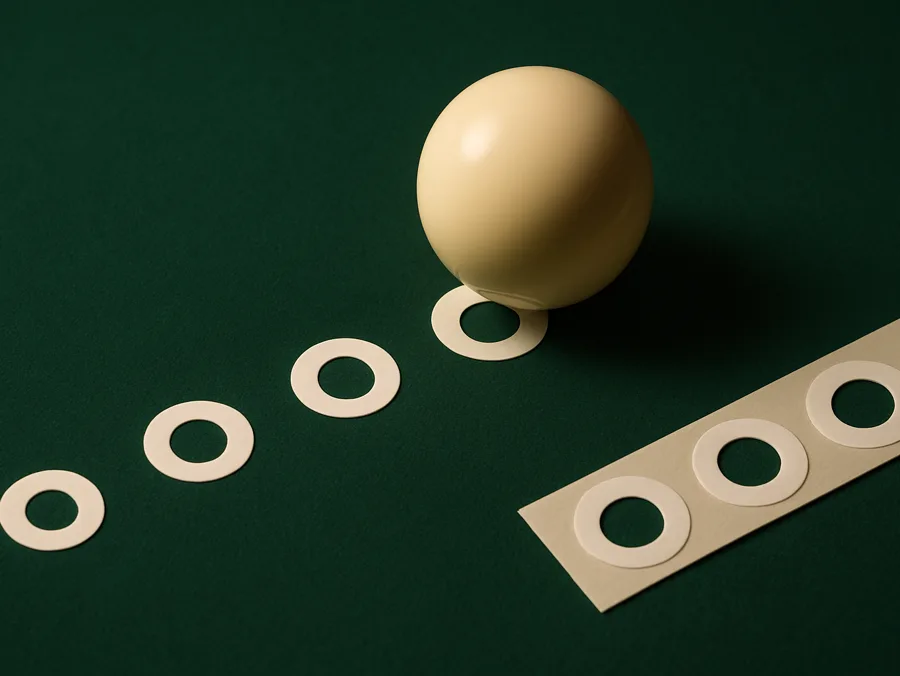
Avery Hole Reinforcement Labels, 1,000 Pack
Spotting the cue ball on your stationThe paper donuts from Sherman's home setup: one on the tape holds the cue ball in the same place every rep. The pack lasts for years and works on the table for drill setups too.
Check price on Amazon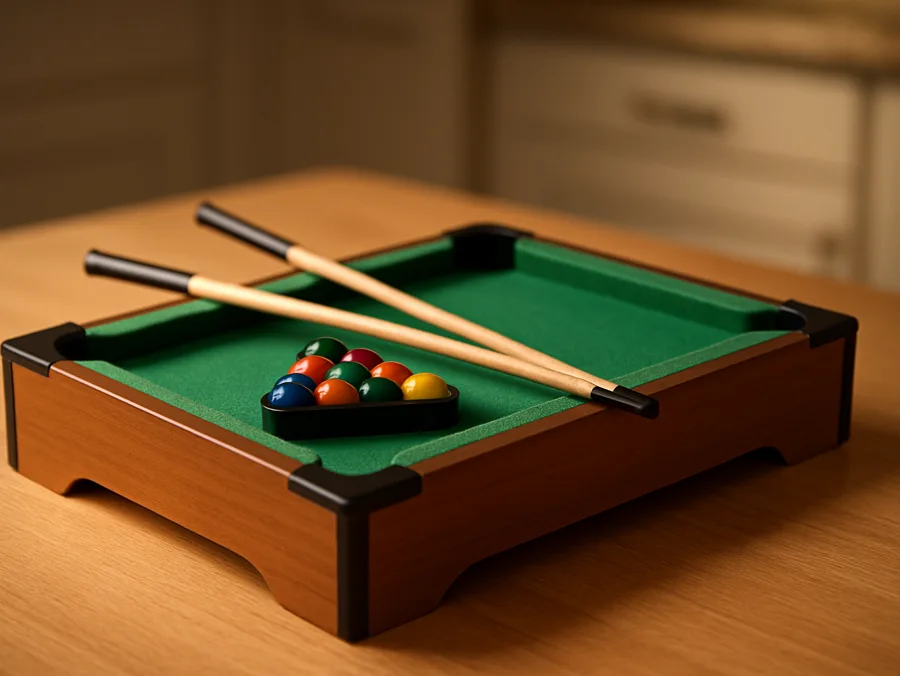
Mainstreet Classics 20-Inch Tabletop Pool Set
Fun for kids, not trainingA 20-inch tabletop table with six pockets, two cues, balls, a triangle, chalk and a brush, weighing about five and a half pounds. Good for family game night and getting kids interested. Its size and light balls play nothing like a real table, so don't expect it to train your stroke.
Check price on AmazonFrequently asked questions
Can you get better at pool without a table?
Yes, in the mechanics. Stroke, grip, bridge, stance and your pre-shot routine all improve with home practice, and watching matches helps your shot choice. Speed control and position play still need a real table.
How high should a practice surface be?
About 30 inches, the height of a pool table bed. An adjustable ironing board can be set to that exactly. A dining table at around 29 inches is close enough.
Does the bottle drill work?
It shows a crooked stroke well, but it blocks a natural follow-through and suits a straight push more than a pendulum. A taped center line, a golf-tee gate or a clear stroke trainer let you finish the stroke normally.
How often should I do home stroke drills?
Ten to fifteen minutes most days beats an hour once a week. You're grooving one repeatable movement, and short, frequent sessions suit that.
Do pool video games help you get better?
A simulator such as Virtual Pool can help with pattern play and visualizing angles. It does nothing for your stroke, and casual phone games use simplified physics, so treat them as a supplement.
What is a pool table without holes called?
A carom table. Carom billiards is played on a table with no pockets, using three balls, and you score by hitting both other balls with your cue ball.
Is a tabletop mini pool table worth it for practice?
As a toy, yes. For training, no: the short table and light balls are too different from a real one. Spend the money on a training cue ball or a stroke trainer instead.
Related guides
LeaguePool is reader-supported. When you buy through links on this site we may earn an affiliate commission at no extra cost to you. As an Amazon Associate we earn from qualifying purchases.