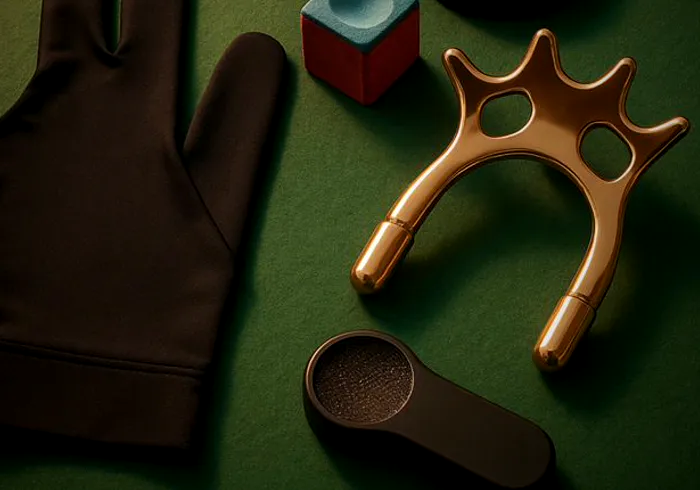
How to Use a Mechanical Bridge in Pool, Plus the Rules
To use a mechanical bridge in pool, lay the bridge stick flat on the cloth with its head a few inches behind the cue ball, hold the handle down with your free hand, rest your cue in the lowest groove that works, and stroke short and level with the cue held near the butt in a dart-style grip, elbow out to the side. That's the whole technique. The rest of this page is the detail that makes it reliable: which groove, how to hold the cue, what the rules say and how to practice it.
The bridge has a bad reputation in bars (crutch, granny stick). Wikipedia's glossary of cue sports terms puts it plainly: the insults come from amateurs who think the bridge shows weak technique, and the opposite is true. A stable bridge beats a one-footed stretch.
When to use the mechanical bridge
Get into your normal stance first. Then stand up and get the bridge if any of these is true:
- Your back foot wants to leave the floor.
- Your bridge hand only reaches the cloth with its fingertips, or it lands short of where you wanted it.
- Your chin ends up nowhere near the cue, so you're aiming from above instead of down the line.
- A ball sits where your bridge hand needs to go, and a raised hand bridge would be shaky.
Decide before you're down on the shot. Once you've stretched out and started practice strokes, it's tempting to talk yourself into it. The stretch costs you the things that win racks: soft speed, an accurate stroke line and any draw at all.
Shots that are only a few inches out of reach have two other answers. A longer hand bridge or a rail bridge often gets there (see how to hold a pool cue), and a cue extension helps when your bridge hand reaches but your grip hand runs out of cue.
How to set up the bridge, step by step
- Pick up the bridge with your bridge hand (the left, for a right-handed player).
- Lay the head flat on the cloth on the shot line, about 6 to 8 inches behind the cue ball. Closer is steadier on soft shots; a little farther gives room for a firmer stroke. Treat that distance as a starting point, not a rule.
- Angle the stick off to the side of your cue (to the left for most right-handers) so it doesn't sit under your stroke.
- Keep the whole stick flat on the cloth. A stick propped up at an angle tips the head, and a tipped head tips your cue.
- Press the handle down with your free hand, close enough to the head to stop it rocking. The table carries the weight; your hand only keeps it still.
- Set the cue in the lowest groove that gets the tip to the height you want and clears any ball in the way.
Check that the head isn't touching or about to touch any ball. Under WPA rules, moving a ball with your bridge is a foul (more on that below).
Which groove to use
A standard head gives you a few heights. Laid flat, the grooves along the top are the low ones. Stood on its side, the head puts the cue higher. The height of the groove sets where your tip meets the cue ball when the cue is level.
| Shot | Groove | Notes |
|---|---|---|
| Stop shot, stun, a little draw | Lowest groove, head flat | The steadiest setup you have. Use it whenever nothing is in the way. |
| Follow | A higher groove | Lets the tip meet the ball above center with the cue still close to level. |
| A ball just behind the cue ball | Head on its side, or a spider head | The cue tilts down more, so stay near the vertical center of the cue ball. |
| A cluster in the way | Two bridges, one on top of the other | Legal under WPA and CSI rules (the top one has to rest on the head of the bottom one). Hard to keep still, so take the simplest shot available. |
Avoid side spin when the cue is raised. A raised cue with english curves the cue ball, which is how a massé works, and you don't want that by accident. Heads differ (spider, swan, moosehead, adjustable); our bridge stick guide explains each one.
How to hold the cue on a bridge
Your normal grip doesn't work here, because the cue now sits beside your body at chest or chin height instead of hanging below your arm. Dr. Dave Alciatore's description (from The Illustrated Principles of Pool and Billiards) is the clearest one we've found:
- Hold the cue deep in the V between your thumb and index finger.
- Rest your index and middle fingers lightly on top of the cue, with the other fingers underneath.
- Let the butt stick out of your hand a little.
- Bring your chin close to the butt so you look straight down the cue, while leaving room to stroke.
Your palm ends up facing down or slightly in, like holding a dart, and your elbow points out to the side. That's the same reverse dart grip our grip guide describes. Stand a little to the side of the shot line so your arm swings freely past your body. Don't squeeze. A fist on the butt is what produces the lurching bridge shot that misses by a diamond.
The stroke
Shorter and more compact than your normal stroke, and that's fine, because the head is doing the job your bridge hand usually does.
- Take a few short practice strokes, keeping the cue level and sliding straight in the groove.
- Pause at the back of the last stroke.
- Accelerate smoothly through the ball and follow through a few inches.
- Finish with the top fingers pointing down the cue, which is the pivot Dr. Dave describes. If the cue ended up angled off the line, the stroke steered.
Play center ball, stun and gentle follow whenever the layout allows. Draw off a bridge is possible: use the lowest groove, keep the cue level and finish the stroke. It's still a lower-percentage shot than the same draw with your hand, so when a simple pot with natural position exists, take it. For more on drawing the ball, see how to draw the cue ball.
The bridge isn't only for desperation shots. Dr. Dave notes it can be used to break, too, when it gives you steadier support at the height you want, and points to a 10-ball break by Corey Deuel as an example.
What the rules say
| Question | WPA | CSI (BCAPL, USAPL) | APA |
|---|---|---|---|
| Is a bridge legal? | Yes, up to two (rule 1.4) | Yes, up to two at once (rule 1-3) | Yes (equipment rules) |
| Two bridges at once | Second rests on the head of the first | Upper rests on the head of the lower | Not addressed on the equipment page |
| No foot on the floor | Foul (rule 3.4) | Foul (rule 1-25) | Not a foul when a bridge is available, but may be a sportsmanship violation |
| Bridge touches a ball | Foul; you're responsible for your bridge (rule 3.6) | Disturbing the cue ball, or more than one ball, is a foul; one stationary object ball moved by accident is a foul only if it affects the shot (rule 1-33) | Moved balls are put back by the opponent unless they hit the cue ball, which is ball in hand; touching the cue ball is ball in hand |
| Your own bridge | Must be similar to a standard bridge | Legal if it only supports the cue and doesn't damage the table | Allowed only if you'll share it with the other team |
| Using the bridge to aim or measure | Equipment must be used as intended (rule 1.4) | Not allowed; only your cue and hands (rule 1-3) | Not addressed |
One more APA detail worth knowing: an object ball that's already rolling and bumps a bridge lying on the table isn't put back. CSI also makes it a foul to use anything to raise or support your bridge hand, so you can't prop your hand on a chalk cube to get over a ball. For fouls in general, see common pool fouls.
Common mistakes
| Mistake | What happens | Fix |
|---|---|---|
| Handle held in the air | The head rocks like a seesaw during the stroke | Lay the stick flat and press the handle down |
| Using a high groove for no reason | A steeper cue, more miscues, accidental swerve | Lowest groove that clears the blockers |
| Normal grip, elbow tucked | The cue swings across the line | Dart grip, elbow out to the side |
| Full power stroke | The cue jumps out of the groove or steers | Short backswing, pause, smooth finish |
| Head too far behind the cue ball | Small errors in the groove become big ones at the tip | Start around 6 to 8 inches |
| Sidespin on a raised cue | The cue ball curves off line | Stay on the vertical center |
| Dragging the bridge off the table | The head clips a ball on the way out | Lift it straight up after the cue ball is gone |
Three drills to get comfortable
Most players use the bridge twice a night, so it never feels normal. Ten minutes of these fixes that.
- Bridge stop shots. Set up a straight-in shot that needs the bridge and shoot stop shots until the cue ball stops dead five times running. Then move the cue ball a diamond farther from the object ball and repeat.
- Groove ladder. Shoot the same shot from the low groove, a middle groove and with the head on its side. You'll learn how much each height changes the hit.
- League replays. Recreate the bridge shots you missed or dodged last week and shoot each one until you make it or play a clean safety three times in a row.
Bridge etiquette and care
Set the bridge down; don't slide it across the cloth. After the shot, lift it away from the balls and put it back where it lives, not across the table or on a rail where it can roll off. Check a house bridge before you use it: a chipped or cracked head scratches shafts and can snag the cloth, and the WPA's equipment spec asks for a smooth head for exactly that reason. If you own a table, buy a proper bridge and keep it next to the cue rack; if you play in bars, carry a slip-on head (options in our bridge stick guide). And remember the APA rule: if your team brings one, the other team gets to use it too.
Sources
- Dr. Dave Alciatore: How to use a mechanical bridge
- WPA Rules of Play (rules 1.4, 3.4, 3.6) and WPA Equipment Specifications (item 18)
- CSI Official Rules (rules 1-3, 1-25, 1-33 and equipment spec 10)
- APA rules: Equipment, One Foot on the Floor, Accidentally Moved Balls and Fouls
- Glossary of cue sports terms (mechanical bridge)
Our picks
Links open the current selection and price on Amazon so you can compare real reviews before buying.

GSE Portable Bridge Head and Stick
Home tables that don't have a bridge yetA home table without a bridge means stretching for every long shot. This is a 57-inch two-piece wood stick with a copper-coated metal head that gives five cue positions, and plastic feet under the head keep it off the cloth and stop it sliding. It breaks down to store in a drawer next to the cues.
Check price on Amazon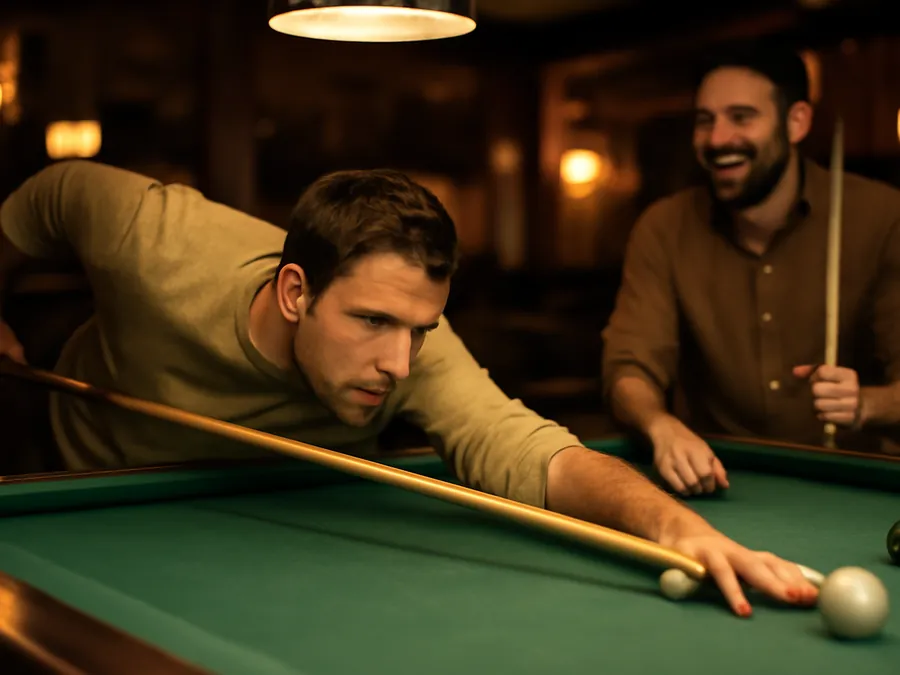
VINTORKY Brass Cross Bridge Head
Carrying your own head to barsHouse bridges in bars are often chipped or missing. This galvanized-copper cross head, about 14 by 8 cm and a little over 9 ounces, screws on and is small enough for a cue case pocket, so you have a clean, heavy head that sits still wherever you play.
Check price on Amazon
CROWN ME 6 in. Carbon Fiber Cue Extension
Shots just past your normal reachWhen your bridge hand reaches the cloth fine but your grip hand runs out of cue, an extension beats the bridge because you keep your own stroke. This one adds 6 inches of carbon fiber and comes with three thread bumpers for different cue butts; make sure one fits yours.
Check price on AmazonFrequently asked questions
Is using a mechanical bridge bad form?
No. Every major rulebook allows it, and the stigma comes from players who think it shows weak technique. A stable stroke off a bridge beats a stretched one.
How far should the bridge head be from the cue ball?
Start about 6 to 8 inches behind it. Move a little closer for soft, delicate shots and a little farther for firmer ones. Keep the head flat and the handle pressed down so it can't shift.
How do you hold the cue when using a bridge?
Near the butt, deep in the V between thumb and index finger, with the index and middle fingers resting lightly on top and the others underneath. Your palm faces down or slightly in, your elbow points out and your chin sits close to the butt.
Can you draw the cue ball with a mechanical bridge?
Yes. Use the lowest groove, keep the cue level, hit below center and follow through. It's less reliable than draw with your hand, so take a simpler shot when one exists.
Is it a foul if the bridge touches a ball?
Under WPA rules, yes: you're responsible for your bridge, and touching any ball with it is a foul. CSI rules call it a foul if you disturb the cue ball or more than one ball, and for a single object ball only if it affects the shot. In APA play, moved object balls are put back unless they touch the cue ball, and touching the cue ball is ball in hand.
Do you have to keep one foot on the floor?
Under WPA and CSI rules, yes; no foot on the floor when the tip hits the cue ball is a foul. The APA requires it when a bridge is available but treats a violation as a sportsmanship issue, not a foul.
Can you use two bridges at once?
Yes. WPA and CSI rules allow up to two, and the upper bridge must rest on the head of the lower one. It's for steep shots over a cluster of balls.
Can I bring my own bridge to an APA match?
Yes, but APA rules say you can use it only if you're willing to let the other team use it as well.
Which hand holds the bridge?
Your bridge hand, the one that normally sits on the cloth. It presses the handle down while your shooting hand holds the cue near the butt.
Related guides
LeaguePool is reader-supported. When you buy through links on this site we may earn an affiliate commission at no extra cost to you. As an Amazon Associate we earn from qualifying purchases.