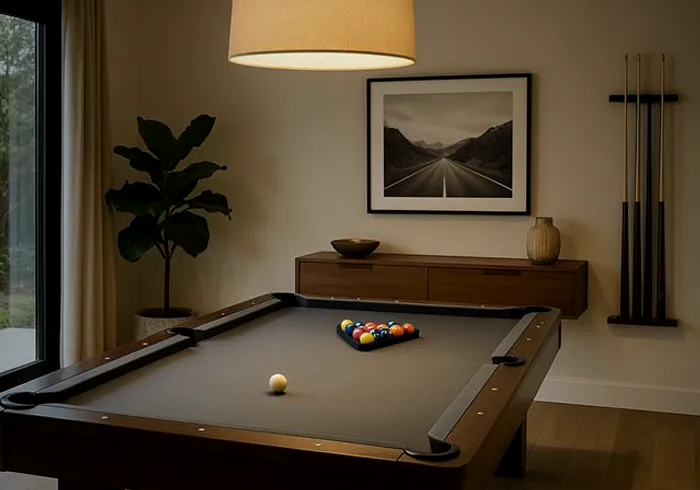
How to Play Pool: A Complete Beginner's Guide
To play pool, you rack fifteen numbered balls at one end of a six-pocket table, break them apart with the white cue ball, and then take turns using a cue to knock object balls into pockets. Which balls you're allowed to shoot, and which ball wins the game, depends on the game you pick. For nearly every beginner that game is 8-ball: one player takes the solids (1 through 7), the other takes the stripes (9 through 15), and whoever clears their group and then legally pockets the black 8 wins.
That's the whole idea. What turns a first game from flailing into real pool is a short list of basics: a stance that doesn't move, a bridge hand that holds the cue steady, a relaxed stroke, and knowing the handful of rules that cause arguments. This page covers all of it, then points you to the full rules and skill guides when you want more depth.
What you need to play pool
A pool hall or bar supplies everything, so on your first night you only need to know what you're looking at.
- The table has six pockets: one in each corner and one in the middle of each long side. Home and bar tables are smaller, but a 9-foot tournament table has a 100 by 50 inch playing surface and an 8-foot table 92 by 46 inches, per the World Pool-Billiard Association (WPA). The playing surface is always twice as long as it is wide.
- A set of balls is one white cue ball and fifteen object balls, each 2 1/4 inches across. Balls 1 to 8 are solid colors (the 8 is black); 9 to 15 are white with a colored stripe.
- House cues hang on the wall. Roll one across the table: if it wobbles, it's warped, so take another. Check that the leather tip is there and has a rounded dome, not flat or mushroomed over the edges.
- Chalk is the little blue cube. Brush it on the tip before most shots so the tip grips the cue ball instead of skidding off (a miscue). See how to chalk a cue.
- The triangle rack is for 8-ball and most 15-ball games. A diamond-shaped rack is used for 9-ball.
You don't need your own cue to learn. Buying one starts to make sense once you play every week, mainly so you stop adjusting to a different stick each night. Our beginner cue guide covers what to look for.
The parts of a pool table you'll hear about
| Term | What it is | Why a beginner cares |
|---|---|---|
| Head of the table | The end you break from | The breaker shoots from here |
| Head string | A line across the table at the second diamond from the head rail (a quarter of the way down) | The cue ball starts behind it on the break |
| Kitchen | The area between the head string and the head rail | Where you place the cue ball to break, and under some bar rules after a scratch |
| Foot spot | A marked dot at the other end | The front ball of the rack sits on it |
| Rails and cushions | The padded edges | Balls bounce off them; a ball must reach a cushion on many shots to avoid a foul |
| Diamonds | The inlaid markers on the rails | Reference points for aiming banks and kicks later on |
Rules every pool game shares
Pool is a family of games, but they run on the same backbone. Learn these and you can sit in on almost any game:
- Players take turns. Your turn, called an inning, lasts as long as you legally pocket a ball. Miss, or foul, and your opponent comes to the table.
- You only ever strike the cue ball, and only with the tip of the cue.
- Every shot has to hit a legal ball first. In 8-ball that's a ball from your group; in 9-ball it's the lowest-numbered ball on the table.
- After contact, either a ball goes in a pocket or some ball (the cue ball or an object ball) has to touch a cushion. Otherwise it's a foul.
- Pocketing the cue ball is a scratch, and that's a foul too. Under official rules every foul gives your opponent ball in hand: they can place the cue ball anywhere on the table.
The details of each game live on their own pages: 8-ball rules, 9-ball rules, common pool fouls and what counts as a scratch.
How to play 8-ball, step by step
- Decide who breaks. Flip a coin, or lag: both players shoot a ball to the far cushion and back, and the one that stops closer to the head rail picks.
- Rack the balls. Fifteen balls in the triangle, front ball on the foot spot, the 8-ball in the middle of the third row, and one solid and one stripe in the two back corners. Press the balls together so they touch, then lift the rack straight up. Our racking guide shows the tight rack.
- Break. Place the cue ball anywhere in the kitchen and hit the rack hard. Under WPA rules a legal break pockets a ball or drives at least four balls to a cushion.
- The table is open. Right after the break nobody owns solids or stripes yet. The first player to legally pocket a called ball takes that group, and the opponent gets the other. See how to break if your breaks barely move the rack.
- Clear your group. Keep shooting as long as you pocket your own balls. In most leagues you call the ball and pocket on any shot that isn't obvious.
- Shoot the 8. Once your seven balls are down, call a pocket for the 8 and make it to win.
You lose on the spot if you pocket the 8 before your group is cleared, pocket it in a pocket you didn't call, scratch while making it, or knock it off the table. That last rule surprises people who learned in a basement, so say it out loud before the first game.
Settle these house rules before the break
Most arguments at a bar table aren't about skill. They come from two people who learned different rules. Ask about these five before anyone shoots:
- Calling shots: does a lucky ball count (slop), or do you have to call it?
- After a scratch, is it ball in hand anywhere (official) or only behind the head string (common in bars)?
- The 8 on the break: win, re-spot, or re-rack? Rule sets disagree.
- Scratching on the 8: almost everyone plays it as a loss, but check.
- Two shots after a foul? Some bars give two visits instead of ball in hand. That's the British blackball habit, not American 8-ball.
Our bar rules guide walks through the common local versions, and pool etiquette covers the unwritten stuff like whose quarters are up and when to stay out of a shooter's line.
Stance, bridge and stroke
These three things decide whether the cue goes where you aim it. Get them roughly right on day one and you skip months of bad habits.
Stance
- Stand behind the cue ball and look down the line of the shot.
- Step in with your back foot on that line (right foot for right-handers), then put your front foot forward and out to the side, roughly shoulder width.
- Bend forward from the hips until your chin is a few inches above the cue. Beginners stand too tall, which makes aiming harder.
- Test it: if a light push on your shoulder rocks you, widen your feet.
Bridge
The bridge is your front hand, the one the cue slides over. Start with the open bridge: lay your hand flat, cup it slightly, press your fingertips into the cloth and raise your thumb against the base of your index finger so the cue rests in that V. Keep it 6 to 8 inches behind the cue ball. Once that feels natural, learn the closed bridge, where your index finger loops over the cue and locks it in place. Both are shown step by step in how to hold a pool cue.
Grip and stroke
Hold the back of the cue with your thumb and first two or three fingers, loosely, with the other fingers barely touching. A death grip is the most common beginner fault there is. Your grip hand should hang straight down below the elbow at the moment the tip meets the ball.
The stroke moves only your forearm, swinging from the elbow like a pendulum. Take two or three slow practice strokes, pause for a beat with the tip just behind the cue ball, then swing through smoothly and let the tip carry a few inches past where the ball was. Stay down until the ball stops. Popping up to watch is the habit that wrecks more beginner shots than bad aim. Stance fundamentals and improving your stroke go further.
Aiming: the ghost ball
To make a ball go into a pocket, the cue ball has to hit it on the side directly opposite that pocket. Picture a line from the center of the pocket through the center of the object ball, and imagine a second ball (the ghost ball) touching the object ball on the far end of that line. Shoot your cue ball at the center of the ghost ball. That's it.
Start with straight-in shots: object ball a foot from a corner pocket, cue ball a foot behind it, all in a line. Make ten in a row, hitting the cue ball dead center at medium speed. Then move the cue ball a few inches to one side so you have to cut it. Hit softer than you think you need to; hard shots magnify every aiming error and send the cue ball flying around the table. More methods are in ghost ball aiming and how to aim in pool.
Which game to play first
| Game | Players | Balls | How you win | Good for |
|---|---|---|---|---|
| 8-ball | 2 (or teams) | 15 | Clear your group, then make the 8 | Your first game, bars, leagues |
| 9-ball | 2 | 9 | Legally pocket the 9; always hit the lowest ball first | Faster games once you can run a few balls |
| Cutthroat | 3 or 5 | 15 | Keep at least one of your balls on the table while sinking everyone else's | Groups and odd numbers |
| Straight pool | 2 | 15, re-racked | Reach a point total; any called ball scores 1 | Learning position and patience |
| One-pocket | 2 | 15 | First to 8 balls in your own corner pocket | Strategy fans; deep defense |
| Bank pool | 2 | 15 | Make your balls only by banking them off a cushion | Players who've learned angles |
One-pocket deserves a word because people search for it: each player owns one of the two corner pockets at the foot of the table, any ball you sink in your pocket counts for you, and balls that fall in your opponent's pocket count for them. It's a slow, tactical game, closer to chess than to 8-ball. Learn 8-ball first, then try it with someone who already plays. For groups, pool games for groups has more ideas.
How to play pool by yourself
Yes, you can play pool alone, and it's how most good players got good. The simplest version is to rack 9-ball, break, take ball in hand and try to run the rack in order. Count how many balls you make before you miss and try to beat it next time.
Other solo games give you a score to chase: playing the ghost (you against an imaginary opponent who never misses), bowlliards (pool scored like bowling), and three-ball (sink three balls in as few shots as you can). The rules and scoring for each are in pool games to play alone, and if you have no table at home, practicing without a table helps with the stroke.
Your first week at the table
An hour, three or four times in a week, beats one long Saturday. A simple plan:
- Session 1: Stance and bridge only. Shoot the cue ball the length of the table and back over the foot spot, trying to make it return straight to your tip. Twenty times.
- Session 2: Straight-in shots at three distances. Note how many of ten you make at each.
- Session 3: Cut shots to both corner pockets, then play a few racks of 8-ball against a friend or the ghost.
- Session 4: Speed. Try to stop the cue ball within a diamond of where you planned after pocketing a ball. That's the start of real position play; see speed control.
Pool practice drills has the next set once these feel routine.
Mistakes that keep beginners stuck
- Gripping the cue hard. Your fingers should almost let it slip.
- Standing up as you shoot. Freeze until the ball stops rolling.
- Hitting everything hard. Medium speed pockets more balls and keeps the cue ball under control.
- Forgetting chalk, then blaming the cue for a miscue. See why cues miscue.
- Aiming the cue ball at the object ball instead of at the ghost ball. Cut shots go thin when you do this.
- Never looking at where the cue ball will stop. Good players think one shot ahead; beginners think zero.
- Using a bridge that's too far from the cue ball. Past about a foot, the tip wanders.
Getting better after the basics
Learning to play pool takes an evening. Playing it well comes down to cue ball control: stopping the cue ball dead (a stop shot), making it roll forward (follow) or spin back (draw). With those three you can start planning where the cue ball lands, which is what position play means. Side spin, or english, comes later and causes more misses than it fixes until your stroke is straight.
The fastest route to playing like the good players at your bar is to play against them. A league gives you a weekly match, a handicap that keeps games close, and teammates who'll tell you what you're doing wrong; how pool leagues work explains signing up. How to improve at pool has the longer plan.
Pool, billiards and the game with no pockets
In the US, people say pool and billiards interchangeably, and both usually mean the six-pocket games on this page. Strictly speaking, billiards is the umbrella term for all cue sports, and it also names carom billiards, played on a pocketless table where you score by making the cue ball contact other balls. If you searched for how to play billiards with no pockets, start with carom billiards explained; for the full breakdown including snooker, see pool vs billiards vs snooker.
Sources
- World Pool-Billiard Association: Rules of Play (8-ball break, fouls, loss of rack, 9-ball)
- World Pool-Billiard Association: Recommended Equipment Specifications (ball size, ball set, table playing surface)
- Wikipedia: Pool (cue sports), game families and one-pocket overview
Our picks
Links open the current selection and price on Amazon so you can compare real reviews before buying.
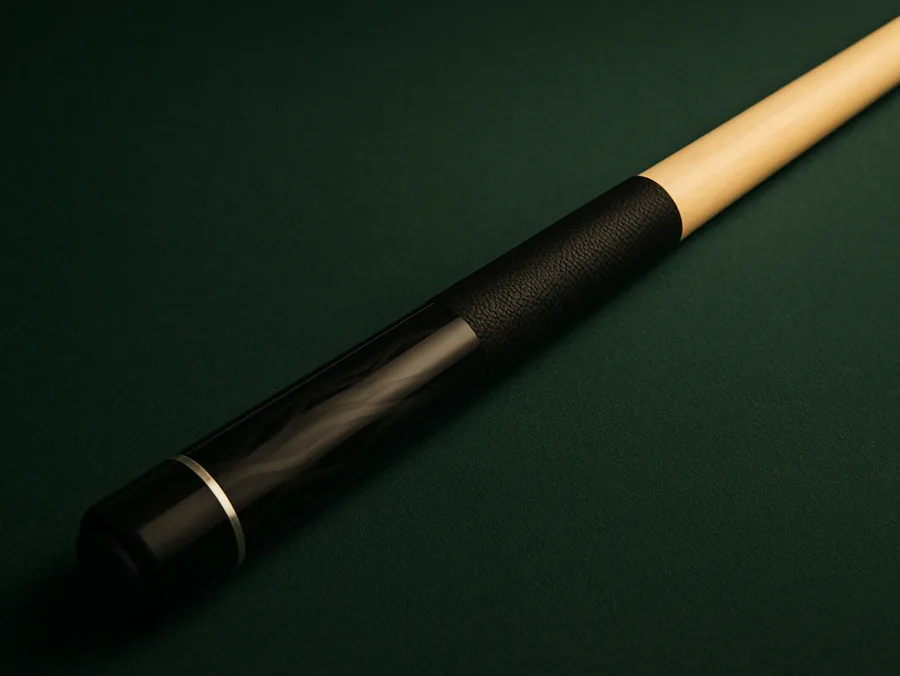
Viper Sinister 58-Inch Pool Cue
First cue of your ownAn inexpensive full-length two-piece cue from Viper. Owning one means every session starts with the same weight and the same tip, which is the whole point of buying a cue as a beginner. House cues change every night; this one doesn't.
Check price on Amazon
Master Billiard Chalk, 12-Cube Box
Keeping a cube in every pocketThe blue Master cube you'll find on most bar tables, in a box of twelve. Bar chalk tends to be worn into a crater by Friday night; a cube of your own in your pocket means you can chalk properly before every shot.
Check price on Amazon
Predator Second Skin Billiard Glove
Bridge hands that stick or sweatA thin glove for your bridge hand so the shaft slides cleanly instead of grabbing on a damp palm. Not required to learn, but if the cue catches in your bridge on humid nights, it fixes that one problem.
Check price on AmazonFrequently asked questions
How do you play pool for the first time?
Pick a straight house cue and play 8-ball. Break the rack from behind the head string, then take turns: once one player legally pockets a called ball they own that group (solids 1-7 or stripes 9-15), and the first to clear their group and then pocket the 8-ball in a called pocket wins.
Is pool hard to learn?
The basics are not. Most people can pocket simple straight shots in their first hour once they learn a still stance and a proper bridge. Getting good is slower, because the real skill is controlling where the cue ball stops after each shot.
Can you play pool by yourself?
Yes. Rack 9-ball and try to run it with ball in hand, play the ghost, or play bowlliards, which is scored like bowling. Solo practice is how most strong players built their game.
What happens if you scratch?
Pocketing the cue ball is a foul. Under official WPA rules your turn ends and your opponent gets ball in hand anywhere on the table. Many bars play that the cue ball goes behind the head string instead, so ask first. Scratching while you pocket the 8-ball loses the game.
Do you have to call every shot in pool?
In most leagues you call any shot that isn't obvious, and you always call the pocket for the 8-ball. In casual bar games, some groups let any legally pocketed ball count. Agree on it before you break.
What game should a beginner play first?
8-ball. It's the game on every bar table, the rules are simple, and having seven balls to choose from means you usually have an easy shot available. Move to 9-ball once you can run three or four balls in a row.
What does play pool mean?
To play pool means to play pocket billiards, the cue sport with six pockets and numbered balls. The phrase pool play in tournament schedules for other sports means something unrelated: a group stage where every team plays every other team.
Do I need my own cue to start?
No. A straight house cue with a good tip is fine for learning. Buy your own once you play every week, mainly so you use the same cue every time.
Related guides
LeaguePool is reader-supported. When you buy through links on this site we may earn an affiliate commission at no extra cost to you. As an Amazon Associate we earn from qualifying purchases.