How to Rack Pool Balls: Rack Diagrams for Every Game
Racking in pool means gathering the object balls into a tight triangle or diamond on the foot spot before the break. To arrange 15 balls for 8-ball, put them in a five-row triangle with the front ball on the foot spot, the 8 in the middle of the third row and one solid and one stripe in the two back corners. For any game, set the front ball of the rack on the foot spot (the marked dot a quarter of the way up from the foot rail), put the game's key ball in its required position, fill the rest at random, then push the pack forward until every ball touches its neighbors. For 8-ball, the 8 goes in the middle of the third row and the two back corners get one solid and one stripe. For 9-ball, the balls form a diamond with the 1 at the front and the 9 in the center.
The order matters less than people think. Only a few balls have fixed spots in any game. Tightness matters more: a rack with a gap behind the front ball breaks dead, and no amount of power fixes it. Below are rack diagrams for every common game (8-ball, 9-ball, 10-ball, straight pool, one-pocket, British 8-ball with reds and yellows, snooker), the official placement rules from the WPA, APA and CSI rule books, and the technique that gets the balls frozen.
Pool ball rack order for every game
This is the whole answer in one table. Everything not listed as fixed goes in at random, and official rules actually require that (more on that below).
| Game | Balls and shape | On the foot spot | Fixed positions |
|---|---|---|---|
| 8-ball | 15 balls, triangle | Apex ball | 8 in the middle of the third row; one solid and one stripe in the two back corners |
| 9-ball (WPA) | Balls 1 to 9, diamond | The 9 | 1 at the front point, 9 in the center |
| 9-ball (APA, CSI) | Balls 1 to 9, diamond | The 1 | 1 at the front point, 9 in the center |
| 10-ball | Balls 1 to 10, triangle | The 1 | 10 in the middle of the third row (CSI also puts the 2 and 3 on the back corners) |
| Straight pool (14.1) | 15 balls, triangle | Apex ball | None under WPA rules; CSI puts the 1 on the right back corner and the 5 on the left |
| One-pocket | 15 balls, triangle | Apex ball | None |
| Bank pool | 9 balls in a diamond (short rack) or 15 in a triangle (full rack) | Front ball | None |
| British 8-ball (blackball) | 7 reds, 7 yellows and the black, triangle | The black | Black in the middle of the third row; reds and yellows in the fixed WPA pattern (diagram below) |
| Snooker | 15 reds in a triangle plus six colors on their own spots | None (the apex red sits just behind the pink) | Each color has its own spot |
The diagrams below are drawn from the breaker's point of view. The top row is the back of the rack, nearest the foot rail. The bottom row is the apex, the ball closest to you when you break.
Where to rack pool balls: finding the foot spot
The foot spot is where the long center line of the table crosses the foot string, the imaginary line between the second diamonds from the foot rail. On a standard table that puts it one quarter of the table's length from the foot cushion. Most tables have a small round sticker there. If yours doesn't, count two diamonds in from the foot rail on each side, run a line across, and mark the middle.
The rack always sits on the foot end (the end opposite where the breaker shoots from), with the rows behind the apex running parallel to the foot rail. A rack that's twisted a few degrees is a common reason breaks look lopsided. If your sticker is worn or curling, our pool table setup guide covers marking a new one.
How to rack pool balls for 8-ball
Eight-ball uses all fifteen object balls in a triangle. Under the WPA rules (rule 4.2), the apex ball goes on the foot spot, the 8 is the first ball directly behind the apex in a straight line (which is the middle of the third row), and the two back corners hold one ball from each group. Every other ball goes in without a pattern.
| St | o | o | o | S | ||||
| o | o | o | o | |||||
| o | 8 | o | ||||||
| o | o | |||||||
| o |
Key: S is a solid, St is a stripe (either corner can take either one), o is any ball. The bottom ball (the apex) sits on the foot spot.
The corner rule exists so that a ball from each group sits in the same spot, which keeps the break even regardless of who ends up solids. Many players also avoid lining up three of one group in a row along a side, since that can leave easy clusters. The rules don't require that, but it's a sensible habit. One thing to drop: there is no rule about which ball goes on the apex in WPA, APA or CSI 8-ball. Some players put the 1 there out of habit, and that's fine.
For what happens after the break (open table, 8 on the break, scratches), see our full 8-ball rules.
How to rack for 9-ball
Nine-ball uses only balls 1 through 9, arranged in a diamond of rows one, two, three, two and one. The 1 goes at the front point (toward the breaker) and the 9 in the center. Where the diamond sits depends on which rules you play:
- WPA world rules (effective September 2025): the 9 goes on the foot spot, so the whole diamond shifts two rows forward and the 1 sits two rows in front of the spot (rule 5.2).
- APA and CSI (BCAPL) leagues: the 1 goes on the foot spot, the older layout most bar players know.
| o | ||||
| o | o | |||
| o | 9 | o | ||
| o | o | |||
| 1 |
Key: 1 at the front point, 9 in the center, o is any of the 2 through 8. Foot spot: under WPA rules the 9 (center) sits on it, which puts the whole diamond two rows closer to the breaker than the old layout; under APA and CSI rules the 1 (bottom) sits on it.
You don't need a diamond rack. With a regular triangle, put the 1 in the front corner, build the five rows of the diamond inside the front of the triangle, and press your fingers into the empty space behind the back ball to push the shape forward. A dedicated diamond rack is faster and its walls fit the shape, which helps the side balls freeze.
The WPA regulations (Regulation 15) say the 2 through 8 must go in randomly. A player who keeps placing them on purpose gets a warning and then an unsportsmanlike conduct penalty. Our 9-ball rules guide covers the break, push out and fouls, and the 9-ball break explains why the balls behind the 1 need to be frozen.
How to rack for 10-ball
Ten-ball uses balls 1 through 10 in a triangle of four rows. The 1 is the apex ball on the foot spot and the 10 goes in the middle of the third row. WPA rule 6.2 says the rest go in without a pattern. CSI adds one requirement: the 2 and the 3 go on the two ends of the back row, either way around.
| o | o | o | o | |||
| o | 10 | o | ||||
| o | o | |||||
| 1 |
Key: 1 on the foot spot, 10 in the middle of the row of three, o is any ball (in CSI play the two back corners are the 2 and 3).
Use the same 8-ball triangle and leave the back row empty. Rules after the break are in our 10-ball rules guide.
How to rack straight pool (14.1)
Straight pool opens with all fifteen balls in a triangle, apex on the foot spot. WPA rules leave the order random. CSI rules (6-2) set the back corners: the 1 on the corner to your right and the 5 on the corner to your left, as you stand at the head of the table. Many straight pool players rack that way regardless of league, since it's the traditional layout.
| 5 | o | o | o | 1 | ||||
| o | o | o | o | |||||
| o | o | o | ||||||
| o | o | |||||||
| o |
Key: CSI placement, viewed from the breaker, apex (bottom) on the foot spot. Under WPA rules every ball can go anywhere.
The re-rack is what makes straight pool different. When fourteen balls have been pocketed, the shooter leaves the last object ball and the cue ball where they are, and the fourteen are racked with the apex spot left empty. Tables used for 14.1 have the triangle's outline drawn on the cloth, because it decides whether the leftover ball is in the way of the new rack (WPA rule 7.8 covers those cases). Templates are banned in straight pool under WPA rules, so this is triangle-only racking. The full game is in our straight pool rules.
How to rack for one-pocket
One-pocket uses all fifteen balls in a triangle with the apex ball on the foot spot, and WPA rule 12.2 says they go in without any pattern. No ball has a fixed position. WPA also bans the ball rack template in one-pocket, so this is a triangle rack, frozen by hand.
| o | o | o | o | o | ||||
| o | o | o | o | |||||
| o | o | o | ||||||
| o | o | |||||||
| o |
Key: o is any ball, placed at random; the apex (bottom) sits on the foot spot. The breaker then picks one of the two foot pockets and the opponent gets the other. See our one-pocket rules for the rest of the game.
How to rack British 8-ball (reds and yellows)
British 8-ball, which the WPA calls blackball, uses seven reds, seven yellows and the black. The rack is the opposite of American 8-ball in one way that trips people up: the black goes on the foot spot, in the middle of the third row. The colors follow a fixed pattern shown in the WPA rule book (rule 8.4), not a random fill.
| R | Y | R | R | Y | ||||
| Y | R | Y | R | |||||
| R | B | Y | ||||||
| Y | R | |||||||
| Y |
Key: R is red, Y is yellow, B is the black, which sits on the foot spot. Viewed from the breaker, so the apex yellow is nearest you. Count it and you get seven of each color, with a yellow on the apex and one corner and a red on the other back corner.
The break in blackball is taken from anywhere in baulk, and if the black goes down on the break the balls are re-racked and the same player breaks again.
How to set up snooker balls
Snooker uses 22 balls: fifteen reds, six colors and the white. The reds go in a tightly packed triangle with the base parallel to the top cushion. Under the WPBSA rules, the apex red sits on the center line just behind the pink spot, as close to it as possible without touching the pink. The colors each have a spot:
| Ball | Points | Where it goes |
|---|---|---|
| Yellow | 2 | Right corner of the D, viewed from the baulk end |
| Green | 3 | Left corner of the D |
| Brown | 4 | Middle of the baulk line |
| Blue | 5 | Center spot, halfway between the cushions |
| Pink | 6 | Halfway between the blue spot and the top cushion |
| Black | 7 | 12 3/4 inches (324 mm) from the top cushion |
| Reds (15) | 1 each | Triangle behind the pink, apex nearest the pink |
On a full-size table the baulk line is 29 inches from the bottom cushion and the D has an 11 1/2 inch radius. The breaker starts with the cue ball in hand inside the D. Snooker balls are 52.5 mm, smaller than pool balls, so a pool triangle won't rack them tightly. Our snooker rules for beginners covers play, and snooker on a pool table covers the home-table compromise.
How to get a tight rack, step by step
Frozen means each ball touches every ball next to it. That's the standard in every rule book we checked (CSI says each ball should touch all balls adjacent to it; APA says frozen as tightly as possible). Here's the method that works with an ordinary triangle:
- Clean the spot. Brush or wipe the rack area. Chalk dust and a worn, dimpled patch of cloth are the two things that stop the front ball from sitting still.
- Set the front ball down and watch where it settles. On an older table it may roll a hair off the sticker into a small dip. Rack to the point where it settles instead of fighting it.
- Fill the rack with the fixed balls in place and the rest mixed.
- Slide the rack so the front ball is on the spot, then put your fingers behind the back row and push the whole pack forward against the front of the rack while pressing down lightly. The front ball is now being held against the rest instead of the other way around.
- Roll the outside balls inward with your fingertips. Spinning a ball toward the center works its way into a gap and seats it.
- If one gap won't close, swap two balls or turn a ball a quarter turn. Balls wear unevenly, and a different face often fits.
- Lift the back of the rack first, then slide it forward and up off the front ball. Lifting straight up from the front is how the apex ball gets dragged loose.
- Get down to eye level and look across the pack. You want no daylight between the front ball and the two behind it.
Racking takes ten seconds once it's habit. A rack where the front ball is touching its neighbors will spread far better than a perfect-looking rack with one gap at the front.
Checking a rack, and what to do when it won't freeze
Not every gap is equal. In 9-ball and 10-ball, the front ball and the balls directly behind it carry the cue ball's energy to the wing balls, so a gap there kills the break. A gap on the back row matters least. In 8-ball, look first at the apex ball and the second row.
When nothing works, the cause is usually one of these:
- A worn spot under the front ball. Players sometimes tap the balls into the cloth to make small seats, which WPA calls table training (tapped balls) and accepts at its ranking events. CSI asks players to avoid tapping unless necessary. On your own table, a light tap that makes a shallow seat is fine; hammering the balls damages the cloth.
- Old or mismatched balls. A ball that's slightly undersized can never touch all its neighbors at once. If your set mixes balls from different sets, that's often the gap. Our guide to the best pool balls covers when a set is worth replacing.
- Dirty balls. Grime adds friction, so the balls won't slide together. Cleaning them sometimes fixes a rack instantly.
- A tired rack. A triangle with a chipped corner or a bowed side can't push evenly. Turn it so a different corner is at the front, and replace it if that doesn't help.
Who racks, and the rules on racking for your opponent
Who racks depends on the rule book, and it's worth knowing before a league night starts.
| Rule set | Who racks | Can the breaker object? |
|---|---|---|
| WPA | Players agree to rack their own or each other's; if they disagree, each racks for the opponent and must do it to the best of their ability | When a referee racks, the breaker can't inspect or touch the rack and must accept a legal one |
| APA | The non-breaking player racks (the loser of the lag or the previous game) | Yes, the breaker may request and receive a re-rack |
| CSI (BCAPL) | You rack for yourself when you break (except straight pool) | Your opponent can inspect without touching and ask for one re-rack; after that a referee racks |
| Bars and home games | Usually the loser racks, by custom | Ask before the first game |
Under WPA rules, a deliberately loose rack for your opponent is unsportsmanlike conduct, and placing balls in a pattern in 9-ball draws a warning and then a penalty. CSI says a wrongly arranged rack is fixed without penalty, but if you don't point it out before your opponent breaks, the game goes on.
Common racking mistakes
- Racking at the wrong end. The balls go on the foot spot, at the end away from the break.
- The 8 on the foot spot in 8-ball. That's UK blackball, where WPA rules put the black on the spot. In American 8-ball the apex ball sits on the spot and the 8 is two rows behind it.
- Two solids or two stripes in the back corners.
- Racking 9-ball in numerical order around the diamond. It's against WPA rules, and it makes the layout after the break predictable.
- Pulling the rack straight up from the front, which drags the apex ball off its spot.
- Leaving a gap behind the front ball and trying to make up for it with a harder break.
- Tapping balls into new cloth every game, which leaves dents that cause the next loose rack.
Triangle, diamond or template rack?
Most homes need two things: a solid triangle and either a diamond or a template. Here's how they compare.
| Rack type | Games | Strength | Weakness |
|---|---|---|---|
| Wood triangle | 8-ball, 10-ball, straight pool, one-pocket | Works for every 15-ball game; allowed everywhere | Tightness depends on your technique |
| Diamond | 9-ball, short-rack bank pool | Shaped for nine balls, so the sides freeze easily | One game only |
| Template (Magic Rack style) | 8-ball, 9-ball, 10-ball | Holds every ball frozen with almost no skill | Not allowed in straight pool or one-pocket under WPA rules; must be removed after the break |
| Thin plastic triangle | Casual play | Cheap, and fine for a game-room table | A cracked or flexed one won't push evenly |
WPA rules allow templates for 8-ball, 9-ball, 10-ball and Heyball, as long as they're plastic no thicker than 0.14 mm and not glued down. After the break the template comes off the table, and if it's left lying on the rail and a ball hits it, that's a foul. Our template racks explained guide covers how to use one, Magic Rack vs Accu-Rack compares the brands, and best pool ball racks rounds up triangles and diamonds.
A word on the cheapest plastic triangles, which sell in big numbers on Amazon. A new one racks fine. The trouble is the one that's been stepped on, dropped or left in a hot garage. When a plastic rack starts giving you gaps, a wood rack is cheaper than the frustration.
Sources
- WPA Rules of Play, effective September 15, 2025 (racks for 8-ball, 9-ball, 10-ball, 14.1, one-pocket, bank pool and blackball)
- WPA Rule Regulations, effective September 15, 2025 (ball rack template, 9-ball rack, rules for racking)
- APA official rules: racking
- CSI (BCAPL) Official Rules, August 2025 (racking procedures and game racks)
- WPBSA Rulebook 2024-25 (snooker table spots and ball positions)
Our picks
Links open the current selection and price on Amazon so you can compare real reviews before buying.

Viper by GLD Products Wood Triangle Ball Rack, Oak
A triangle that holds its shapeSolid hardwood with reinforced corners, sized for regulation 2-1/4 inch balls. The corners are the part that matters: a rack pushes the pack forward from the back, and a corner that flexes is where a tight rack turns into a loose one.
Check price on Amazon
GSE 2-Tone Solid Wood 8-Ball Triangle and 9-Ball Diamond Racks
One purchase for 8-ball and 9-ballA solid wood triangle and a matching diamond, both reinforced and both cut for 2-1/4 inch balls. If your table sees 8-ball one night and 9-ball the next, the diamond saves you building the shape inside a triangle every rack.
Check price on Amazon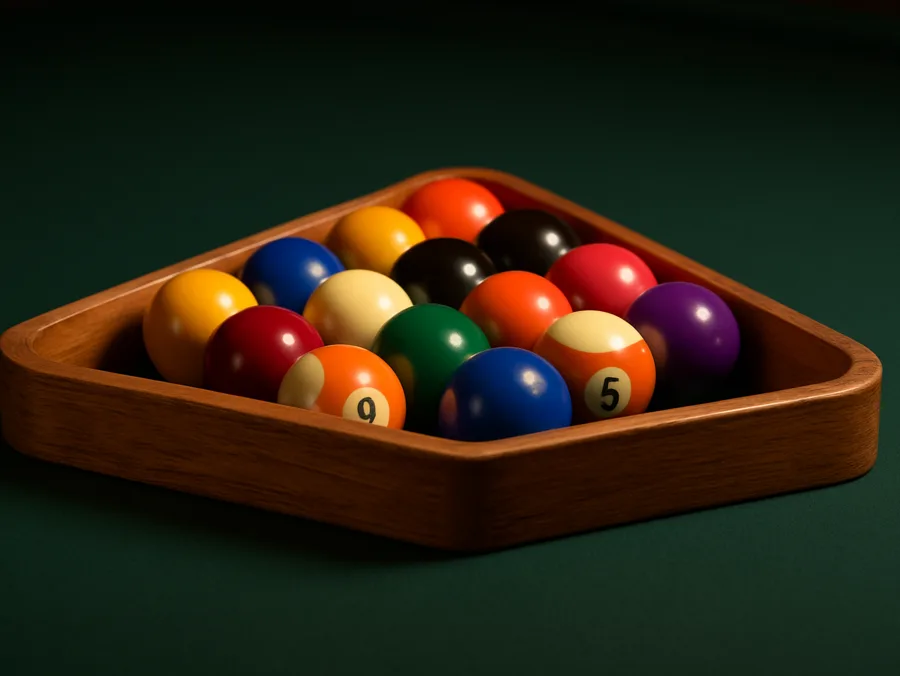
MoyanSuper Solid Wood Pool Ball Triangle Rack
Replacing the rack that came with the tableSolid pinewood with rounded, reinforced edges that slide over the cloth without catching. It fits standard 2-1/4 inch balls and comes with a dozen cubes of chalk, so it covers the two things that go missing first from a home table.
Check price on Amazon
Magic Ball Rack, 8 and 9/10-Ball Pack
Frozen racks without the techniqueThin sheets that hold each ball against its neighbors, so the rack comes out tight no matter who sets it. That's the fix for the argument over whose rack was loose, and it's allowed for 8-ball, 9-ball and 10-ball under WPA rules.
Check price on Amazon
Standard Tournament Ball Set
Clean, true-rolling balls that seat tightlyA matched, polished regulation set. Balls from one set are the same size, which is the one thing a worn, mixed set can't promise and the reason some racks never freeze no matter how you push.
Amazon price: $213.62 as of 12:30 PM EDT. Price and availability can change; Amazon’s price at purchase applies.
Check price on AmazonFrequently asked questions
What is the correct way to rack pool balls?
Put the front ball on the foot spot, place the balls your game fixes (the 8 in the middle for 8-ball, the 9 in the center for 9-ball, the 10 in the middle for 10-ball), fill the rest randomly, push the pack forward until every ball touches its neighbors, then lift the back of the rack first and slide it off.
Where does the 8 ball go in the rack?
In the middle of the third row, which is the first ball directly behind the apex in a straight line. The two back corners take one solid and one stripe, and the apex ball goes on the foot spot.
What does racking mean in pool?
Racking is setting up the object balls for the break: gathering them in a triangle or diamond frame (the rack) with the front ball or key ball on the foot spot and every ball touching its neighbors, then lifting the frame away.
How do you arrange 15 balls in billiards?
Make a five-row triangle with the apex ball on the foot spot. For 8-ball, the 8 goes in the middle of the third row and the two back corners take one solid and one stripe; every other ball goes in at random. For straight pool and one-pocket, all fifteen go in at random.
What does a perfect pool rack look like?
Every ball touches every ball next to it, with no light visible between the front ball and the two behind it. The apex or key ball sits exactly on the foot spot, the rows run parallel to the foot rail, and the fixed balls are in their places for the game.
How do you rack British 8-ball with reds and yellows?
Under WPA blackball rules the black goes on the foot spot in the middle of the third row, and the seven reds and seven yellows follow a fixed pattern. From the apex: yellow; then red, yellow; then yellow, black, red; then red, yellow, red, yellow; then yellow, red, red, yellow, red on the back row, as drawn in the WPA rule book with the apex toward the head of the table.
Does the 8 ball go on the dot?
Not in American 8-ball. The apex ball goes on the foot spot and the 8 sits two rows behind it. The black goes on the spot in UK blackball, which is where the confusion comes from.
Does it matter which ball is at the front of an 8-ball rack?
No. WPA, APA and CSI rules don't fix the apex ball in 8-ball. Only the 8 and the two back corners have required positions.
Where do you rack pool balls on the table?
At the foot end, opposite the end you break from. The front ball goes on the foot spot, where the center line meets the line between the second diamonds from the foot rail.
How do you rack 9-ball with a triangle?
Put the 1 in the front corner of the triangle, build a diamond of rows one, two, three, two and one with the 9 in the center, then push your fingers into the empty space behind the last ball to press the diamond forward before lifting the triangle off.
Does the 1 ball or the 9 ball go on the foot spot in 9-ball?
Under the WPA world rules effective September 2025, the 9 goes on the foot spot with the 1 in front of it. APA and CSI leagues still put the 1 on the foot spot. Use your league's rule.
Can you rack the balls in numerical order?
Only for fun. Official rules want the unfixed balls placed without a pattern, and WPA rules penalize deliberate placement in 9-ball after a warning.
Who racks the balls in pool?
In APA leagues the non-breaking player racks. In CSI leagues you rack for yourself when you break, and your opponent can ask for one re-rack. Under WPA rules players can agree either way, and if they disagree each racks for the other.
Why won't my pool balls rack tight?
The usual causes are a worn spot under the front ball, dirty or mismatched balls, chalk dust on the cloth, or a bent rack. Clean the balls and the rack area, swap or rotate the ball that leaves a gap, push from the back while pressing down, and try a template if the triangle still won't do it.
How do you rack balls for straight pool?
All fifteen balls in a triangle with the apex on the foot spot. CSI rules put the 1 on the back right corner and the 5 on the back left. After fourteen balls are pocketed, the fourteen are re-racked with the apex spot left empty.
How are snooker balls set up?
Fifteen reds in a triangle with the apex red just behind the pink, base parallel to the top cushion. Yellow, brown and green sit on the baulk line (yellow on the right corner of the D, green on the left, brown in the middle), blue on the center spot, pink halfway between blue and the top cushion, and black 12 3/4 inches from the top cushion.
Related guides
LeaguePool is reader-supported. When you buy through links on this site we may earn an affiliate commission at no extra cost to you. As an Amazon Associate we earn from qualifying purchases.