
Rotation Pool Rules: How 61 Is Played and Scored
Rotation pool rules come down to one shot rule and one scoring rule. On every shot the cue ball must hit the lowest-numbered ball on the table first, and every ball you legally pocket scores its number. All fifteen balls add up to 120 points, so the first player to 61 wins. That's why the game is also called 61.
The WPA's world rules don't cover rotation the way they cover 9-ball and 10-ball, so published versions differ on the details (mainly what a foul costs). Below are the core rules, where they come from, and a short list of things to agree on before the first break.
Rotation pool rules at a glance
| Rule | What it means |
|---|---|
| Balls | Object balls 1 through 15 and the cue ball |
| Rack | Triangle, 1 at the apex on the foot spot; common modern rack puts the 2 and 3 on the back corners and the 15 in the center |
| Break | Cue ball from behind the head string; the 1 must be hit first |
| Legal shot | Hit the lowest-numbered ball first, then pocket a ball or send a ball to a rail |
| Scoring | Each legally pocketed ball scores its number (the 9 is worth 9) |
| Calling shots | Not required; combinations, caroms and flukes all count |
| Your turn | Keep shooting while you legally pocket balls |
| Fouls | No points scored; balls made on a foul are spotted; penalty depends on the rule set (see below) |
| Winning | First to 61 of the 120 points |
Why 61? The scoring math
Add 1 through 15 and you get 120. Half of that is 60, so 61 is the first score nobody can catch. Brunswick's 1910 rule handbook makes exactly that point about fifteen-ball pool: the numbers on the balls count for the player who pockets them, and "sixty-one is more than one-half" when two people play. Rotation borrowed the scoring and added the lowest-ball-first rule.
The values aren't spread evenly, and that's the whole strategy of the game:
| Balls | Points | Share of 120 |
|---|---|---|
| 1 through 5 | 15 | 12.5% |
| 6 through 10 | 40 | 33% |
| 11 through 15 | 65 | 54% |
The last five balls alone are worth 65, more than enough to win. A player who misses early and then runs 11 through 15 wins the game even if the opponent made every other ball. So keep a running count. If you're on 48, you need 13, and that tells you whether the 13 is a ball you have to make or one you can play safe around.
Need a way to keep score? Our pool scoring guide covers bead strings, counters and the pencil method.
How to rack for rotation
All fifteen balls go in a triangle with the 1 at the apex on the foot spot. Two versions are in print:
| Rack | Placement | Source |
|---|---|---|
| Modern | 1 at the apex, 2 on the back corner to the racker's right, 3 on the back left corner, 15 in the center, others random | The BCA rule book, as summarized by Wikipedia (we couldn't check the book itself) |
| Old | Balls in order: 1 at the apex, 2 and 3 in the second row, 4 to 6 in the third, 7 to 10 in the fourth, 11 to 15 in the back row | Brunswick 1910 handbook; The Complete Hoyle, 1922 |
Use the modern rack. The old ordered rack puts the five big balls together at the back, which makes the break predictable. Kelly pool uses the same old-style rack with the 2 and 3 in the second row (see kelly pool rules). Technique for a tight fifteen-ball rack is in how to rack pool balls.
The break and legal shots
The breaker shoots from behind the head string and must hit the 1 first. The 1922 Hoyle states it plainly: "The opening stroke must be to strike the one-ball," and any ball pocketed by that stroke counts for the breaker, whatever its number. Make a ball and you keep shooting.
After that, one rule governs everything: the cue ball's first contact must be with the lowest-numbered ball on the table. What happens after that contact is up to you. Play the 3 into the 14 and the 14 scores 14. Carom off the 6 into the 15 and you've banked 15 points. You never have to call the ball or the pocket, and a ball that falls by luck still counts.
If the low ball is hidden, the old rules say you may bank or masse to reach it, but missing it is still a foul. Our kick shots guide is useful here, because rotation hands you more hidden low balls than any other game.
One habit from other games to drop: in rotation you aren't trying to run the balls in order. You're trying to score points. Sometimes the right shot is a soft hit on the 4 that leaves your opponent nothing, and sometimes it's a combination you'd never try in 9-ball because the ball behind it is worth 15.
Fouls and penalties
The fouls themselves are the usual ones: scratching, hitting the wrong ball first or nothing at all, no ball to a rail after contact, and knocking a ball off the table. A ball pocketed on a foul doesn't score and goes back on the table (spotted on the foot spot). No points are scored on a foul.
The penalty is where rule books split. Here are the three versions you'll run into:
| Rule set | Penalty for a foul | After a scratch |
|---|---|---|
| The Complete Hoyle (1922) | Missing the required ball "forfeits three," a point penalty | Not described separately |
| BCA version (as summarized by Wikipedia; not checked against the book) | No point penalty. The incoming player shoots from where the balls lie or makes the fouler shoot again. Three fouls in a row lose the game. | Ball in hand behind the head string; the incoming player may make the fouler take it instead. If the low ball is behind the line, it can be spotted. |
| 9-ball-style house rule | Ball in hand anywhere, as in 9-ball | Ball in hand anywhere |
The difference is huge on a crowded table. Ball in hand anywhere with fifteen balls out is often a rack-winning gift; ball in hand behind the line with the low ball near the head rail is a puzzle. Agree on one before you break. Our common pool fouls guide defines each foul and covers the three-foul warning used in 9-ball and 10-ball.
The BCA version also limits one kind of safety: simply rolling the low ball to its nearest cushion without touching another ball is allowed only twice per player per game. Many casual games ignore it. If you play it, say so up front.
Settle these before the first break
- Which rack: modern (2 and 3 on the back corners, 15 in the middle) or old (in order).
- Scratch penalty: ball in hand behind the head string or anywhere.
- Other fouls: shoot-or-pass option, or ball in hand anywhere.
- Three fouls in a row: loss of game or not.
- The safety limit, if you'll use it.
- One game to 61, or several racks with points carried over to a bigger total.
- A tie at 60 apiece: the BCA version, per Wikipedia's summary, gives a bonus point to the player who legally pocketed the last ball.
Three or more players, teams and handicaps
With three or more players, 61 no longer settles it. The target becomes whatever score the others can no longer reach with the points left on the table, so keep everyone's total visible. In team play the BCA version (again via Wikipedia's summary) alternates teams and players within teams, and a player who commits three fouls in a row sits out the rest of that game.
Because every ball has a value, rotation is easy to handicap: give the weaker player a lower target. A stronger player going to 70 against a weaker player going to 51, for example, still adds up to more than 120, so someone always gets there. Pick numbers that feel fair after a few games and adjust.
Rotation vs other rotation games
| Game | Balls | Calling | How you win |
|---|---|---|---|
| Rotation (61) | 15 | No | First to 61 points |
| 9-ball | 9 | No | Legally pocket the 9 |
| 10-ball | 10 | Yes | Legally pocket the called 10 (last ball under WPA) |
| American rotation | 15 | Yes | First to a set total; balls 1 to 10 are worth 1 point, 11 to 15 worth 2 |
| Kelly pool | 15 | No | Pocket your secret numbered ball |
American rotation is a separate game, developed by Joe Tucker, with call shots and ball in hand after every break after the first, as Dr. Dave Alciatore's pool site describes it. Don't mix its scoring into a game of 61.
Rotation is also the best practice game in the set. Fifteen balls in order means long position routes and plenty of hidden low balls. Play it alone with a target score and you'll learn where your position play breaks down.
Sources
- The Complete Hoyle (1922 edition), "Rotation Pocket Billiards" (rack, opening stroke, lowest-ball rule, forfeit for missing the required ball)
- Brunswick-Balke-Collender, A Complete Hand-Book of Standard Rules (1910) (Rotation Pool; fifteen-ball scoring and 61 of 120)
- Wikipedia, Rotation (pool) (summary of the BCA rule book's rotation rules; we could not check the book directly)
- Dr. Dave Pool Info, American Rotation
Our picks
Links open the current selection and price on Amazon so you can compare real reviews before buying.

Aramith Crown Standard Ball Set
Full fifteen-ball playA complete 16-ball set (8 solids, 7 stripes and a cue ball) in regulation 2 1/4 inch phenolic resin. Rotation uses every numbered ball, so you need a full, matched set, and phenolic holds up to rack after rack of full-table play.
Check price on Amazon
MoyanSuper Solid Wood Triangle Rack
Racking all fifteenA solid pine triangle sized for 2 1/4 inch balls, with rounded edges that slide off the cloth without dragging the apex ball. Rotation always racks all fifteen, so the triangle gets used every game. A dozen chalk cubes come in the box.
Check price on Amazon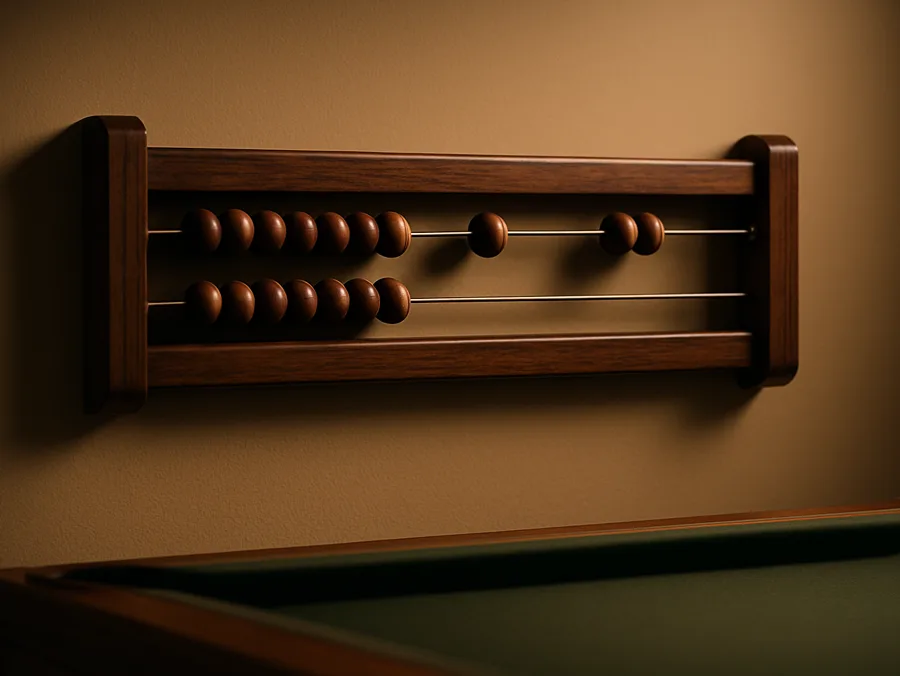
YDDS Wooden Bead Score Keeper
Tracking points to 61A 63-inch wall string of wooden scoring beads. Rotation is a counting game, and a bead string lets both players see the running totals without arguing over a pencil tally mid-rack.
Check price on AmazonFrequently asked questions
What are the rules of rotation pool?
Rack all fifteen balls, break from behind the head string hitting the 1 first, and on every shot hit the lowest-numbered ball first. Any ball pocketed on a legal shot scores its number and you keep shooting. The first player to 61 of the 120 points wins.
Why is rotation pool called 61?
The fifteen balls are worth 1 through 15 points, which totals 120. Sixty-one is more than half, so the first player to reach it can't be caught.
Do you have to pocket the balls in order in rotation?
No. You only have to hit the lowest-numbered ball first. Any ball that drops on that legal shot counts, including combinations and caroms.
Do you call shots in rotation?
Not in standard rotation (61). Flukes count. American rotation, a different game, does require called shots.
What happens if you scratch in rotation?
You score nothing on the shot and any ball you pocketed is spotted. In the BCA version your opponent gets ball in hand behind the head string, or can make you shoot from there. Some house games use ball in hand anywhere instead, so agree first.
Do fouls cost points in rotation?
Not in modern published rules; you just don't score on the shot. The 1922 Hoyle did charge a forfeit of three for missing the required ball. Three fouls in a row lose the game in the BCA version.
What happens if both players finish on 60?
All the balls are gone, so it's a tie on points. The BCA version, as summarized by Wikipedia, gives a bonus point to the player who legally pocketed the last ball.
Is rotation the same as 15-ball or American rotation?
No. American rotation scores balls 1 to 10 at one point and 11 to 15 at two, plays to a set total over many racks and requires called shots. Fifteen-ball is a name used for several games, so ask which rules a player means.
How many players can play rotation?
Two is standard. With three or more, play until a player's total can no longer be caught with the points left on the table.
Related guides
LeaguePool is reader-supported. When you buy through links on this site we may earn an affiliate commission at no extra cost to you. As an Amazon Associate we earn from qualifying purchases.