
How to Keep Score in Pool: Every Game and League
How you keep score in pool depends on whether the game is scored by the rack or by the ball. In 8-ball, 9-ball and 10-ball each rack has one winner, so you only count racks won toward a race (first to 5, say). In straight pool, one-pocket, bank pool and rotation every ball is worth points, fouls take points away, and you need a running total that both players can see.
Below is how each game counts, how to run a bead string or a score sheet for straight pool, the ball-marker trick the WPA rule book recommends for one-pocket and bank pool, and how APA and CSI league scores work.
How each pool game is scored
| Game | What you count | Usual target | What a foul does to the score |
|---|---|---|---|
| 8-ball | Racks won | Race to an agreed number | Nothing; opponent gets ball in hand |
| 9-ball and 10-ball | Racks won | Race to an agreed number | Nothing, but three fouls in a row lose the rack (WPA) |
| Straight pool (14.1) | 1 point per ball | 100 or 150 traditionally | Minus 1; minus 2 on a bad opening break; minus 15 extra on a third straight foul |
| One-pocket | Balls in your own pocket | 8 per rack | You spot one of your scored balls (or owe one) |
| Bank pool | Called banks made | 5 (nine-ball rack) or 8 (full rack) | You spot one of your scored balls (or owe one) |
| Rotation (61) | Face value of each ball | 61 of the 120 points | No deduction; three fouls in a row lose the game |
| Snooker | Reds 1, colors 2 to 7 | Most points in the frame | Points awarded to the opponent |
Rack-scored games are easy to track. The rest of this page is mostly about the point games, where scoring mistakes actually happen.
Keeping score in a race (8-ball, 9-ball, 10-ball)
Agree on the race before the lag: "race to 5" means the first player to win five racks wins the set. A tally on a napkin works. So does sliding one bead per rack on a counter. Write down who broke if you're alternating, because under WPA rule 1.3 the break alternates in games scored by the rack, and "whose break is it?" is the most common argument in a long race.
Two terms you'll hear: a player one rack from winning is "on the hill," and when both are, it's "hill-hill." For handicapped play at home, give the weaker player a shorter race (for example 5 against 3) rather than spotting balls.
How to keep score in straight pool with beads
The classic tool is a bead wire strung above the table. The traditional pool hall version holds 100 beads, 50 for each player, in colored groups of five, with a marker every ten. Each player's beads start at one end of the wire, and you slide them to the other end as you score.
- Use one side of the wire per player. Agree which side is whose before the lag.
- Keep the current inning apart from the total. Slide beads for the balls you make in this inning into a small group a few inches from your total, so you can still see how many you've run.
- When the inning ends, push that group over to join your total.
- For a foul, slide one bead back from your total (two after a failed opening break). On a third foul in a row, slide back the one for the foul plus fifteen more.
- Past 50, a common approach is to push all your beads back to the start; the first bead is now 51. Write "50" on paper or flip a marker so nobody forgets.
Two snags. A foul before you've scored anything puts you below zero, which beads can't show, so put a coin on the rail (or mark a bead at the far end) for each point owed and cancel them as you score. And beads shift when someone brushes the wire, so call out your total each time you post it.
The rules behind these numbers, including when the opening break costs two points, are in our straight pool rules.
Straight pool on paper: a sample score sheet
A paper sheet is slower than beads but leaves a record you can check. One line per inning, with each player's run and running total, is all you need. Here's an example of how the first few innings of a game to 100 might look:
| Inning | Player A run | A total | Player B run | B total |
|---|---|---|---|---|
| 1 | Break foul (minus 2) | -2 | S (safety) | 0 |
| 2 | 0 | -2 | 9 | 9 |
| 3 | 17 | 15 | Foul (minus 1) | 8 |
| 4 | S | 15 | 23 | 31 |
Write "S" for a safety, a dash or a zero for a miss, and "F" next to any foul so the foul count is visible. That last habit matters, because the WPA regulations count a visible foul count on a scoreboard as the required warning that a player is on two fouls.
No pencil? Count the balls. At the end of each inning note how many balls are on the table. Your run is the number at the start of your inning, minus the number at the end, plus 14 for each re-rack in between. It breaks down if balls were spotted during the inning, so use it for casual games only.
One-pocket and bank pool: let the balls keep score
The WPA rule book has a neat method for one-pocket and bank pool when there's no scorekeeper. Each player keeps the balls they've scored in their own spot (on the rail or a shelf in front of them). When you foul, one of your scored balls goes back on the table as the penalty. If you foul with nothing scored, put a marker down to show you owe a ball, and the next ball you make gets spotted to pay it off.
The count is always right there, no beads required. Scoring is per rack: eight balls in your pocket wins a one-pocket rack, and a bank pool rack is five banks with nine balls or eight with fifteen. Matches are a race to a set number of racks, so keep a simple tally of racks on top.
Rotation and other point games
In rotation, each ball is worth its number, all fifteen add up to 120, and 61 wins. Fouls don't cost points (three in a row lose the game), so a pencil and a running sum is enough. Add as you go rather than at the end; adding up fifteen numbers twice never matches.
Snooker and the party games use their own systems. Snooker's ball values and foul points are in snooker rules for beginners, and group games like cutthroat and Kelly pool are covered in pool games for groups.
Pool league scores: APA and CSI
League scoring adds handicaps and a score sheet. In the APA, each team keeps its own sheet, and the two don't have to match.
| Format | How a match is scored | Team points |
|---|---|---|
| APA 8-ball | Race in games; each player's target comes from the Games Must Win chart for the two skill levels | Up to 3 points per individual match; 15 per week for a five-player team |
| APA 9-ball | Balls 1 to 8 score one point, the 9 scores two (10 per rack); each skill level has a points target | Up to 20 points per individual match; 100 per week for a five-player team |
| CSI USA Pool League 8-ball | Rack winner gets 14 points; loser gets one per ball of their group pocketed | Race-to numbers set by the league's handicap calculator |
| CSI USA Pool League 9-ball and 10-ball | Rack winner gets 14 points; loser gets one per ball legally pocketed | Same calculator; both players within 14 of their target are on the hill |
APA scorekeepers also mark innings and defensive shots. An inning is marked only when the player who lost the lag misses or fouls, and any shot with no intent to legally pocket a ball goes in the defensive shot block. Those marks feed your skill level, so the APA treats sloppy or dishonest scorekeeping as a rules violation. Our APA skill levels guide has the full race and points charts, and how pool leagues work explains a typical league night.
Choosing a scoring tool
| Tool | Best for | Drawback |
|---|---|---|
| 100-bead wire (50 per player) | Straight pool to 100 or 150 | Needs a wall or ceiling run above the table; beads drift if bumped |
| Short wall bead counter | Races and short point games | Too few beads for a long straight pool game without counting in groups |
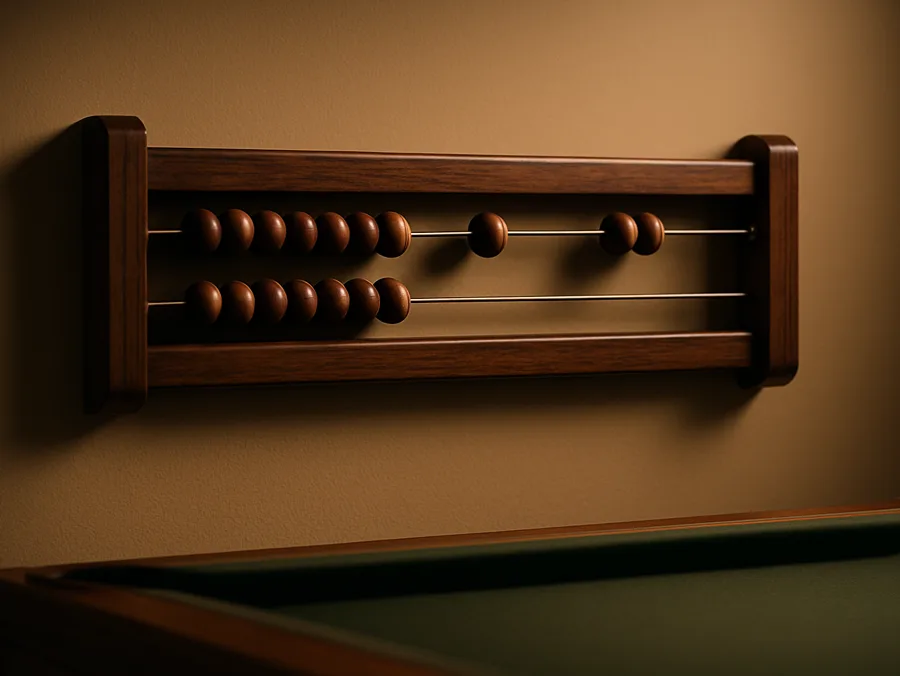
| Overhead abacus on the light | One-pocket, bank pool, races | Same bead limits; hard to reach on a low light |
| Digit-wheel counters | Any running total, including negatives | Small, so put them where both players can read them |
| Dry-erase board or paper sheet | League nights, keeping a record | Someone has to write after every inning |
| Phone app | Solo practice and high-run tracking | In a match, calls and screen time get in the way |
If you mostly play 8-ball and 9-ball, a small bead counter or a dry-erase board is plenty. If you play straight pool, buy or build the long wire. One practical note from players who've built their own: plastic-coated wire or heavy line is kinder to cue shafts than bare copper.
How to avoid scoring arguments
- Agree on the game, the rule book and the target before the lag.
- Update the score at the end of every inning, not three innings later.
- Call fouls right away. Under WPA rules a foul that isn't called before the next shot is treated as if it never happened, and the score should reflect that.
- Tell your opponent when they're on two fouls in any game with a three-foul rule.
- Say the totals out loud now and then ("I'm at 42, you're at 37") so a drifted bead gets caught early.
For the rest of the unwritten rules at the table, see pool hall etiquette.
Sources
- WPA Rules of Play, effective September 15, 2025 (14.1 scoring 7.7 and 7.11; one-pocket 12.5; bank pool 13.2 and 13.6)
- WPA Rule Regulations, effective September 15, 2025
- APA: How to Score 8-Ball
- APA: How to Score 9-Ball
- APA: Scoring
- CSI: USA Pool League scoring, how it works
- Wikipedia: Rotation (pool)
Our picks
Links open the current selection and price on Amazon so you can compare real reviews before buying.
Wooden Bead Score Keeper
Races and short point gamesA wall bead counter keeps the score where both players can see it, which ends most arguments before they start. This one has 30 wooden beads on a string about 63 inches long, so it's sized for races and short games rather than a full 150-point straight pool match (count in groups of ten if you use it for that).
Check price on Amazon
JINGSEY 4-Digit Score Counter Set, 4-Pack
Long running totalsFour rotating number wheels per counter means a 150-point straight pool game, a rotation total or a high-run log fits easily, and you get four counters, enough for two players' totals plus a foul count each. They're small, so park them on the rail or a shelf where both players can read them.
Check price on Amazon
Overhead Abacus Score Counter
Two-player running scoresAn abacus-style counter that hangs from the table light lets each player slide beads for their own total, keeping one-pocket and rotation scores honest at a glance.
Check price on Amazon
Dry-Erase Billiard Scoreboard
League match trackingA compact dry-erase scoreboard records racks won in a race format and gives you a written record to settle any question about the match total.
Check price on AmazonFrequently asked questions
How do you keep score in 8-ball?
Count racks won. Each rack has one winner, so agree on a race (for example first to 5) and add one for each rack a player wins. Fouls don't change the score.
How do you keep score in nine-ball?
In standard 9-ball, whoever legally pockets the 9 wins the rack and you play a race to a set number of racks. APA 9-ball is different: balls 1 to 8 score one point each and the 9 scores two, toward a points target set by skill level.
How are pool scoring beads used?
Each player slides beads along a wire as they score, usually 50 beads per side in colored groups of five. Keep the current inning's beads apart from your total, push them over when the inning ends, and slide one back for each foul.
How do you score fouls in straight pool?
Subtract one point for a standard foul and two for a failed opening break. A third foul in a row costs one point plus fifteen more. Scores can go below zero.
How do APA 8-ball scores work?
Each player needs a set number of games from the Games Must Win chart, based on both players' skill levels. Each individual match is worth up to 3 team points, so a five-player team can win up to 15 a week.
What does 'on the hill' mean?
A player is on the hill when they need one more rack to win a race. In CSI USA Pool League scoring, both players are on the hill when each is within 14 points of their race-to number.
Related guides
LeaguePool is reader-supported. When you buy through links on this site we may earn an affiliate commission at no extra cost to you. As an Amazon Associate we earn from qualifying purchases.