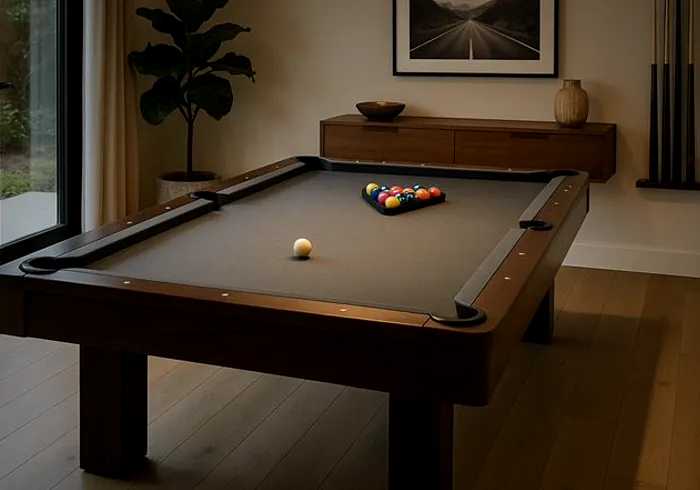
Snooker on a Pool Table: How to Play and Set Up
Yes, you can play snooker on a pool table, and it's a good game. Buy a snooker ball set sized for your table (2 1/8 inch suits most 7 and 8 foot pool tables), mark a baulk line, a D and six spots, and play the normal snooker rules with 10 reds instead of 15. The WPBSA rulebook itself says a simplified form of snooker can be played with any number of reds.
What you can't copy is the table. A full-size snooker table has about twice the playing area of a 9-foot pool table and tighter, rounded pockets, so pots that are hard on the real thing are easy on yours. Below: how to play snooker in a few minutes, the right ball size for your table, measured markings for 7, 8 and 9 foot tables, and an honest list of what changes.
How to play snooker (the short version)
Snooker is a points game played with one white cue ball, 15 reds worth 1 point each (10 on most pool-table setups) and six colors: yellow 2, green 3, brown 4, blue 5, pink 6, black 7.
- Break off with the cue ball anywhere in the D. You must hit a red first.
- Pot a red, then nominate and pot any color. The red stays down; the color goes back on its spot.
- Keep alternating red and color. Miss, and your opponent plays, starting on a red.
- When the reds are gone, pot the colors in order from yellow to black. Now they stay down.
- A foul gives your opponent 4 points, or more if a higher-value ball was involved (up to 7 for the black).
- Most points when the black goes down wins the frame.
That's enough to start playing tonight. Free balls, the miss rule and the full foul table are in our snooker rules for beginners.
Pool table vs snooker table: what changes
| 12 ft snooker table | 9 ft pool table | 8 ft pool table | 7 ft pool table | |
|---|---|---|---|---|
| Playing surface | 140.5 x 70 in | 100 x 50 in | 92 x 46 in (WPA size) | 76 x 38 in |
| Balls | 22 at 2 1/16 in (52.5 mm) | 16 at 2 1/4 in (pool) | 16 at 2 1/4 in (pool) | 16 at 2 1/4 in (pool) |
| Pockets | About 3.5 in, rounded jaws | Corner 4.5 to 4.625 in (WPA spec), angled jaws | Corner 4.5 to 4.625 in (WPA spec), angled jaws | Corner 4.5 to 4.625 in (WPA spec), angled jaws |
| Cloth | Napped wool | Napless worsted | Napless worsted | Napless worsted |
| Markings | Baulk line, D, six spots | Head string and foot spot | Head string and foot spot | Head string and foot spot |
A snooker corner pocket is about 1.7 times the width of the ball. A WPA-spec pool corner with a 2 1/8 inch snooker ball is about 2.1 times. That gap, plus a table 40 to 64 inches shorter, is why pool-table snooker plays easier than the real thing. Full table sizes and buying options are in our snooker table guide.
Searching for how to play on a pool table in general? Our how to play pool guide starts from zero with 8-ball.
Which snooker ball set fits your table
Ball size is the whole trick. Full-size snooker balls on a small table leave no room to play, and pool-size balls make the rack huge. Here's how the options compare, measured by how many balls would fit side by side across the table, which is a fair proxy for how open the game feels.
| Table | Ball size | Balls across the table | How it plays |
|---|---|---|---|
| 12 ft snooker (reference) | 2 1/16 in | About 34 | The real thing |
| 9 ft pool | 2 1/8 in | About 23.5 | Roomy; 15 reds fit easily |
| 9 ft pool | 2 1/4 in | About 22 | Tighter, but potting gets harder, which some players prefer |
| 8 ft pool | 2 1/8 in | About 21.5 | Good with 10 or 15 reds |
| 7 ft pool | 2 1/8 in | About 18 | Use 10 reds |
| 7 ft pool | 2 in | 19 | A little more room; 10-red sets common |
| 6 ft and smaller | 2 in or smaller | Depends on the table | 10-red sets only |
Our pick: a 2 1/8 inch set for any 7 to 9 foot pool table. It's the size American snooker sets have traditionally used, it drops cleanly into pool pockets, and it leaves workable space. Aramith also makes 10-red snooker sets in 2 inch and in smaller sizes down to 1 3/8 inch for compact tables (Peradon lists six sizes), and a 2 1/4 inch snooker set the same size as pool balls, which suits a 9-footer if you want potting to stay hard.
Why not 15 reds on a 7-footer? We worked it out from the scaled spot positions: with 2 1/8 inch balls, a full 15-red triangle behind the pink ends less than half an inch from the black. Ten reds leaves a proper gap. On an 8-footer, 15 reds fit with about 3 inches to spare.
Marking the baulk line, the D and the spots
The WPBSA puts the baulk line 29 inches from the bottom cushion on a 140.5-inch playing surface (20.6 percent of the length), gives the D a radius of 11.5 inches on a 70-inch-wide table (16.4 percent of the width) and sets the black spot 12.75 inches from the top cushion (9.1 percent of the length). We scaled those percentages to common pool-table playing surfaces:
| Mark | 7 ft (76 x 38 in) | 8 ft (92 x 46 in) | 9 ft (100 x 50 in) |
|---|---|---|---|
| Baulk line, from the bottom cushion | 15 3/4 in | 19 in | 20 5/8 in |
| D radius | 6 1/4 in | 7 1/2 in | 8 1/4 in |
| Blue spot | Center of the table | Center of the table | Center of the table |
| Pink spot, from the top cushion | 19 in | 23 in | 25 in |
| Black spot, from the top cushion | 6 7/8 in | 8 3/8 in | 9 1/8 in |
Measure your own table between the cushion noses before you mark anything; home tables sold as 8-footers vary. Then multiply: baulk line at 0.206 of the length, D radius at 0.164 of the width, black spot at 0.091 of the length from the top.
Where the snooker balls go on the table
- Brown: the middle of the baulk line.
- Yellow and green: the two ends of the D where it meets the baulk line. Looking up the table from the baulk end, yellow is on the right, green on the left.
- Blue: the center spot. Pink: halfway between the blue and the top cushion. Black: its own spot near the top cushion.
- Reds: a tight triangle behind the pink, the front red as close to the pink as possible without touching it.
For the lines, use something that comes off the cloth. A baulk marking stick works like a compass for the D (Peradon sells one with holes for different table sizes), drawn with a cloth-marking pencil, or lay thin removable tape if you swap between pool and snooker every week. Self-adhesive spots mark the six color positions. Skip pens and permanent markers: you'll see the line every time you play 8-ball.
Rules for snooker on a smaller table
Play the WPBSA rules as written; the only thing you change is the number of reds. Ten reds is the usual home choice, and six reds is an official format with its own section in the rulebook (it adds a cap on consecutive foul-and-miss calls and bans snookering your opponent behind the color you nominated). Scoring doesn't change, so the maximum break shrinks with the reds:
| Reds | Maximum break | Good for |
|---|---|---|
| 15 | 147 | 8 and 9 ft tables |
| 10 | 107 | 7 and 8 ft tables, evening sessions |
| 6 | 75 | Quick frames, any table |
That's reds times 8 (a black after every red), plus 27 for the six colors. Two things to agree on before the first frame. Without a referee, the WPBSA rules make your opponent the referee, so decide whether you'll call foul and a miss at all; it's hard to judge between friends. And remember that the jump shots your pool cue makes easy are fouls in snooker.
What doesn't translate, honestly
- Pocket shape. Pool pockets have angled jaws that funnel a ball in; snooker pockets are rounded and spit out anything slightly off line. Balls running down the rail drop on a pool table that would rattle out on a snooker table.
- Distance. A snooker table's playing surface is 11 ft 8 1/2 in long; a 7-footer's is 6 ft 4 in. Long potting, the core snooker skill, gets far less testing.
- The nap. Snooker cloth has a nap running from the baulk end toward the black, which drags slow balls off line depending on direction. Pool cloth has none.
- Cushions. Pool cushions are a different profile from snooker's, so angles off the rail won't match what you see on TV.
Purists will tell you an American pool table isn't a snooker table, and they're right. It isn't the real thing, but the scoring, the safety battles and the cue ball control are, and that's most of what makes snooker worth playing. Treat it as its own game and it's excellent practice for pool, because it rewards planning several balls ahead.
What you need to get started
- A snooker ball set sized for your table (see the table above). This is the only essential purchase.
- Marking: spots for the six colors and a way to draw the D.
- A scoreboard. Snooker scores pass 50 in a good frame and arguments about the count start soon after.
- Optional: a snooker cue. Your pool cue works, but a 9.5 mm snooker tip on a 2 1/8 inch ball gives finer control of screw and side; see best snooker cues.
- Optional: a rest, for the shots a pool player would normally stretch for. One foot must stay on the floor under snooker rules. See bridge sticks.
If you're still choosing a table, a 7 or 8 foot slate table is the sensible base for both games; our 8-foot pool table picks and 7-foot picks cover the options.
Sources
- WPBSA: Official Rules of the Games of Snooker and English Billiards, September 2024 (table markings, ball set, six reds, any number of reds)
- WPA: Recommended Equipment Specifications (pool playing surfaces, pocket openings, ball size)
- Wikipedia: Billiard table (7-foot playing surface, snooker pocket size)
- Wikipedia: American snooker (2 1/8 inch balls, 2 1/4 inch Aramith set for pool tables)
- Peradon: Aramith 10-red snooker sets, 2 in to 1 3/8 in
- Peradon: baulk marking stick
- Predator USA: tables, including slate heating on its 12 ft snooker table
Our picks
Links open the current selection and price on Amazon so you can compare real reviews before buying.
Aramith Premier 2 1/8 Inch Snooker Ball Set
Snooker on a 7 to 9 ft pool tableThe full 22-ball English snooker set, unnumbered, at 2 1/8 inches: big enough to drop cleanly in pool pockets, small enough to leave room for a real rack of reds. Aramith rates the balls for over 4,000,000 impacts and says the smooth surface means less cloth wear, which matters on a table that still does pool duty. Use all 15 reds on an 8 or 9 footer, 10 on a 7.
Check price on Amazon
Yctze Cloth Spot Stickers, 15 Pack
Marking the six color spotsFifteen 35 mm cloth spots that stick to the table and peel off cleanly. Six of them mark the color spots, which leaves spares for the pool foot spot and replacements. They keep re-spotting honest: on a small table, a pink put back an inch off its spot changes the next shot.
Check price on Amazon
MoyanSuper Wooden Wall-Mount Scoreboard
Tracking points through a frameA wooden scoreboard with two slide rails marked 0 to 100 that hangs on two nails in under a minute. With 10 reds the most you can score is 107, so the 100 scale covers real home frames, and the board on the wall saves stopping play to add up foul points.
Check price on Amazon
CueSoul 57 Inch Snooker Cue Kit
When you get hookedA 57-inch, 18 oz 3/4 jointed cue with a 9.5 mm tip and a kiln-dried ash shaft, in an aluminum case with a 6-inch mini butt and a telescopic extension. A narrow snooker tip shows you exactly where you're striking the cue ball, which is the skill snooker trains. One of the best-selling snooker cues on Amazon.
Check price on AmazonFrequently asked questions
Can you use regular pool balls to play snooker?
You can improvise with numbered balls standing in for the colors, but you won't have 15 reds, and 2 1/4 inch balls crowd a 7 or 8 foot table. A snooker set in 2 1/8 inch, or a 2 1/4 inch snooker set on a 9-footer, gives you the real ball colors and count.
How many reds should I use on a 7-foot table?
Ten. With 2 1/8 inch balls, a full 15-red rack ends less than half an inch from the black spot on a 7-footer. Ten reds leave a sensible gap, and the maximum break becomes 107.
Is a pool table the same size as a snooker table?
No. A full snooker table's playing surface is 140.5 x 70 inches. A 9-foot pool table is 100 x 50 inches and a 7-footer 76 x 38, so even the biggest pool table has about half the playing area.
Will the markings damage my table cloth?
Not if you use cloth-safe materials: a cloth-marking pencil, removable tape or self-adhesive cloth spots. Avoid pens and markers.
Are snooker tables heated?
Some are. An electric heater under the slate keeps the cloth dry so balls roll consistently; Predator, for one, lists slate heating on its 12-foot snooker table. The WPBSA rules don't require it (heating is required for carom tables). Your pool table doesn't need one to play snooker.
What's a snooker table?
A 12 by 6 foot table with six small rounded pockets, napped cloth and snooker markings: the baulk line, the D and six color spots. Our snooker table guide covers sizes and prices.
Related guides
LeaguePool is reader-supported. When you buy through links on this site we may earn an affiliate commission at no extra cost to you. As an Amazon Associate we earn from qualifying purchases.