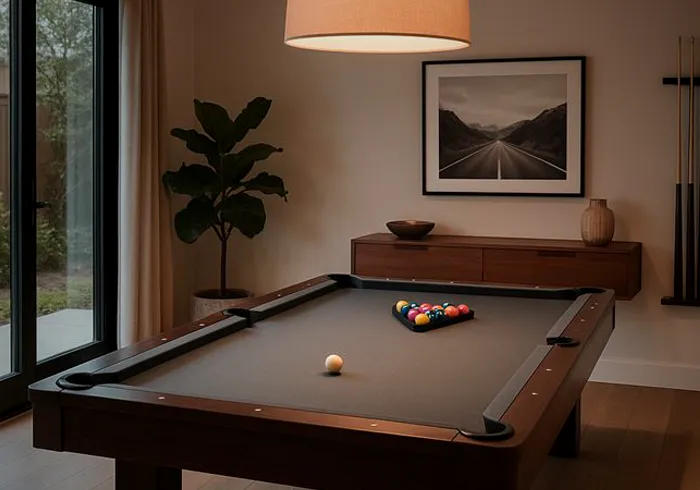
Pool vs Billiards vs Snooker: The Real Differences
Billiards (said BIL-yerdz) means any game where you hit balls with a long stick, the cue, around a cloth-covered table with cushioned rails.
Billiards is the name for the whole family of cue sports. Pool and snooker are two games inside that family, and carom billiards is a third. Pool is played on a 7 to 9 foot table with six pockets and sixteen 2 1/4 inch balls. Snooker uses a 12 by 6 foot table, smaller 52.5 mm balls, tight rounded pockets and a points system built on fifteen reds and six colors. Carom billiards has no pockets at all: you score by making your cue ball hit the other balls.
Americans add to the confusion by calling pool billiards, which is fine in everyday speech and wrong only if you're talking to a three-cushion player. Below are the differences side by side, what snooker actually means, and a short history drawn from the official rulebooks.
Is billiards the same as pool?
Sometimes. Billiards has two meanings, and which one someone intends depends on where they learned the game.
- As an umbrella term, billiards covers every game played with a cue and balls on a cloth table: pool, snooker, carom and the rest. That's how most Americans use it, and why so many pool halls have billiards in their name.
- As the name of a specific game, billiards means carom billiards (pocketless) or, in Britain and the Commonwealth, English billiards, a two-cue-ball game played on a snooker table that scores both pots and cannons.
Pool itself is short for pocket billiards. So all pool is billiards, but not all billiards is pool. If a friend says let's shoot some billiards in Ohio, bring your pool cue.
What does billiards mean? Definition and pronunciation
The dictionary sense is short: billiards is a game played on a cloth-covered table, where players use a cue to knock balls into each other and, in most versions, into pockets. The word came into English from the French billard, which first meant the wooden stick, not the game. Billard itself comes from the Old French bille, a log or piece of wood. A billiard (singular) is used mostly as an adjective now: billiard table, billiard ball, billiard room.
| American | British | |
|---|---|---|
| Billiards | BIL-yerdz (two syllables) | BIL-ee-udz (three syllables) |
| Snooker | SNOOK-er, rhymes with cooker | SNOO-ker, with the oo of moon |
Both billiards pronunciations are correct; Cambridge lists each for its own country.
Why is the game called pool?
Because of money. A pool was the pot of stakes that several players paid into, from the French poule, and billiard games played for a shared pot took the name. The Oxford English Dictionary finds pool used for a billiards-type game by 1797. The betting parlors called poolrooms came later and spread the name rather than coining it. The whole story, with the dates, is in why is pool called pool.
Is it 8-ball pool or billiards?
Both names are right, at different levels. 8-ball is one game. It's a pool game, because it's played on a six-pocket table with fifteen numbered balls. And pool is a kind of billiards, so 8-ball is billiards too, in the broad American sense. The WPA, the world body that writes the 8-ball rules, is literally the World Pool-Billiard Association.
The one place 8-ball is not billiards is a carom room, where billiards means the pocketless game. In everyday US speech, 8-ball, 8-ball pool and billiards all point to the same table. The official rules are in 8-ball rules.
How do you play billiards? The basics in five steps
Most Americans who ask this mean pool, and 8-ball is the game to learn first. Here is how a game runs:
- Rack and break. The fifteen object balls go in a triangle at the foot of the table. The breaker hits the cue ball from behind the head string into the rack. A legal break pockets a ball or drives at least four object balls to a rail.
- Claim a group. The table stays open after the break. Your first legally pocketed ball after that decides your group: solids (1 to 7) or stripes (9 to 15).
- Make a legal hit every shot. Strike only the cue ball, hit a ball of your group first, and then either pocket a ball or send some ball to a cushion.
- Keep shooting until you miss or foul. Pocket a ball legally and you go again. A foul, including scratching the cue ball into a pocket, gives your opponent ball in hand anywhere on the table.
- Finish on the 8. Once your group is cleared, call the 8 into a pocket and make it to win. Pocket the 8 early, in the wrong pocket or on a foul, and you lose.
Snooker and carom billiards work differently: snooker is a points game on a bigger table, and carom scores by making the cue ball contact the other two balls. Both are covered below. For a full beginner walk-through of stance, aim and practice, read how to play pool.
Pool vs billiards vs snooker at a glance
| Pool | Snooker | Carom billiards | |
|---|---|---|---|
| Table | 7, 8 or 9 ft (9 ft is regulation) | 12 x 6 ft full size; smaller tables exist | 10 x 5 ft |
| Playing surface | 100 x 50 in on a 9 ft table | 11 ft 8 1/2 in x 5 ft 10 in | About 9.3 x 4.7 ft |
| Pockets | 6, with sharp pointed jaws; side pockets slightly wider | 6, smaller with rounded entries | None |
| Balls | 16: cue ball plus 15 numbered (solids 1-8, stripes 9-15) | 22: cue ball, 15 reds, 6 colors | 3: two cue balls and a red |
| Ball size | 2 1/4 in (57.15 mm) | 52.5 mm (about 2 1/16 in) | 61 to 61.5 mm (about 2 3/8 in) |
| Cloth | Napless worsted wool, fast | Traditionally napped, so balls roll differently with and against the nap | Napless, fast |
| Cue tip | Commonly 12 to 13 mm (WPA cap 14 mm) | Commonly 9 to 10 mm | Varies by player |
| How you score | Pocket the right balls, depending on the game | Points: red 1, then a color worth 2 to 7 | Points for cue ball contacting both object balls (plus cushion rules) |
| Best-known games | 8-ball, 9-ball, 10-ball, straight pool, one-pocket | Snooker; six-red snooker | Three-cushion, straight rail, balkline, artistic |
| Where it's big | US, and bars worldwide | UK, Ireland, China and much of the Commonwealth | France and Europe, South Korea, Vietnam, Japan |
| Governing body | WPA (BCA in the US) | WPBSA (pro), IBSF (amateur) | UMB |
Sizes come from the WPA equipment specifications and the WPBSA rulebook; carom figures from the UMB-standard table and ball. Tip sizes are what the cues and replacement tips on sale actually use, not a rule.
Pool: pockets and numbered balls
Pool is the cue sport most Americans grew up with: a six-pocket table, a white cue ball and fifteen numbered object balls. The WPA sets the ball at 2 1/4 inches and 5 1/2 to 6 ounces, and a regulation 9-foot table has a 100 by 50 inch playing surface. Bar and home tables are usually smaller.
Pool is really a group of games. The equipment stays the same, and the rules change what you're allowed to hit and which ball wins:
- 8-ball: solids against stripes, then the black 8. The most played pool game in the world.
- 9-ball: hit the lowest-numbered ball first, and whoever pockets the 9 wins. The main professional game.
- Straight pool and one-pocket: slower point games for players who like strategy.
New to it? How to play pool starts from zero.
Snooker: what it is and how scoring works
Snooker is a cue sport played on a large six-pocket table with 22 balls: fifteen reds worth 1 point each, six colors, and a white cue ball. Everyone shoots the same cue ball. Unlike pool, nobody owns a group of balls; you win a frame by scoring more points than your opponent.
| Ball | Points |
|---|---|
| Red (15 of them) | 1 each |
| Yellow | 2 |
| Green | 3 |
| Brown | 4 |
| Blue | 5 |
| Pink | 6 |
| Black | 7 |
The rhythm of the game: you pot a red, then any color you nominate. The color comes back out onto its spot, and you go for another red. A run of scoring shots in one visit is a break. Once all the reds are gone, the colors are potted in order from yellow to black and stay down. Potting every red with the black and then clearing the colors gives the maximum break of 147.
Fouls give points to your opponent: at least 4, or more if a higher-value ball is involved (up to 7 for the black). That's why so much snooker is safety play. Leaving your opponent snookered, with no straight line from the cue ball to any ball they're allowed to hit, can force them into fouls. The table markings matter too: the cue ball starts in the D, a semicircle at the baulk end. For the full rules, read snooker rules for beginners.
What does snooker mean?
As a noun, snooker is the game, and also the position it's named for in play: the cue ball is snookered when another ball blocks a straight path to every ball you're allowed to hit. The WPBSA rulebook defines it that way.
The word itself was army slang. According to the game's history, snooker was a mocking term for first-year cadets and inexperienced soldiers, and the officers who invented the game borrowed it. As a verb, to snooker someone means to trick them, and being snookered means you're stuck in a bad spot, both carried over from the table. The American and British pronunciations are in the table near the top of this page.
Carom billiards: the game with no pockets
Carom billiards is played on a pocketless table, typically 10 by 5 feet, with just three balls about 61 to 61.5 mm across: a white cue ball, a yellow cue ball (one for each player) and a red. You score a point when your cue ball contacts both other balls. The most famous version, three-cushion, also requires your cue ball to touch the cushions at least three times before it hits the second ball, which turns every shot into an angle and spin problem.
The world governing body is the Union Mondiale de Billard (UMB). Carom is big in France, where it began, and in South Korea, Vietnam and Japan, but rare in North America, where pool took over. Our carom billiards guide covers the rules and where to play in the US.
English billiards sits between the two worlds: two cue balls and a red on a snooker table, scoring pots, in-offs and cannons (a cannon is the British name for a carom). It's governed by the same WPBSA rulebook as snooker.
Is snooker harder than pool?
For potting balls, yes, and the numbers show why. A snooker table's playing surface is about 140 by 70 inches against 100 by 50 on a 9-foot pool table, so shots are longer. The pockets are tighter relative to the ball too: snooker pockets are about 86 mm with rounded entries for a 52.5 mm ball, roughly 1.6 balls wide, while a regulation pool corner pocket is 4 1/2 to 4 5/8 inches (114 to 117 mm) for a 57 mm ball, about 2 balls wide. Rounded snooker pocket edges also reject balls that would rattle in off the sharp jaws of a pool table.
Pool is hard in different ways. 9-ball and 10-ball reward a powerful break and fast decisions, and the bigger pool ball reacts differently to spin and speed. Plenty of good pool players struggle on a snooker table at first, and plenty of snooker players find the pool break strange. If you're a pool player, half an hour on a full-size snooker table is a humbling, useful lesson in straight cueing.
Snooker cue vs pool cue
A snooker cue is built for a smaller, lighter ball. The snooker cues we checked on Amazon run 57 inches with 9 to 10 mm tips and ash shafts, and many are 3/4 jointed (the joint sits low on the butt so the shaft is one long piece). Pool cues carry a wider tip, commonly 12 to 13 mm, usually on a maple shaft with a center joint. The WPA caps pool tips at 14 mm; the WPBSA only requires a snooker cue to be at least 3 feet long.
You can hit balls with either cue on either table, but neither feels right. A 13 mm tip covers a lot of a 52.5 mm snooker ball, and a 9.5 mm snooker tip on a 2 1/4 inch pool ball leaves very little margin when you hit off center. If you play both games regularly, own one of each. Our best snooker cues guide compares the main makers, and pool cue tip sizes covers the pool side.
A short history of cue sports
- 1340s: A recognizable form of billiards is played outdoors, much like croquet.
- 1400s: Louis XI of France owns the first known indoor billiard table.
- About 1800: The straight cue replaces the mace, a club used to push the ball. The word cue comes from the French queue, tail, because players had turned the mace around to shoot with its tail. English billiards takes shape in the same era.
- 1797: The oldest known use of pool for a billiards-like game appears in a Virginia newspaper. Where the name came from is debated; see why pool is called pool.
- 1875: Lt. Neville Chamberlain, a British Army officer, creates snooker in Jubbulpore (now Jabalpur), India, by combining two pool games, pyramids and black pool. That's the date the WPBSA itself credits, though Chamberlain wasn't publicly named as the inventor until 1938.
- 1888 to 1910: In the US, continuous pool replaces fifteen-ball pool as the championship game in 1888 (some sources say 1889) and becomes straight pool by 1910. Eight-ball appears in the early 1900s.
- 1927: The first World Snooker Championship. Joe Davis wins it and every one through 1946.
- 1977: The World Snooker Championship moves to the Crucible Theatre in Sheffield, where it has stayed. Stephen Hendry and Ronnie O'Sullivan hold the record with seven world titles each.
The balls changed over the centuries too, from wood and clay to ivory to plastic: billiard ball history.
Finding a snooker hall or club, and following the pros
Snooker is everywhere in Britain and Ireland, where it's mostly played in dedicated snooker halls and clubs rather than pubs. In the US it's rare. A full-size table needs a big room once you add space to swing a cue, so most American pool halls don't have one. To find a table, search for snooker clubs and billiards halls in your city, then call and ask whether they have a full-size 12-foot snooker table, not just a pool table with snooker balls.
For pro snooker scores, results, the tournament calendar and rankings, the official source is the World Snooker Tour at wst.tv. The rules are owned by the WPBSA, and amateur snooker internationally falls under the IBSF.
No snooker table nearby? You can play a scaled-down version on a pool table with smaller balls; snooker on a pool table explains how to mark it up.
Is billiards a sport?
Yes, by the standard sports bodies use. Each branch has a world governing body that writes the rules and runs world championships: the World Pool-Billiard Association (WPA) for pool, the Union Mondiale de Billard (UMB) for carom, and the WPBSA and IBSF for snooker. Above them sits the World Confederation of Billiards Sports (WCBS), founded in 1992, covering pool, carom and snooker. The WCBS is a member of ARISF, the association of international federations recognized by the International Olympic Committee.
Billiards is on the program of The World Games, the International World Games Association's multi-sport event, at every edition since Akita 2001. Chengdu 2025 had carom (three-cushion), pool (10-ball and heyball) and snooker (6-red and 15-red), and all three are scheduled for Karlsruhe 2029.
What it is not, so far, is an Olympic sport. Billiards has not been on the Olympic Games program.
Billiards terms you'll hear
| Term | Meaning |
|---|---|
| Cue | The stick. Pool stick is the casual name. |
| Cue ball | The white ball, the only one you strike with the cue (carom uses two cue balls, one per player). |
| Break | In pool, the opening shot into the rack. In snooker, a run of scoring shots in one visit. |
| Pot | To pocket a ball; the usual word in snooker and British pool. |
| Scratch | Pocketing the cue ball in pool, a foul. See what counts as a scratch. |
| Ball in hand | After a foul in pool, the opponent places the cue ball anywhere on the table. |
| English | Side spin on the cue ball. See how to put English on the cue ball. |
| Carom (cannon) | The cue ball glancing off one ball into another. Cannon is the British word. |
| Safety | A defensive shot that leaves the opponent a hard shot instead of trying to score. |
| Snookered | No straight path from the cue ball to any ball you're allowed to hit. |
| Rack, frame | One game. Rack is the pool word; frame is the snooker word. |
Fouls by game are in common pool fouls.
Which one should you play or buy?
For a home in the US, buy a pool table. It fits a normal game room, every friend who visits knows 8-ball, and leagues run on pool tables in nearly every town. Start with the pool table buying guide, and pool table sizes to see what fits your room.
Pick snooker if you already love watching it, have room for a very large table, or live near a club. Carom is a niche worth trying if you find a table, especially if you want to sharpen your cue ball control for pool.
Sources
- WPBSA: Official Rules of the Games of Snooker and English Billiards, 2024 (table, balls, values, fouls, snookered, 1875 origin)
- World Pool-Billiard Association: Recommended Equipment Specifications (pool table, pockets, balls, cue)
- Union Mondiale de Billard (carom governing body)
- World Snooker Tour (scores, calendar, rankings)
- Wikipedia: Snooker (history, word origin, World Championship records)
- Wikipedia: Cue sports (early history, origin of the cue)
- Wikipedia: Carom billiards (table, balls, disciplines)
- Wikipedia: Billiard table (pocket shape and cloth)
- Cambridge Dictionary: billiards (definition, US and UK pronunciation)
- Wiktionary: billiards (French billard and bille)
- ARISF: World Confederation of Billiards Sports (founded 1992; pool, carom, snooker)
- The World Games: billiards sports (editions since 2001, 2025 disciplines)
- Wikipedia: World Confederation of Billiards Sports (IOC recognition history)
Our picks
Links open the current selection and price on Amazon so you can compare real reviews before buying.
Teekerwan 58 Inch Canadian Maple Pool Cue
Pool at home or the barA full-length 58-inch maple pool cue. If you came here because you're about to play your first real games, this is the side of the family you'll be playing, and a cue of your own beats a warped house stick.
Check price on Amazon
CueSoul 57 Inch Snooker Cue Kit
Trying snooker with the right cueA 57-inch, 18 oz 3/4 jointed snooker cue with a 9.5 mm tip and an ash shaft, the classic snooker setup. It comes in an aluminum case with a 6-inch butt extension and a telescopic extension for reaching across a 12-foot table, plus a towel, glove and joint protector.
Check price on Amazon
JAPER BEES 16-Ball Pool Ball Set
Replacing worn home pool ballsA full set of sixteen resin pool balls at the regulation 2 1/4 inch size and 6 oz weight. It's one of the best-selling ball sets on Amazon and a simple upgrade over the dull balls that come with many home tables.
Check price on Amazon
Aramith 2 1/8 Inch Snooker Ball Set
Snooker on a smaller tableAramith snooker balls at 2 1/8 inches, between full-size snooker balls and pool balls. Smaller balls are the trick to getting a snooker feel on a table that isn't 12 feet long; our snooker on a pool table guide explains the setup.
Check price on Amazon
MoyanSuper Wooden Wall-Mount Snooker Scoreboard
Keeping snooker score at homeA wall-mounted wooden scoreboard for snooker. Snooker scores run well past 100 in a good frame, so a board on the wall saves the mental math and the arguments.
Check price on AmazonFrequently asked questions
What is the difference between pool and billiards?
Pool is one kind of billiards. Billiards is the umbrella term for all cue sports and, strictly, the name of carom billiards, which is played on a table with no pockets. Pool, or pocket billiards, uses a six-pocket table and numbered balls.
Is snooker the same as pool?
No. Both use six-pocket tables, but snooker's table is 12 by 6 feet against 7 to 9 feet for pool, its balls are smaller (52.5 mm vs 2 1/4 inches), there are 22 of them, and you score points instead of clearing a group of balls.
How many balls are used in snooker?
Twenty-two: fifteen reds worth 1 point each, six colors (yellow 2, green 3, brown 4, blue 5, pink 6, black 7) and one white cue ball.
What is the highest score in snooker?
The maximum break is 147: all fifteen reds each followed by the black, then all six colors. Higher totals in a frame are possible only through penalty points from fouls.
What does snookered mean?
In the game, you're snookered when another ball blocks a straight path from the cue ball to every ball you're allowed to hit. In everyday speech it means you've been tricked or left in a position with no good option.
Can I use a snooker cue to play pool?
You can, but it's a poor match. Snooker cues usually have 9 to 10 mm tips sized for the smaller snooker ball, which leaves little margin on the larger pool ball, especially on breaks. A pool cue with a 12 to 13 mm tip is the better tool.
Is snooker a sport?
Yes. It has a professional tour run by World Snooker Tour, official rules owned by the World Professional Billiards and Snooker Association, an amateur world body (the IBSF), and a World Championship first held in 1927.
What is a billiard?
Billiard on its own is mostly an adjective, as in billiard table or billiard ball. Billiards is the game: any cue sport played by hitting balls with a cue on a cloth-covered table with cushioned rails. The word comes from the French billard, the wooden stick.
Is it 8-ball pool or billiards?
Both. 8-ball is a pool game, and pool (pocket billiards) is a branch of billiards. Only in a carom room, where billiards means the game with no pockets, would 8-ball not count as billiards.
Is billiards a sport?
Yes. Pool, carom and snooker each have a world governing body, they share an umbrella federation (the WCBS) that belongs to the association of IOC-recognized federations, and billiards has been played at The World Games since 2001. It is not an Olympic sport.
How do you pronounce billiards?
In American English it is two syllables, BIL-yerdz. In British English it is usually three, BIL-ee-udz.
Why is it called pool?
Pool was the pot of money several players staked on the game, from the French poule. The Oxford English Dictionary finds pool used for a billiards-type game by 1797, before the horse-betting poolrooms of the 1800s spread the name.
Why do Americans call pool billiards?
Because billiards is the family name for all cue sports, and pool is the version Americans play. Plenty of US pool halls put billiards in their name, so the two words became interchangeable in everyday speech.
Related guides
LeaguePool is reader-supported. When you buy through links on this site we may earn an affiliate commission at no extra cost to you. As an Amazon Associate we earn from qualifying purchases.