Buying a Pool Table: Size Guide, Slate and Setup
Buying a pool table comes down to two measurements and one material: the size of your room, the length of the cues you'll use in it, and whether the bed is slate. Get those right and every other choice (cushions, cloth, pockets, finish) is a matter of taste and budget. Get them wrong and no amount of nice wood fixes it.
This guide walks through each decision in the order you should make it, with a full room size chart, a spec decoder for product pages, the real total cost, and what happens on setup day. When you're ready to shop, our best pool tables for home has the picks by size and budget.
Buying a pool table: the decisions in order
- Measure the room and pick the largest table that leaves a full stroke on every side.
- Choose the bed: slate if you'll keep the table, MDF only for light or short-term use.
- Check the frame and legs, because they hold the slate flat for decades.
- Judge the cushions, cloth and pockets.
- Set a total budget that includes delivery, installation and accessories.
- Decide between new and used.
- Plan the setup: access, floor, installer and the checks before the installer leaves.
People usually start with the finish and the price. Start with the tape measure instead.
Pool table size guide: how much room you need
The room has to fit the table plus a full cue stroke from every edge of the playing surface. Brunswick publishes minimum room sizes for three cue lengths, and they are the most useful numbers in this whole decision:
| Table (playfield) | 58 in cue | 52 in cue | 48 in cue |
|---|---|---|---|
| 7 ft (38 x 76 in) | 13 ft x 16 ft | 12 ft x 15 ft | 11 ft 6 in x 14 ft 6 in |
| 8 ft (44 x 88 in) | 13 ft x 17 ft | 12 ft x 15 ft 6 in | 11 ft 2 in x 15 ft |
| Oversize 8 ft (46 x 92 in) | 13 ft 6 in x 17 ft 6 in | 12 ft 6 in x 16 ft 6 in | 12 ft x 16 ft |
| 9 ft (50 x 100 in) | 14 ft x 18 ft | 12 ft 6 in x 16 ft 6 in | 12 ft x 16 ft |
A standard cue is 57 to 58 inches, so plan on the first column. The shorter columns are for rooms where one wall, a post or a staircase is in the way; keep a 48 or 52-inch cue in the rack for those shots and use full-length cues everywhere else.
How to measure
- Measure wall to wall at the narrowest point, then subtract anything that sticks into the room: a bar, a fireplace hearth, a support post, a sofa you won't move.
- Mark the table's outline on the floor with painter's tape and walk around it with a broomstick or cue. If you hit something on a normal stroke, the table is too big.
- Check the hanging light position and any ceiling beams before you commit to where the table sits.
Which size? Eight feet is the common home size. Seven feet fits more rooms and matches most bar league tables. Nine feet is the tournament size and needs a dedicated room. Our 7 ft vs 8 ft comparison goes through the trade-offs, and pool table sizes explained covers regulation dimensions.
Slate or MDF: the bed is the decision that lasts
Slate is quarried stone ground flat. It stays flat, it can be releveled after a move, and it takes new cloth again and again. MDF and other engineered boards are lighter and much cheaper, but they can swell or sag with humidity, and once the bed moves the table never rolls true again. If you plan to keep the table for years, buy slate. Our slate vs MDF guide has the long version.
Within slate, three specs matter:
| Spec | What to look for | Why |
|---|---|---|
| Thickness | 1 inch | The WPA sets 1 inch as the minimum for tournament slate. Cheaper tables use 3/4 inch. |
| Pieces | Three equal pieces | The tournament standard. Each piece can be leveled on its own, and three pieces carry through doors and down stairs far more easily than one slab. |
| Backing | Framed or backed slate | A wood frame under the slate gives the cloth something to staple into. The WPA calls for at least 3/4 inch lumber. |
One-piece slate shows up on many coin-op bar tables. It has no seams, but it is far harder to move. For a home table, three-piece is the practical choice. For thickness details see pool table slate thickness.
Watch the names. Slate-tech, slate-style and similar terms describe engineered boards, not stone.
Frame and legs
A slate bed is only as flat as the frame under it. Look for solid hardwood rails and a wood cabinet with cross beams under the slate, and legs that bolt to the frame. Particleboard aprons and hollow legs are the giveaway on a cheap table. Adjustable leg levelers help on an uneven floor, though on a slate table the installer does the real leveling with shims under the slate.
Cushions: what to check
Cushions decide whether bank shots go where you aimed them. Natural gum rubber gives a lively, consistent rebound and holds up for years. Synthetic rubber is cheaper and can lose its bounce sooner. Listings that name the profile (K66 is the one you'll see most on home tables) are giving you more information than ones that only say rubber bumpers.
On a table you can touch, run the WPA's own test. Place a ball on the head spot and shoot it firmly with center ball through the foot spot. On a table that meets the WPA standard it travels four to four and a half table lengths. A ball that dies after two or three lengths means slow or dead cushions. Also listen: a dull thud from one rail usually means a loose rail bolt or tired rubber.
Cushions can be replaced later, but on a new table you shouldn't have to. If you are looking at an older table, see pool table cushion replacement.
Cloth: worsted vs napped felt
The WPA standard calls for nap-free cloth of 80 to 85 percent combed worsted wool with 15 to 20 percent nylon, and it prefers 100 percent worsted. Worsted cloth is woven tight and sheared smooth, so the ball rolls fast and straight and the cloth resists pilling. Napped woolen felt is the fuzzy cloth on many factory tables; it plays slower and wears faster.
- Fast worsted cloth suits players who want the table to respond to spin and speed control.
- Slower cloth forgives beginners and kids, who hit everything hard.
- Cloth is replaceable. If a good slate table comes with cheap felt, plan to recover it rather than passing on the table.
Two common upgrades show the range. Simonis 860 is a combed worsted cloth that Simonis says is slightly slower than its 760. Accuplay's worsted fast speed cloth is a 70 percent wool, 30 percent polyamide blend at 21 ounces. Both are on our product cards. Color is your call; see pool table felt colors, and for every option compared, best pool table felt.
Pockets and ball return
Home tables come with drop pockets (each pocket holds the balls until you reach in) or a ball return that rolls every pocketed ball to one end. Drop pockets are quieter and simpler, with fewer parts under the table. A ball return is handy on a bar-style or coin-op table, where you want every ball back at the foot end. Leather drop pockets give the traditional look.
Pocket size changes how hard the table plays. The WPA spec for tournament tables is a corner pocket mouth of 4.5 to 4.625 inches and a side pocket mouth of 5 to 5.125 inches. Home tables are not held to that spec and pocket cuts vary, so if you play in a league, ask for the corner pocket measurement before you buy. More in pool table ball return.
Budget: what a pool table really costs
The table is the biggest line, not the only one.
| Item | Typical cost | Notes |
|---|---|---|
| New slate table, dealer or maker brand | About $3,500 to $12,000+ | Imperial's 8-foot tables were listed at $3,495 to $11,995 in its store today; Brunswick's Centennial 8-foot from $13,750 |
| New slate table sold online | Below dealer brands | See the live prices on our best pool tables picks |
| Used 7 or 8-foot table | $500 to $1,200 basic; $1,500 to $3,000+ premium or slate | Triangle Billiards' ranges for good to excellent condition |
| Moving a table (local) | $650 average; $200 to $550 for 8 and 9-foot | HomeAdvisor; some movers add $75 to $200 for disassembly |
| Recovering with new cloth | $250 to $450 | HomeAdvisor's range for refelting |
| Accessories | Varies | Cues, balls, rack, brush, cover, light; see our accessories checklist |
Ask every seller one question: does the price include delivery and professional installation? It changes the comparison more than any spec. For the full breakdown, read how much does a pool table cost.
Buying a used pool table
A used slate table from a good maker is often the best value in pool tables. The table can be cheap; the move rarely is. Go see it in person and bring a cue ball.
Ask the seller:
- How old is it, and who made it? Look for a nameplate on the rail or apron.
- Is the slate one piece or three, and how thick?
- Has it been recovered, re-cushioned or moved before?
- Any cracks, chips or water damage?
Then check it yourself: roll the cue ball slowly down the length and across the width and watch for drift, bounce a ball off each rail, push on the corners for wobble, and look at the cloth for tears and bald spots. Cloth and cushions are fixable. Cracked slate and a wobbly frame are not.
Price it with the move included before you make an offer. Our how to buy a used pool table guide has the inspection steps, and used pool table prices has values by brand.
Billiard table setup: delivery and install day
A slate table arrives in pieces and is built in the room where it will live. Plan these before the truck shows up:
- Access. Measure doorways, stair turns and hallways. Three-piece slate is carried in one piece at a time, which is why it is the standard for homes.
- Floor. A slate table puts hundreds of pounds on four legs, and the Legacy Baylor II 7-foot lists 600. Concrete and hardwood are easiest to level; carpet is workable (see pool table on carpet), and upper floors are worth a check first (see pool table upstairs).
- Installer. Use a billiard installer, not a general furniture assembly service. Playcraft's own listings say the same.
On the day, the installer assembles and levels the frame, sets the slate pieces, shims them until the seams sit flush (the WPA allows only .005 inch between joints on a tournament table), fills the seams, then stretches and staples the cloth and mounts the rails.
Check before the installer leaves
- Put a machinist's level on the slate lengthwise, across the width and on the diagonals.
- Roll a ball slowly across each slate seam. It should not hop or curve.
- Bounce a ball off all six rail sections and listen for the same sound from each.
- Run your hand over the cloth for wrinkles, especially at the corner pocket facings.
Setting up the balls for a game is a separate job: a wood triangle for 8-ball, a diamond rack for 9-ball. See how to rack pool balls, and how to set up a pool table for the full assembly walk-through.
Mistakes that cost buyers the most
- Buying a 9-footer for a room that fits an 8-footer, then playing half the shots with a short cue.
- Choosing MDF for a damp basement or a garage. Humidity is what ruins those beds.
- Comparing a dealer price that includes installation with an online price that doesn't.
- Hiring a general mover or handyman for a slate table. Releveling after a bad move costs more than doing it right.
- Passing on a good used slate table because the cloth is worn. Cloth is the cheapest part to replace.
Sources
- World Pool-Billiard Association: recommended equipment specifications (slate, cushions, pockets, cloth)
- Brunswick Billiards: room size requirements
- HomeAdvisor: cost to move a pool table (moving and refelting)
- Imperial: pool table store prices
- Brunswick Billiards: billiard table store prices
- Triangle Billiards: used pool table price ranges
- Manufacturer specs from the Amazon listings for the cloth and accessory kit on this page
Our picks
Links open the current selection and price on Amazon so you can compare real reviews before buying.
Simonis 860 Pool Table Cloth, 8 ft, Pre-Cut Rails
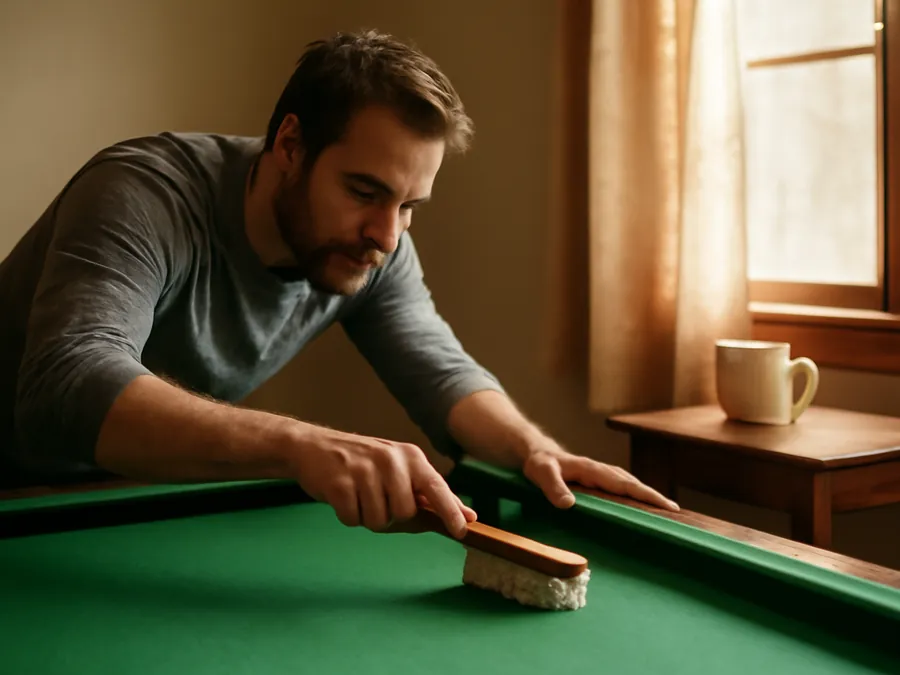
Recovering a slate table with tournament clothCombed worsted wool cloth from Simonis, sold pre-cut with rails for an 8-foot table. Simonis lists it as slightly slower than its 760 and built for consistent speed and rebound. If a good used slate table comes with tired felt, this is the cloth that turns it into a table you'd want to practice on.
Check price on Amazon
Accuplay Worsted Fast Speed Pool Table Cloth, 8 ft
Worsted cloth on a tighter budgetPre-cut worsted cloth for an 8-foot table: a 54 by 102 inch bed piece plus six 6-inch rail strips, in a 70 percent wool, 30 percent polyamide blend at 21 ounces. A real step up from napped felt for less than premium cloth.
Check price on Amazon
Hathaway Deluxe Pool Table Accessories Kit
Everything you need on setup dayFour two-piece maple cues with a wall rack, a 2.25-inch regulation ball set, a wood triangle and a diamond 9-ball rack, a bridge stick, a rail brush, chalk and a vinyl cover with weighted corners. One box covers the first night of play, with a 180-day warranty.
Check price on AmazonFrequently asked questions
What should I look for when buying a pool table?
In order: a size that fits your room with full cue clearance, a one-inch three-piece slate bed, a solid wood frame, lively natural rubber cushions, worsted cloth and a price that includes delivery and professional installation.
How much room do I need for a pool table?
With standard 58-inch cues, Brunswick's minimums are 13 by 16 feet for a 7-foot table, 13 by 17 feet for an 8-foot table and 14 by 18 feet for a 9-foot table. Shorter 48 or 52-inch cues bring those numbers down by a foot or more.
Should I buy a 7-foot or 8-foot pool table?
Buy 8 feet if the room is at least about 13 by 17 feet; it is the common home size. Choose 7 feet for a smaller room or if you play in a bar league, since most league tables are 7 feet.
Is slate really better than MDF?
For a table you will keep, yes. Slate stays flat, can be releveled after a move and takes new cloth many times. MDF is lighter and cheaper but can warp with humidity, and a warped bed can't be fixed.
How thick should pool table slate be?
One inch. The WPA sets one inch as the minimum for tournament slate, and three equal pieces on a wood frame as the tournament standard. Thinner 3/4 inch slate is found on cheaper tables.
Is it worth buying a used pool table?
Often, if it is slate from a known maker and the slate is not cracked. Budget for professional moving, which HomeAdvisor puts at about $650 on average, and possibly new cloth at $250 to $450.
Do I need a professional for billiard table setup?
For a slate table, yes. The slate pieces have to be shimmed flush at the seams, leveled and covered with tightly stretched cloth. A general furniture assembler won't have the tools or the practice.
What kind of cloth should a pool table have?
Worsted wool cloth plays fastest and truest. The WPA standard is 80 to 85 percent combed worsted wool with nylon, nap-free. Napped felt is slower and wears faster, but it is fine for casual play and can be replaced later.
Related guides
LeaguePool is reader-supported. When you buy through links on this site we may earn an affiliate commission at no extra cost to you. As an Amazon Associate we earn from qualifying purchases.