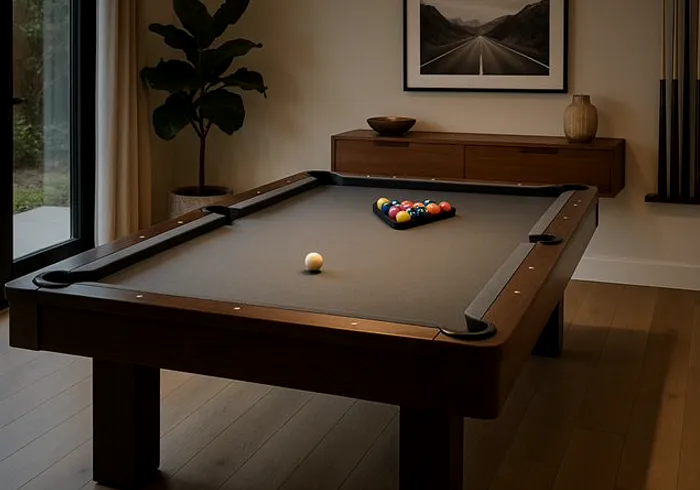
Pool Table Ball Return System: How It Works, How to Fix Jams
A pool table with ball return runs on gravity and nothing else. Each pocket drops the ball into a rubber or plastic funnel (the gully boot), the boot feeds a sloped track under the slate, and every track tilts toward one collection box at the foot of the table. No motor, no power cord, and on a home table no sorting at all: the cue ball goes to the same tray as everything else.
That simplicity is why a stuck ball almost always has a short list of causes. A cracked boot, a chalk cube on a track, a section knocked loose during a move, a lip of old glue under the slate. Find which pocket fails, and you have usually found the fix.
How a ball return system works
Follow one ball from the moment it drops:
- The ball falls through the pocket liner, which is shaped to turn it downward instead of letting it bounce around.
- It lands in the gully boot, a short rubber or plastic funnel under the pocket that points it at the track.
- The track (a wood or plastic trough, or a pair of coated steel wires on some tables) is set at a slight downhill angle. The ball rolls along it toward the center or the foot of the table.
- The six pocket tracks merge into one main channel that runs to the collection box, usually behind an opening in the foot apron.
- The ball rolls to a stop in the tray with the others, ready to rack.
A recent patent on gully tracks describes the same layout in engineering terms: each pocket gutter and the main return surface are both canted against gravity, so the ball never needs a push after it leaves the pocket (US 11,484,777). That patent exists because the gutters can shift slightly from thousands of ball impacts, which is also one of the reasons old tables start jamming.
Furniture-style home tables use the plain version above. Coin-op bar tables add two things: a locked storage area that holds the object balls until someone pays, and a cue ball separator.
The main types of return
| Type | Where you see it | What to know |
|---|---|---|
| Gully troughs (wood or molded plastic) | Most home tables with a return, bar boxes | Simple and easy to clean once you can reach them. Molded plastic chutes collect sticky residue and chalk. |
| Wire track | Brunswick Gold Crown and similar commercial-style tables | Coated steel wires carry the ball. Quick, but a ball that hits a wire off-center can bounce out, and the run can be loud. |
| Long side-rail return | Some home tables | Two long rails run under the cushions. More length means more places for a ball to stall. |
| Coin-op trap with separator | Bar tables from Valley, Diamond and others | Object balls queue behind a gate until coins release them. The cue ball is pulled off to its own exit. |
| Drop-down hybrid | A few dining-style tables | The channels sit in the frame rather than in a bulky belly, so the table keeps a slim look. |
The best-known Brunswick pool table ball return is the wire track on the Gold Crown. Brunswick builds the Gold Crown VII only as a gully return table, with no drop-pocket version, according to this Brunswick dealer listing.
How do pool tables know the cue ball?
On a home table it doesn't. The cue ball rolls into the box with the rest, and you reach in for it after a scratch. On a coin-op table the object balls are locked away, so the table has to recognize the cue ball and hand it back. Three methods are in use:
- By size: an oversized cue ball, about 2 3/8 inches against the regulation 2 1/4, can't pass a gauge that the object balls slip through, so it gets steered to a separate exit.
- By magnet: a cue ball with magnetic material inside is pulled against a magnet beside the track and diverted onto its own path. Current Valley Panther tables work this way with a cue ball the same size and weight as the object balls.
- By optical sensor: Diamond's Smart Table uses a switch, a laser density sensor and a small solenoid arm to spot a normal cue ball and push it off the track.
The full breakdown, including what happens to the cue ball when the storage area is full, is in our guide to how coin-operated pool tables work.
Why balls get stuck: symptom, cause, fix
Start with the symptom. It narrows things faster than taking the table apart.
| What you see | Most likely cause | Fix |
|---|---|---|
| Balls from one pocket never arrive | Something lodged in that boot or track: chalk cube, coin, bottle cap, a kid's toy | Reach up through the pocket or from underneath, or use a grabber or magnetic pickup |
| Balls sit in the pocket and won't drop | Gully boot sagged, cracked or torn | Replace the boots (do all six) |
| Corner pockets hang up, sides are fine | Old glue built up under the slate at the pocket cut, catching the ball | Scrape the old glue clean when the cloth is off |
| Balls stop partway down the table | A track section shifted, a support sagged, or the table is out of level | Reseat and screw the track, then check level along the length |
| Balls arrive slowly, then a jam after a few games | Sticky lanes from spilled drinks, plus chalk dust | Vacuum and wipe the tracks with a damp cloth, let them dry |
| Balls bounce out of the pocket or off the track onto the floor | Ball hitting a wire or a misaligned track off-center | Realign the track under the pocket, or pad the impact point |
| Cue ball vanishes on a coin-op | Wrong cue ball for the separator | Match the cue ball to the table (size or magnetic) |
The glue problem surprises people. When a table is recovered, the glue used on the slate around the pockets can leave a ridge where the ball drops, and that ridge is just enough to stop a ball rolling under the slate edge. It shows up after a refelt, and it shows up in the corners first.
Ball quality matters too. Lightweight or undersized sets have less momentum on a long track run. Regulation balls are 2 1/4 inches and weigh 5 1/2 to 6 ounces under the WPA equipment specifications; our ball size and weight guide has the details.
How to find and clear a jam
- Roll one ball into each pocket by hand, one pocket at a time, and listen. A ball that stops makes a different sound than one that rolls home, and you'll know which pocket is the problem within a minute.
- Look up into that pocket with a flashlight. Most jams sit in the boot or the first foot of track.
- Get under the table. On most home tables the tracks are visible from below, and you can reach the stuck ball or object with your hand or a grabber.
- If the jam is out of reach, try air before tools. Plug the other pockets with rags and use a shop vac on blow (or suction) at the problem pocket.
- Don't jab at it with a cue. A bent wire or a cracked plastic chute turns a ten-minute job into a parts order.
- Clear it, then test all six pockets again. One jam often means debris has spread along the track.
How to disassemble a pool table with a ball return
When nothing is reachable from below, the slate has to come up. That's a job for at least two or three people, because slate runs to hundreds of pounds (see how much a pool table weighs). The order on a return table is: take out the ball return tray or collection box, remove the rails, pull the cloth staples if the slate will come fully off, then lift the slate with helpers on every corner. Our disassembly guide walks through the order. Coin-op tables are easier: the front access door opens to the ball storage area and the separator, and the slate only comes off for boot replacement or deep cleaning.
Ball return replacement: boots, tracks and liners
Most repairs are one of three parts.
Gully boots
The most common replacement by far. Rubber dries and cracks with age, and a sagging boot holds the ball instead of passing it on. Boots come in sets of six, and replacing all six together makes sense because they age at the same rate. Boots for bar boxes are close to generic (Valley and Dynamo tables share a common style), but home tables vary, so measure the old boot or match it to the table's make before ordering. Lift the slate for the easiest access, and vacuum the tracks while it's off.
Pocket liners
Liners and boots are different parts. The liner is the visible pocket lining at the top; the boot sits under it. The WPA spec asks that both be made of plastic, rubber or leather that won't stain the balls, and that the liner turn a ball downward when it hits the wall. A cracked liner can kick balls back out, so check them while you're in there.
Tracks and wires
A broken track section or a missing wire is usually a parts-house item matched to the table's make and model. Plain wood or plastic troughs can be rebuilt by a handy owner; wire returns on tables like the Gold Crown are better repaired with original-style parts. If the wire track is loud, some mechanics sleeve it in rubber tubing to quiet it down.
Balls bouncing back out: rebound at the pocket
A ball that drops and then pops back onto the cloth, or off the table, is a rebound problem at the pocket. The WPA equipment spec says ball returns must be installed so pocketed balls are not "trampolined" back to the table or off it. On a return table the usual culprits are a hard, cracked liner, a missing or shrunken boot (the ball hits the bare frame), or a track that isn't centered under the pocket so the ball strikes the edge of a wire. Fresh boots and a realigned track cure most of it. If you meant rebound off the rails, that's the cushion rubber; see cushion replacement for dead or overly bouncy rails.
Maintenance that prevents most jams
- Keep chalk off the rails. A cube left on a rail ends up in a pocket sooner or later.
- Vacuum the tracks whenever the slate or rails are off, and at least wipe the collection box a few times a year. A low-suction table vacuum with a crevice tool reaches into most boots.
- Check level after a move. A table that's off along its length can slow balls on one side.
- Replace boots before they fail. If the rubber feels hard or shows surface cracks, it's close.
- Use regulation balls. Cheap undersized sets are a frequent reason a long track stalls.
Some newer coin-op designs build a "chalk relief" into the ball collector so chalk falls out of the path instead of piling up, which tells you how often chalk is the villain.
Pool table balls on a return table: how many and how to set them up
A standard set of pool table balls is 16: one white cue ball and 15 numbered object balls, solids 1 through 8 and stripes 9 through 15. A return table swallows all of them into one tray, so after each game you pull them out at the foot end and rack right there.
For 8-ball, the WPA rules set the balls up this way:
- Put all 15 object balls in the triangle, packed tight.
- Place the front (apex) ball on the foot spot.
- Put the 8-ball in the middle of the third row, the first ball directly below the apex ball.
- Put one solid and one stripe in the two back corners.
- Fill the rest in any order, with no deliberate pattern.
9-ball uses a diamond with the 1-ball in front and the 9 in the middle. Our racking guide covers every game and how to get a tight rack.
Clean balls matter more on a return table than on a drop-pocket one. Every ball rolls through the same tracks, so chalk and grime picked up on the cloth get dragged through the channels, and dirty balls leave residue that slows the run. The WPA spec says balls should be cleaned with a dry cloth or soap and water, never waxed or polished. See how to clean pool balls for the method, and if you're buying a new set, our best pool balls guide compares the regulation sets worth having.
Ball return vs drop pockets
If you're shopping, the honest answer is that drop pockets suit most homes and ball returns suit people who practice alone a lot.
| Ball return | Drop pockets | |
|---|---|---|
| Racking | All balls in one tray at the foot | Walk to six pockets |
| Noise | Rolling rumble, louder on wire tracks | A soft thud |
| Jams and repairs | Possible, and harder to work on | Nothing to jam |
| Counting balls (one-pocket, straight pool) | Harder, balls disappear | Easy, balls stay where they fell |
| Cloth wear | Break end is fixed by the tray | You can rotate which end you break from |
| Cabinet | Bulkier belly | Slimmer, which suits dining tables |
| Capacity | Unlimited | The WPA spec requires at least 6 balls per pocket |
A Maryland table service put it plainly on its blog: return tables work great, and they are much harder to work on. If you play one-pocket or straight pool, drop pockets make the game easier to follow. If you run drills for an hour at a time, a return saves a lot of bending.
Should you convert a broken return to drop pockets?
On an old furniture table with chewed tracks or missing sections, yes, it's often the better repair. A set of six drop pockets removes every part that can jam, and some models were sold both ways from the factory (Brunswick offered the Gold Crown IV with either). Castings differ, though, so measure your pocket openings and the mounting style before ordering. You give up the single collection point. You never fish for a stuck ball again.
Coin-op tables are the exception. The return, the storage gate and the separator are the whole design, so fix those instead of converting.
Sources
- WPA Recommended Equipment Specifications (pocket liners and boots, ball returns, drop pocket capacity, ball size and weight)
- WPA Rules of Play, 2026 (8-ball and 9-ball racks)
- US Patent 11,484,777, wedge for billiards gully track
- US Patent 4,726,586, pool ball return control apparatus (coin-op gate and magnetic cue ball)
- Diamond Billiards R9 Bird House (optical cue ball separator)
- Valley Panther ZD-11 specifications (magnetic separator, ball collector)
- Baltimore Billiards: leather pockets, plastic pockets or a ball return
Our picks
Links open the current selection and price on Amazon so you can compare real reviews before buying.
Sterling Small Gully Boots, Set of 6
The most common repairSagging, cracked boots cause more stuck balls than anything else, and they all age together. A full set of six means one trip under the table instead of six. Compare them with your old boots before ordering, since boot sizes vary between tables.
Check price on Amazon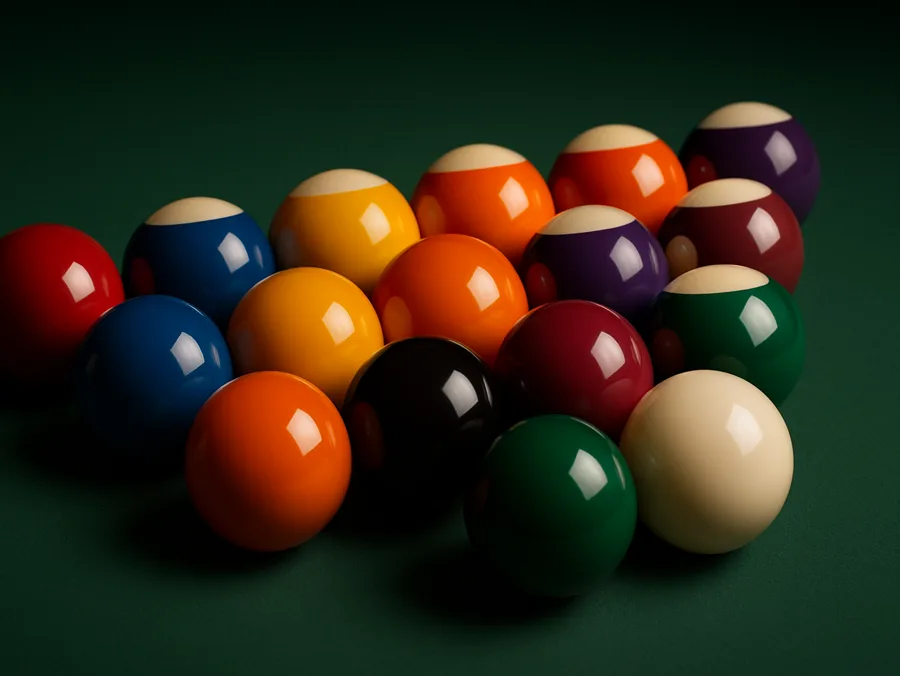
Aramith Regulation Ball Set
Balls that roll all the way homeRegulation 2 1/4 inch phenolic balls carry proper momentum through long track runs, which lightweight bargain sets often don't. If your table stalls balls halfway, try a real set before you rebuild the tracks.
Check price on Amazon
Aramith Magnetic Cue Ball, 2-1/4 Inch
Coin-op tables with a magnetic separatorRegulation size with magnetic material inside, so a magnetic separator can pull it off the track and send it back after a scratch. A plain cue ball on one of these tables goes into storage with the object balls.
Amazon price: $32.24 as of 10:58 AM EDT. Price and availability can change; Amazon’s price at purchase applies.
Check price on Amazon
Billiard Depot Leather Drop Pockets, Set of 6
Retiring a broken returnSix drop pockets turn a jam-prone return table into one with nothing left to break. Measure your pocket openings and mounting before ordering, since iron sizes vary by maker.
Check price on AmazonFrequently asked questions
How does a pool table ball return work?
Each pocket drops the ball into a gully boot that feeds a sloped track under the slate. The tracks all run downhill to one collection box at the foot of the table, so gravity alone brings every ball back. There is no motor or power.
Why do balls keep getting stuck in my pool table?
The usual causes are worn or collapsed gully boots, debris such as chalk cubes on a track, a track section that shifted during a move, and old glue under the slate at the pocket cut. Roll a ball into each pocket separately to find which one fails.
How does the cue ball return on a pool table?
On a home table it rolls into the same tray as the object balls. On a coin-op table a separator recognizes it by size (an oversized cue ball), by a magnet (a magnetic cue ball) or by an optical sensor, and sends it to its own opening.
Can I replace a pool table ball return myself?
Gully boots and track cleaning are a reasonable DIY job, though lifting the slate takes two or three people. Broken wire tracks or missing sections are better sourced as original-style parts for your table's make, or the table can be converted to drop pockets.
How many balls are on a pool table?
A standard set has 16 balls: one white cue ball and 15 numbered object balls (solids 1 to 8, stripes 9 to 15). On a ball return table all 16 collect in the tray at the foot end after they are pocketed.
Do ball return tables need electricity?
Home ball returns never do. Some modern coin-op tables plug in for bill acceptors, lighting or an optical cue ball separator, but magnetic and oversized-ball separators are purely mechanical.
Why do balls bounce back out of the pocket?
A hard or cracked pocket liner, a missing gully boot, or a track that isn't centered under the pocket lets the ball rebound. The WPA equipment spec says returns should be installed so balls are not trampolined back onto or off the table.
Is a ball return or drop pockets better for a home table?
Drop pockets are quieter and never jam, which suits most homes. A ball return is worth it if you practice alone a lot and want every ball at one end for racking.
Related guides
LeaguePool is reader-supported. When you buy through links on this site we may earn an affiliate commission at no extra cost to you. As an Amazon Associate we earn from qualifying purchases.