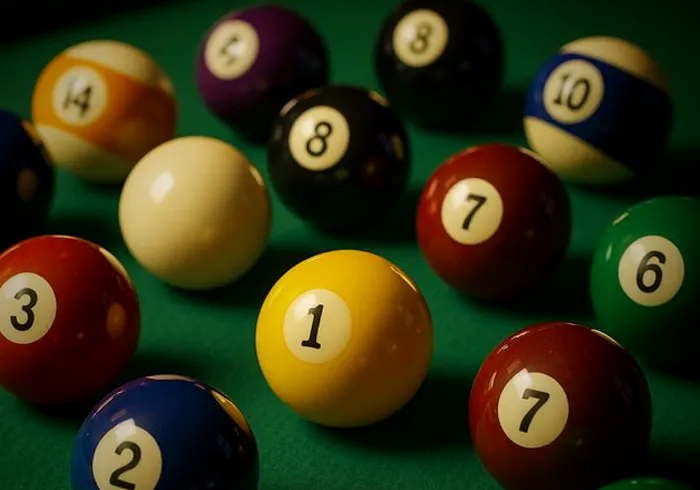
Pool Ball Size and Weight: Regulation Specs by Game
A regulation pool ball is 2 1/4 inches (57.15 mm) in diameter and weighs 5 1/2 to 6 ounces (156 to 170 grams). Those numbers come from the World Pool-Billiard Association's equipment specifications, and they apply to all sixteen balls, cue ball included.
Other cue sports use other sizes. Snooker balls are 52.5 mm, British (UK) pub pool balls are 2 inches, and carom balls run 61 to 61.5 mm and over 200 grams. Below are the official numbers for each game with their sources, what else the WPA rule says about balls, why bar cue balls differ, and how to check your own set with a ruler and a kitchen scale.
Pool ball size and weight at a glance
| Measurement | US units | Metric |
|---|---|---|
| Diameter | 2 1/4 in | 57.15 mm (Aramith rounds to 57.2 mm) |
| Diameter tolerance (WPA) | .005 in | 0.127 mm |
| Radius | 1 1/8 in | 28.6 mm |
| Circumference | about 7.07 in | about 180 mm |
| Weight per ball | 5 1/2 to 6 oz (0.34 to 0.375 lb) | 156 to 170 g |
| Balls in a set | 16: a white cue ball and 15 numbered object balls | |
| Weight of a full set | about 5 1/2 to 6 lb | about 2.5 to 2.7 kg |
| Material (WPA) | Cast phenolic resin | |
Diameter, tolerance, weight and material are the WPA's numbers. Radius, circumference and set weight are simple math from them (sixteen balls at 5 1/2 to 6 ounces is 88 to 96 ounces). A ball rack, bag or case built for 2 1/4 inch balls fits every regulation set.
What the WPA specification actually says
Section 16 of the WPA's Recommended Equipment Specifications is short, and most people only quote the first line. The whole rule covers more:
- All balls must be cast phenolic resin, 2 1/4 inches in diameter within .005 inch, and 5 1/2 to 6 ounces.
- Balls should not be polished or waxed. They can be wiped with a clean towel or washed with soap and water, and balls with wax or polish on them get cleaned with a cloth dampened with diluted alcohol before play.
- A set is one white cue ball and fifteen object balls numbered 1 to 15, each number printed twice on opposite sides (one upside down) in black on a white circle. The 6 and 9 are underlined so nobody mixes them up.
- The colors are fixed: 1 yellow, 2 blue, 3 red, 4 purple, 5 orange, 6 green, 7 maroon, 8 black, with 9 to 15 as white balls carrying a band of the same colors in the same order.
- The recommended rack is a wooden triangle. The WPA advises against plastic racks because they flex and make a tight rack hard to get.
Two caveats. The spec is written for WPA championships and sanctioned events, and the WPA says it doesn't necessarily apply to tables made for home use. And the printed tolerance in the PDF reads "(+.005)"; it's commonly quoted as plus or minus .005 inch, which is how we read it. Color charts and the TV color variations are on our pool balls guide.
How close good sets really come
The rule allows a .005 inch spread. Aramith, which claims more than 85 percent of the world market, publishes tighter targets for its own production: diameter within 0.003 inch, roundness within 0.002 inch (0.0012 inch on its top grades), and density held to plus or minus 0.015 depending on the resin. Aramith doesn't publish a weight tolerance for its pool sets, only that weight is one of the eight things it checks on every set.
Budget sets usually list "2 1/4 inch, 6 oz, regulation" and nothing else. That isn't proof they're off, but it means the only way to know is to measure them yourself (see below). The material story behind the tolerances is in what pool balls are made of.
Billiard ball sizes for every cue sport
"Billiard balls" covers several games, and each governing body sets its own numbers. These are from the official rulebooks, with Aramith's catalog for games without one.
| Game | Diameter | Weight rule | Source |
|---|---|---|---|
| Pool (American, 8-ball, 9-ball) | 2 1/4 in (57.15 mm) | 5 1/2 to 6 oz (156 to 170 g) | WPA |
| UK pool (British blackball) | Object balls 2 in (50.8 mm); cue ball 1 7/8 in (47.6 mm) | Object balls 116 g, cue ball 94 g, each within 2 g | WEPF |
| Snooker | 52.5 mm, within 0.05 mm | No set weight; heaviest and lightest ball in a set within 3 g | WPBSA |
| English billiards | 52.5 mm, within 0.05 mm | Balls within 0.5 g of each other | WPBSA |
| Carom (three-cushion) | 61 to 61.5 mm | 205 to 220 g, within 2 g of each other | UMB |
| Russian pyramid | 67 or 68 mm | Not published | Aramith sets |
| Bumper pool | 2 1/8 in | Not published | Aramith sets |
Two things jump out. British pool is the only game here where the cue ball is meant to be smaller than the object balls. And a carom ball is roughly 30 percent heavier than a pool ball. The games themselves are compared in pool vs billiards vs snooker; for British pool, see blackball rules.
Is the cue ball the same size as the other balls?
On a regulation set, yes. The WPA's numbers apply to every ball, and a matched set comes with a cue ball of the same size and weight, in the same resin. Aramith sells its plain cue ball in sizes from 1 7/8 inch (47.6 mm) up to 61.5 mm, so a replacement should match your set's diameter, not just say "cue ball".
Bar tables are the exception. A coin-op table has to pick the cue ball out of the return track after a scratch, and it does it one of three ways: a slightly oversized cue ball (about 2 3/8 inches), a regulation-size cue ball with magnetic material inside, or an optical sensor. The oversized ball is the one that feels heavy and makes draw shots harder. Our coin operated pool tables guide explains each system and which cue ball your table needs.
Why matched size and weight matter at the table
Hit a ball dead full with a stun stroke, and when both balls weigh the same the cue ball stops on the spot and the object ball takes nearly all the speed. That's the stop shot, and it's the reason the rules care about weight. Make the cue ball heavier and it keeps drifting forward after contact; make it lighter and it bounces back. Every position shot you play leans on that.
Size matters for the cushions too: the WPA sets the cushion nose at 62.5 to 64.5 percent of the ball's diameter above the bed, so the rails are built around one ball size. And it matters for racking. Balls of slightly different diameters can't all freeze against each other in a rack, and gaps in the rack spread the break unevenly. If you fight to get a tight rack with a good template or triangle, a worn ball is a likely culprit; how to rack pool balls has the rest of that checklist.
Balls for small tables and bumper pool
Not every table takes 2 1/4 inch balls. Aramith's Premier set is made in five sizes for this reason: 1 7/8 in (48 mm), 2 in (50.8 mm), 2 1/16 in (52.4 mm), 2 1/8 in (54 mm) and 2 1/4 in (57.2 mm). Small novelty and kids' tables often take one of the smaller sizes, and bumper pool tables use 2 1/8 inch balls.
Before you order, check the table's manual or measure one of the balls it came with. A set in the wrong size won't match the table's pockets and cushions. More on small tables in best mini pool tables and bumper pool.
How to check your own balls
- Measure each ball with calipers in two or three directions. A regulation ball reads 2.245 to 2.255 inches (57.0 to 57.3 mm). A cheap plastic caliper is fine for this.
- Weigh each ball on a kitchen scale set to grams. Anything from 156 to 170 grams is inside the rule.
- Write the numbers down and compare. A spread of a few grams across the set matters more than the average, especially between the cue ball and the object balls.
- Roll each ball slowly along the rail with a gentle push. A ball that wobbles or veers when others roll straight is worn or out of round.
If the cue ball is the odd one out, replace just that ball with one from the same maker. If several object balls are off, it's time for a new set; Aramith pool balls compared and best replacement cue balls cover the choices.
Sources
- World Pool-Billiard Association: Recommended Equipment Specifications, section 16 (balls) and section 1 (scope)
- Aramith pool ball range (sizes by set) and Aramith cue balls
- Aramith general specifications (diameter and roundness tolerances)
- Aramith other games (Russian pyramid, bumper)
- WPBSA Official Rules of Snooker and English Billiards
- UMB World Rules of Carom Billiard, article 12
- World Eight-ball Pool Federation byelaws, Annexe A (British pool balls)
Our picks
Links open the current selection and price on Amazon so you can compare real reviews before buying.

Aramith Premier Ball Set
A regulation set that measures upCast phenolic resin, the material the WPA spec calls for, at 2 1/4 inches with a matched cue ball. Aramith checks every set for diameter, roundness and weight among its eight criteria. The detail people miss: Premier is also the Aramith set made in smaller sizes if your table needs them.
Check price on Amazon
Aramith Premier 2 1/4 Inch Cue Ball
Replacing a worn cue ballA single 2 1/4 inch Aramith Premier cue ball, made in Belgium and checked against the same eight criteria as the sets. It is not magnetic, so it's for home tables, not coin-op bar tables.
Check price on Amazon
Aramith Blue Logo Regulation Cue Ball
A marked cue ball at regulation sizeA genuine Aramith cue ball at the regulation 2 1/4 inch size and weight, with a blue logo you can watch to see how the ball is spinning.
Check price on Amazon
Aramith Magnetic Cue Ball
Coin-op tables with a magnetic returnA phenolic Aramith cue ball for coin operated tables that sort the cue ball with a magnet. Check your table's system first: on a table that sorts by size, a regulation-size magnetic ball won't come back.
Amazon price: $32.24 as of 4:45 PM EDT. Price and availability can change; Amazon’s price at purchase applies.
Check price on AmazonFrequently asked questions
What size is a regulation pool ball?
2 1/4 inches (57.15 mm) in diameter, within .005 inch, according to the World Pool-Billiard Association's equipment specifications. The cue ball is the same size.
How much does a pool ball weigh?
5 1/2 to 6 ounces, which is 156 to 170 grams or about a third of a pound. The cue ball should weigh the same as the object balls.
How much does a full set of pool balls weigh?
About 5 1/2 to 6 pounds (2.5 to 2.7 kg) for the 16 balls, worked out from the WPA's 5 1/2 to 6 ounce range per ball. Add the box or case if you are shipping them.
How big is a pool ball in centimeters?
5.715 cm across. Aramith lists it as 57.2 mm.
Are billiard balls bigger than pool balls?
Carom billiard balls are. They measure 61 to 61.5 mm and weigh 205 to 220 grams under UMB rules, against 57.15 mm and 156 to 170 grams for pool. Snooker and English billiards balls are smaller, at 52.5 mm.
Why is the cue ball bigger on bar tables?
Some coin-op tables separate the cue ball from the object balls by size, so they use a cue ball about 2 3/8 inches across. Others use a regulation-size magnetic cue ball or an optical sensor instead.
What size balls does a 7 foot pool table use?
A standard 7 foot table uses regulation 2 1/4 inch balls, the same as 8 and 9 foot tables. Only small novelty, kids' and bumper pool tables use smaller balls, so check the manual or measure an existing ball.
Can I use snooker or British pool balls on an American table?
You can roll them, but they won't play right. Snooker balls are 52.5 mm and British pool balls 2 inches, both smaller than 2 1/4 inch pool balls. The WPA sets cushion height at 62.5 to 64.5 percent of the ball's diameter, so a smaller ball meets the cushion at the wrong point.
Related guides
LeaguePool is reader-supported. When you buy through links on this site we may earn an affiliate commission at no extra cost to you. As an Amazon Associate we earn from qualifying purchases.