How to Chalk a Pool Cue Properly (and How Often)
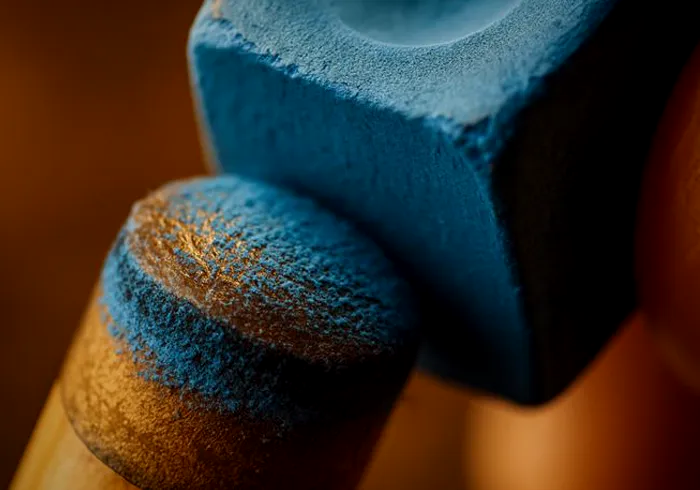
To chalk a pool cue properly, hold the cue just below the ferrule with the tip angled up and away from the table, then brush the cube across the tip in light strokes while you turn the cue a little at a time. Stop when the whole tip, edges included, has an even coat with no bare leather showing. It takes about three seconds, and you do it before every shot.
Watch casual players and you'll see the opposite: cue jammed into the cube and twisted like a pepper grinder until there's a hole bored through the middle. It feels thorough. It coats only the center of the tip, smears chalk on the ferrule and wears the tip unevenly, and the miscues it causes get blamed on everything else.
How to chalk a pool cue, step by step
- Step back from the table. Chalk dust that falls on the cloth gets ground into it and onto the balls.
- Hold the cue with your free hand just below the ferrule, tip pointing up at a slight angle.
- Hold the cube at a slight angle too, so its face meets the tip at a glancing angle rather than head on.
- Brush the chalk across the tip in two or three light strokes. Think of painting a small surface, not sanding it.
- Turn the cue a quarter turn and brush again. Repeat until you've gone all the way around.
- Look at the tip. It should be evenly colored from the crown to the edges, with no shiny leather and no blue on the white ferrule.
- Set the cube down color side up, or back in your holder.
Billiards Digest's version of this is the same: brush gently, don't chalk side to side, don't spin the tip in the chalk, and keep your eyes on the tip so you can see the whole surface take the chalk. The line PoolDawg's academy credits to Minnesota Fats says it more memorably: chalk your tip the way you'd put on lipstick.
What does chalk on a pool cue do?
It gives the tip enough friction to grip the cue ball when you hit off center, so the tip doesn't slip off and miscue. Spin of any kind depends on it. For what chalk is made of, how brands differ and which to buy, see our best pool chalk guide.
Brush, don't grind
Grinding is the habit worth breaking first, and three separate sources say why. Predator's advice on its chalk page is to brush the chalk across the tip, because grinding the tip into the cube wears the tip unevenly. PoolDawg's academy warns that drilling a hole puts chalk only on the very center of the tip and all over the ferrule. And Billiards Digest points out that a blue ring around your ferrule is the sign you aren't chalking properly.
Your cube tells on you too. A cube worn into a shallow, even dish across its face belongs to someone who brushes. A deep round crater belongs to a grinder, and once that hole forms, every chalking coats the same small circle in the middle of the tip no matter how long you twist. If your cube has a crater, start on a fresh face or edge.
Brushing also wastes less chalk, since the cube wears down evenly across its face instead of in one deep hole.
Cover the edges, not just the crown
On a center-ball hit, the tip meets the cue ball near the crown. Draw moves the contact low on the tip, follow moves it high, and side spin moves it toward the edge. Those off-center contacts are exactly where miscues happen, so the edges are the part of the tip that most needs chalk.
That's why the turning matters. A player who brushes straight across without rotating the cue coats a stripe and leaves two bare crescents. Glance at the tip after you chalk: if you can see bare leather anywhere a spin shot might land, give it another stroke.
How often should you chalk your cue?
Before every shot. Chalk transfers to the cue ball each time you hit it, so the coat is thinner after every stroke whether you can see it or not. In Dr. Dave Alciatore's tests at Colorado State, one chalking lasted about 5 to 8 shots with heavy spin before a miscue for most chalks: 8 for Master in one set, about 5 for Taom on a hard tip. That's under hard conditions, but it shows why waiting until you "need" it doesn't work.
| Situation | Chalk first? |
|---|---|
| Any shot with draw, follow or side spin | Always. These are the shots that miscue. |
| Soft center-ball shot | Yes, out of habit. It costs three seconds and keeps the routine the same. |
| The break | Yes. A miscue on the break wastes your most powerful stroke of the rack. |
| Casual game with friends | At least every other shot, and before every spin shot. |
| Using Kamui 0.98 | It holds longer (about twice Master's shots in testing), but it marks the cue ball more. Chalk every shot anyway and wipe the ball. |
| Using Taom | Every shot. Taom's advantage is a clean cue ball, not a longer-lasting coat. |
Predator's own guidance is slightly looser: chalk before most shots and always before shots with spin or draw. We'd go all the way to every shot. Making it part of your pre-shot routine means you never have to decide.
Chalk on the cue ball
Some chalk always leaves the tip on contact, and chalk marks on the cue ball cause skids (also called kicks): the cue ball grabs the object ball and throws it off line. Dr. Dave's advice is to wipe the cue ball whenever you have ball in hand and before every break. That small habit matters more than which chalk you use. If you own a table and want less on the ball and cloth to begin with, the low-residue chalks are compared in our premium chalk comparison.
Common chalking mistakes
| Mistake | What goes wrong | Do this instead |
|---|---|---|
| Drilling or twisting the tip into the cube | Only the center of the tip gets chalk; the ferrule gets a blue ring; the tip wears unevenly | Brush across the tip while turning the cue |
| Chalking over the table | Dust and crumbs land on the cloth and balls | Step back and chalk over the floor |
| Blowing on the tip | Moisture from your breath makes the chalk cakey | Leave it; a light coat doesn't need clearing |
| Tapping the cue on the rail or floor to knock dust off | Spreads dust and risks dinging the cue | Apply less chalk in the first place |
| Slamming the cube down or setting it face down | Cracks the cube and prints a blue ring on the rail | Set it down gently, color side up |
| Using a damp cube | "Dead chalk" cakes instead of coating and leads to miscues | Store chalk somewhere cool and dry; replace a cube that's gone bad |
| Rubbing a white talc cone on the tip | Talc is hand chalk; it adds no grip | Use cube chalk on the tip, talc on your bridge hand only |
The last one is more common than you'd think, because the Silver Cup cone shows up next to cue chalk in shop listings. It's for a sweaty bridge hand; our pool hand chalk guide covers how to use it.
When chalk won't stick to your tip
If you brush carefully and part of the tip still looks shiny, the problem is the tip. Tips go smooth with play, and a slick tip won't take chalk. Billiards Digest's fix is to rough up the surface with 60-grade sandpaper or a scuffer so it has tiny pores to hold the chalk. A few light passes is enough; our guide to scuffing and shaping a cue tip covers the tools and the shape to keep.
A brand-new tip often needs the same treatment before it holds chalk well. See how to break in a new cue tip.
The cube can be the problem too. Billiards Digest notes that new chalk is often too hard and cakey, and a partly used piece works best. If a fresh cube seems to skate over the tip, a few strokes break in its surface. If it has gone hard from moisture, replace it.
Already have a blue ring on the ferrule from past grinding? Our cue cleaning guide shows how to take it off without harming the ferrule or shaft.
Chalk etiquette at the table
House chalk is shared, so put it back where the next player can find it, color side up. Don't pocket it. If you carry your own cube, a belt clip or pocket chalker keeps it from wandering off and keeps blue dust out of your pants pocket; our chalk holder guide sorts out which holder fits which chalk. And chalk away from the table even in a bar. Nobody who has to brush that cloth will thank you for chalking over it.
Sources
- The proper way to chalk your tip (Samm Diep, PoolDawg Academy)
- Cue maintenance (Billiards Digest)
- Predator billiard chalk (Predator's chalking advice)
- Does the brand of chalk really make a difference? (Dr. Dave Alciatore, shots per chalking and cue ball cleaning)
Our picks
Links open the current selection and price on Amazon so you can compare real reviews before buying.

Master Billiard Chalk, 12-Cube Box (Blue)
Everyday and league playTwelve cubes from Tweeten Fibre, the maker of the chalk every test uses as its baseline. A full box means you can retire a cratered cube the day it forms instead of fighting it all season.
Check price on Amazon
Taom Pyro Chalk (Blue)
Less chalk on the cue ballHandmade in Finland, and Taom chalk tested among the least likely to stick to the cue ball. You still chalk every shot, but less of it ends up on the ball and cloth, which means fewer skids. A good blue for tournament-blue cloth.
Check price on Amazon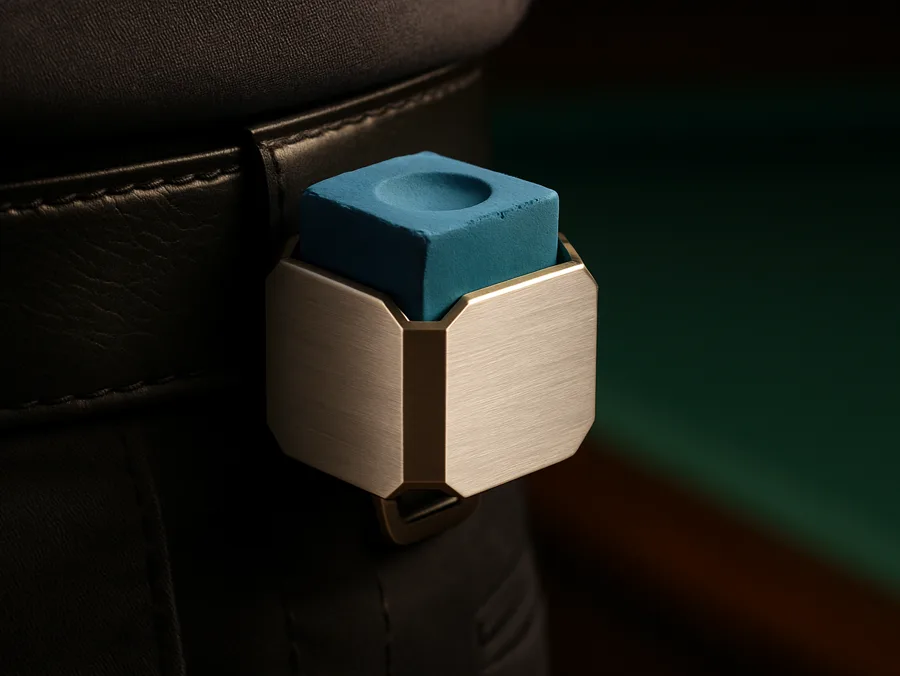
Octagon Pool Chalk Holder with Magnetic Belt Clip
Keeping your chalk with youA lightweight plastic holder (42 grams) on a magnetic belt clip, made for standard-size chalk. Your cube rides at your hip instead of on the rail, so it stays yours and never prints a ring on the wood.
Check price on AmazonFrequently asked questions
How often should you chalk your cue?
Before every shot, and never skip it before a shot with draw, follow or side spin. In controlled testing, one coat lasted only about 5 to 8 heavy-spin shots for most chalks.
How do you properly chalk a pool cue?
Hold the cue below the ferrule away from the table, brush the chalk across the tip in light strokes, turn the cue a quarter turn and repeat until the whole tip, edges included, is evenly covered.
Why is there a hole in the middle of my chalk?
That crater comes from twisting the tip into the cube. Once it forms, only the center of the tip gets chalk. Switch to brushing strokes and use a fresh face of the cube.
Why does my ferrule have a blue ring?
Drilling the tip into the chalk pushes chalk down onto the ferrule. Billiards Digest calls a chalk ring on the ferrule the sign of improper chalking. Brush across the tip instead and clean the ring off.
Should you chalk before the break?
Yes. A miscue on the break wastes the shot, and Dr. Dave also recommends wiping the cue ball before every break.
Do premium chalks need fewer applications?
Not most of them. Taom lasted about as long per chalking as Master in Dr. Dave's tests; its advantage is a cleaner cue ball. The soft original Kamui 0.98 does last longer, but it marks the cue ball more.
Can you put too much chalk on a cue?
A heavy, caked layer falls off onto the table and puts more chalk on the cue ball, which can cause skids. A light, even coat applied every shot works better than a thick one applied rarely.
Should you blow excess chalk off the tip?
No. PoolDawg's academy points out that the moisture in your breath makes chalk cakey. Brush on a light coat and there's nothing to blow off.
Related guides
LeaguePool is reader-supported. When you buy through links on this site we may earn an affiliate commission at no extra cost to you. As an Amazon Associate we earn from qualifying purchases.