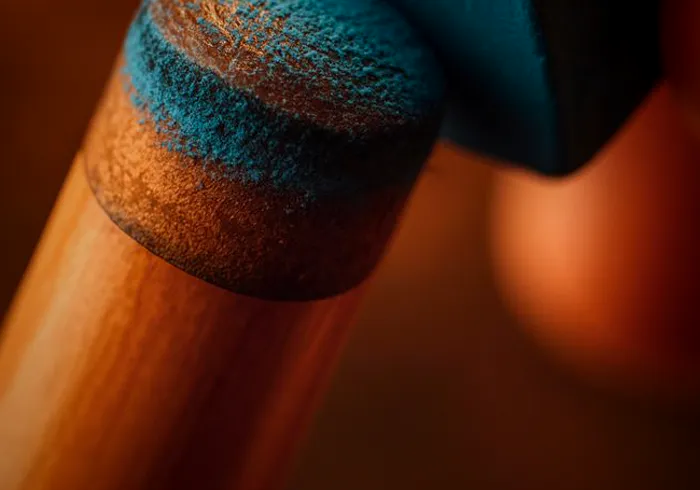
Best Pool Chalk: What Cue Chalk Does and Which to Buy
Pool chalk (also sold as billiards chalk or cue chalk) is a small cube of ground silica and corundum (aluminum oxide) held together with a dye and a binder. You brush it on the cue tip so the leather grips the cue ball instead of sliding off it when you hit off center. That slide is a miscue, and a fresh coat of chalk is what prevents it.
Which cube you buy matters less than the packaging suggests. In Dr. Dave Alciatore's controlled tests at Colorado State, no brand let a player hit farther from center than any other, as long as the tip was chalked. The brands do differ in how long one coat lasts and how much chalk ends up on the cue ball. Those two things are what you're really choosing between, and for most players the answer is a dollar cube of Master in the color of their cloth.
What pool chalk does
A leather cue tip and a polished cue ball are both smooth. Hit the ball dead center and that's fine, because the force goes straight through. Hit it off center to put draw, follow or side spin on it, and the tip has to grip the ball's surface for the instant they touch. Without enough friction the tip skates off the side. You hear a click and the cue ball squirts away weakly. That's a miscue.
Chalk fixes it with grit. The abrasive particles bond to the texture of the tip and bite into the cue ball's surface on contact. Every spin shot you've ever seen depends on it.
Two findings from Dr. Dave's chalk tests change how you should think about buying it:
- The maximum distance from center you can hit before miscuing didn't change from one brand to another. He concluded it depends on the tip and shaft, not on extra friction from fancier chalk.
- One coat doesn't last. With heavy spin, most chalks gave out after roughly 5 to 8 shots (Master lasted 8 in one set, Taom about 5 on a hard tip). Kamui and Blue Diamond held on longer, and Magic Chalk longest of all.
So the habit matters more than the label. Chalk before every shot and almost any real cue chalk does the job. Our how to chalk a pool cue guide covers the motion and the timing.
What chalk does not do is just as useful to know:
- It doesn't add power or speed. It only keeps the tip from sliding.
- It doesn't stretch your limits. Hit too far from center and you miscue on a freshly chalked tip too.
- It can't revive a tip that has gone slick and hard. That tip needs scuffing first.
- It isn't free. Some of every coat ends up on the cue ball and cloth, and those marks cause skids.
What is pool chalk made of?
Not the stuff in a classroom. Blackboard chalk is calcium carbonate. Cue chalk is crushed silica plus corundum (aluminum oxide, a hard abrasive), mixed with a dye and a binder and pressed into a cube. Each brand keeps its exact recipe to itself.
The modern version dates to 1897, when straight rail pro William A. Spinks and chemist William Hoskins patented it (U.S. patent 578,514). The dye started out green or blue-green to match billiard cloth, which is why those two colors still dominate.
One weakness carries over from the chemistry: moisture. High humidity makes chalk less effective, and PoolDawg's academy calls a damp, compromised cube "dead chalk" that leads to miscues. A cube stored in a wet basement or a sweaty pocket gets cakey instead of granular.
Best pool chalk by budget
Cue chalk falls into four rough price tiers. Prices below are from the makers' own shops on the day we checked; Amazon prices differ and move daily.
| Tier | Examples | Maker's price | What you get | Who should buy it |
|---|---|---|---|---|
| Standard cube | Master | About $1 a cube in a 12-box | Reliable grip, gritty feel, marks the cue ball and cloth more than premium chalk | Almost everyone, especially if you chalk every shot |
| Generic multi-pack | GoSports, EastPoint, Vibrantia | Similar to Master per cube | Basic cubes from importers; no independent testing we could find | Stocking a home table or game room |
| Mid-price | Predator 1080 | $9.95 for a five-piece tube | Medium-hard chalk with good grip; leaves marks on the cue ball that wipe off | League players who want a step up without boutique prices |
| Premium piece | Taom V10 and Pyro, Predator Pure, Kamui 0.98 and Roku | About $16 to $36 a piece | Either far less cue ball residue (Taom, Pure, Roku) or a longer-lasting coat (Kamui 0.98) | Table owners and weekly players bothered by skids |
Our picks, in plain terms:
- Best overall: Master. It's the chalk every test measures against, it's made in the USA by Tweeten Fibre, and the testing says you give up nothing in miscue protection if you chalk each shot.
- Best for a table you own: Taom V10. It was among the least likely chalks to stick to the cue ball, which means less blue grime ground into your cloth.
- Best for players who forget to rechalk: Kamui 0.98. One coat lasted about twice as many shots as Master, at the cost of more chalk on the cue ball.
- Best cheap upgrade: Predator 1080, five pieces for about the price of one boutique cube.
The full brand-by-brand data, including Kamui 1.21, Roku, Blue Diamond and Magic Chalk, is in our Kamui vs Taom vs Predator comparison. If you've settled on Taom and just need to choose a formula, see Taom Pyro vs V10 vs 2.0.
Does expensive chalk work better?
Not at the thing most people buy it for. Premium chalk won't let you hit farther from center. It earns its price in two other ways, and they pull in opposite directions.
The first is how long a coat lasts. Soft, creamy chalks like the original Kamui 0.98 stay on the tip longer, so a player who skips chalking now and then gets away with it more often. The second is how much chalk transfers to the cue ball. Chalk marks on the cue ball are what cause skids (also called kicks): the cue ball grabs the object ball, throws it off line, and a makeable shot rattles out. In Dr. Dave's tests, Kamui and Blue Diamond left clear marks on five of six hits, while Master left them on two. Taom, Kamui Roku and Predator Pure were the best of the lot at not sticking to the cue ball.
The practical upshot: if you already chalk every shot, a premium cube mostly buys cleanliness. That's worth real money on a home table, where chalk dust ends up in the cloth. On a bar box with house chalk and a grimy cue ball, it buys very little. Wiping the cue ball before each break and whenever you have ball in hand, as Dr. Dave recommends, does more against skids than any brand.
Types of pool chalk: soft, medium and hard
Beyond price, chalks differ mainly in hardness, and hardness decides the trade-off you live with:
| Type | Examples | Upside | Downside |
|---|---|---|---|
| Soft, creamy | Kamui 0.98, Predator Pure soft (light blue) | Coats heavily, so one application lasts longer | More chalk on the cue ball and cloth, more skids |
| Medium | Predator Pure medium (light teal), Predator 1080 (medium-hard) | Good grip, easy to apply | Needs chalking every shot |
| Hard, dry | Kamui 1.21, Predator Pure hard (light green) | Leaves less on the ball and cloth | Thinner coat, so rechalk each shot |
Wikipedia's billiard chalk article notes that most players consider harder, drier compounds better, and the cleanliness results in Dr. Dave's tests point the same way. Does the chalk you pick change how dirty your cloth gets? Yes. Predator says premium chalk leaves less residue on balls and cloth while cheaper chalk can build up, which is why table owners are the ones who get the most from a premium cube.
What pool chalk do professionals use?
There's no single answer. We found no pro tour that names an official chalk, and the makers' own pages are where pro names show up: Taom's V10 page calls it "the chalk of the pros" and names snooker champion John Higgins. Treat that as marketing, not a test result. What the controlled testing does say is that no brand lets anyone, pro or not, hit farther from center, so a pro's choice tells you about their taste in feel and cleanliness more than about grip.
What can I use instead of pool chalk?
Nothing that works well. Cue chalk does its job because of hard, abrasive grit (silica and aluminum oxide). The common stand-ins fail for clear reasons:
- Blackboard or sidewalk chalk is calcium carbonate, a much softer mineral, and it isn't made to grip a cue ball.
- Hand chalk (talc) does a different job: it helps the cue glide through your bridge hand. It isn't made to grip a ball.
- Going without chalk can get you through a center-ball shot, but any spin shot is a miscue waiting to happen.
If you're out of chalk, play center ball until you can borrow a cube. Every pool hall and bar with a table keeps house chalk on the rail, and a box of Master costs little enough to keep spares in your case.
Pool chalk colors and matching your cloth
Pick the color of your table cloth. Some chalk always lands on the cloth and the balls, and matching it hides the marks. The dye is there for looks; nothing we read ties a color to more grip, with one exception noted below.
| Cloth color | Chalk that blends in |
|---|---|
| Green | Master green, Taom V10 (green), Kamui Roku Forest |
| Tournament blue | Master blue, Taom Pyro or V10 Blue, Predator 1080, Kamui Sky |
| Red, burgundy or pink | Red generic cubes such as GoSports red, Taom Pyro Pink Edition |
| Black or charcoal | GoSports black, Predator Crest black |
| Gray, tan or other | Predator Crest gray or Kamui Roku Slate on gray; otherwise blue is the usual compromise |
The exception is Predator Pure, where the color tells you the hardness: light blue is soft, light teal is medium and light green is hard. Kamui's original 0.98 and 1.21 now come only in its Sky blue. For the cloth side of the choice, see our felt colors guide.
Cheap chalk multi-packs: what you're getting
The busiest pool chalk listings on Amazon are 12-cube boxes from GoSports and Vibrantia and six-cube sets from EastPoint. They're fine for a basement table where guests chalk with whatever is on the rail. We found no independent testing of any of them, so treat their "low dust" and "no miscue" bullets as advertising.
Two details worth knowing before you buy. EastPoint sells its cubes "pre-hollowed" to sit on a cue tip, which is a ready-made version of the crater that grinding digs. Brush across the face anyway, or you'll only ever coat the middle of the tip. And the Hathaway Silver Cup cone that shows up next to these listings isn't tip chalk at all. It's white talc for a sweaty bridge hand, covered in our pool hand chalk guide.
The top-selling Predator listing, titled just "Predator Cue Chalk," sells five pieces but doesn't say which Predator formula you get. Check the photos for the 1080 label or the octagonal Pure shape.
Is pool chalk toxic?
We couldn't find a published safety data sheet from Master, Predator, Kamui or Taom, so we can't give you a hazard rating. What's known is the ingredient list: ground silica and aluminum oxide with a dye and a binder. Treat it the way you'd treat any fine mineral dust. Don't blow it off the tip into the air, wash the blue off your hands before you eat, and keep loose cubes away from toddlers and pets who might chew them.
Making a cube last and work well
- Keep it dry. Damp chalk cakes on the tip instead of laying down a granular coat.
- Don't worry if a brand-new cube feels hard and slick. Billiards Digest notes that new chalk is often too hard and a partly used piece works best; a few strokes break the surface in.
- Brush it on, don't grind. Predator's own advice is to brush the chalk across the tip, because grinding the tip into the cube wears the tip unevenly.
- Set it down color side up so it doesn't print a ring on the rail.
- Give a good cube a home. Premium pieces chip and collect grit loose in a case pocket. Our chalk holder guide covers magnetic clips and pocket chalkers, and which ones fit which cube shape.
If chalk won't stick to part of your tip no matter how you apply it, the tip has gone slick. A few passes with a scuffer restores the texture; see how to scuff and shape a cue tip. Frequent miscues with a well-chalked tip usually point to hitting too far from center, which why your cue miscues walks through.
Where to buy pool chalk
Billiards retailers such as PoolDawg, Seybert's and Billiards.com stock everything from Master to Taom, Kamui, Predator, Blue Diamond, Lava and Magic Chalk. Predator, Kamui and Taom also sell direct from their own shops. Amazon carries all of the chalks on this page, and the cards below show live prices.
For premium chalk, buy from the maker, an established billiards shop or a reputable Amazon seller. Taom in particular gets counterfeited; our Taom guide lists the warning signs. For Master and generic packs, the risk is low, and a big-box store's sporting goods aisle works fine if it has your cloth color.
Sources
- Does the brand of chalk really make a difference? (Dr. Dave Alciatore, Colorado State, chalk test results)
- Billiard chalk (composition, 1897 patent, humidity)
- Predator billiard chalk (Pure, 1080 and Crest; colors, pack sizes, prices, chalking advice, residue)
- Kamui chalk range (Kamui)
- Taom V10 chalk (Taom, endorsement wording)
- Taom shop (current range and prices)
- Cue maintenance (Billiards Digest, on chalk condition)
- The proper way to chalk your tip (PoolDawg Academy, on storing chalk)
Our picks
Links open the current selection and price on Amazon so you can compare real reviews before buying.

Master Billiard Chalk, 12 Cubes (Green)
Best overall valueThe chalk every other brand gets measured against, made in the USA and sold in a protective 12-cube box. Master says it goes on smooth and even without caking, and it comes in a range of colors so you can match your cloth. Chalk every shot and you give up nothing in miscue protection.
Check price on Amazon
Predator Cue Chalk (5 pieces)
Cheap step up from MasterThe best-selling cue chalk on Amazon, five pieces to a pack. Predator promises longer on-tip chalk life and better coverage. The listing doesn't name the formula, so check the photos for the 1080 label if that's the one you want.
Check price on Amazon
Taom V10 Chalk (Green)
Table owners, cleanest playHandmade in Finland and rated by Taom for every tip from soft to hard. Taom chalk tested among the least likely to stick to the cue ball, which means fewer skids and much less blue grime in your cloth. Our pick if you're spending premium money.
Check price on Amazon
Kamui 0.98 Chalk (Sky)
Players who forget to rechalkThe soft original Kamui. One coat lasted nearly twice as many shots as Master in Dr. Dave's testing, so it forgives a skipped chalking. It also marks the cue ball more than most, so keep a towel handy and wipe the ball often.
Check price on Amazon
GoSports Pool Cue Chalk, 12 Pack
Red or black cloth, home tablesA 12-cube box in black, blue, red or green, so it covers the cloth colors Master's common colors miss. Basic chalk for a game room, with a storage box to keep the spares together. We found no independent testing, so judge it as a house chalk, not a performance pick.
Check price on AmazonFrequently asked questions
What does pool chalk do?
It adds friction between the cue tip and the cue ball. That grip lets you hit the ball off center for draw, follow and side spin without the tip sliding off, which is called a miscue.
What is pool chalk made of?
Crushed silica and corundum (aluminum oxide) mixed with a dye and a binder. It isn't the calcium carbonate chalk used on blackboards, and each brand keeps its exact recipe private.
What is the best pool chalk brand?
For most players, Master: cheap, and the benchmark in every test. For a home table, Taom V10 or Predator Pure, because they leave the least chalk on the cue ball and cloth. Kamui 0.98 suits players who don't chalk every shot.
Is expensive pool chalk worth it?
Only for cleanliness or chalk life. Controlled testing found no brand lets you hit farther from center. If you own a table or keep getting skids, a low-residue premium cube is worth it. If you chalk every shot on a bar table, Master does the job.
Does chalk color matter?
Not for grip. Match the color to your cloth so the marks on the table and balls are less visible. The one exception is Predator Pure, where the color shows the hardness.
How often should you chalk?
Before every shot is the safe habit, and always before any shot with spin. In testing, one coat lasted only about 5 to 8 heavy-spin shots for most chalks.
Is pool chalk toxic?
We found no published hazard rating from a cue chalk maker. It is ground silica and aluminum oxide with dye, so treat it like any fine mineral dust: don't blow it around, wash your hands before eating and keep cubes away from small children and pets.
Can you put pool chalk on your hands?
No. Tip chalk is abrasive and stains, so it makes the cue drag through your bridge instead of gliding. Use talc hand chalk or a glove; our hand chalk guide covers both.
How long does a cube of pool chalk last?
Nobody has published a measurement. A cube is done when it has a deep crater, has gone hard and cakey from moisture, or is too small to hold. Brushing instead of grinding wears it more evenly and makes it last longer.
What can I substitute for pool chalk?
Nothing works well. Cue chalk grips because of hard silica and aluminum oxide grit. Blackboard chalk is softer calcium carbonate, and hand talc is made to help the cue glide, not grip. Without real chalk, stick to center-ball shots.
What pool chalk do professionals use?
There is no single pro chalk, and we found no tour that names an official one. Makers name their own endorsers; Taom, for example, names John Higgins for its V10. Controlled testing found no brand lets anyone hit farther from center, so a pro's pick is about feel and cleanliness.
Does chalk choice affect how dirty the table cloth gets?
Yes. Soft chalks such as Kamui 0.98 transfer more to the cue ball and cloth, while low-residue chalks such as Taom, Kamui Roku and Predator Pure leave less. On a table you own, that difference shows up as less blue grime in the cloth.
Who invented pool chalk?
Straight rail pro William A. Spinks and chemist William Hoskins patented modern cue chalk in 1897 (U.S. patent 578,514).
Related guides
LeaguePool is reader-supported. When you buy through links on this site we may earn an affiliate commission at no extra cost to you. As an Amazon Associate we earn from qualifying purchases.