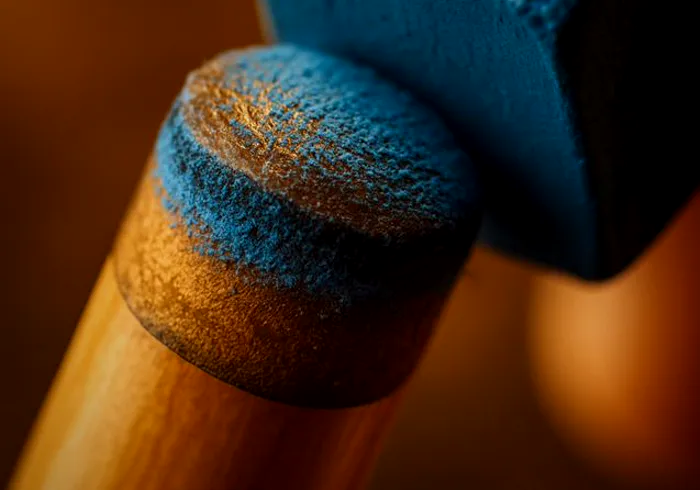
How to Scuff and Shape a Cue Tip
To shape a cue tip, put a dime- or nickel-radius shaper over the tip and turn the shaft slowly with light pressure until the dome is even and centered, checking against a coin as you go. To scuff it, brush a scuffer lightly across the crown until the shine is gone. Shaping is occasional work; scuffing is only for when chalk stops sticking.
The best cue tip shape is any dome curved enough that you never hit with the edge. On a standard 12.5 to 13mm tip, dime and nickel are both inside that limit, and the difference between them is smaller than most players think. What ruins tips is over-doing either job.
Scuffing and shaping are different jobs
| Shaping | Scuffing | |
|---|---|---|
| What it fixes | A flat or lopsided crown | A slick, glazed surface that won't hold chalk |
| Tool | Fixed-radius shaper, or sandpaper in a curved holder | Scuffer face, tapper or pick |
| Leather removed | Some, from the edges of the dome | A little (scuffer) to almost none (tapper) |
| How often | When the dome has visibly flattened | When chalk won't coat evenly |
| After | Burnish the sides, then scuff lightly | Chalk |
People treat both as routine and run a tool over the tip every session. That wears the tip out faster than playing does. Dr. Dave Alciatore's maintenance FAQ quotes the old rec.sport.billiard rule: "For maximal tip life, tap more, scuff less."
Dime vs nickel: the best cue tip shape
The coin names are real measurements. A dime is 17.91mm across, so a dime radius is about 9mm (.353 inch). A nickel radius is about 10.6mm (.418 inch). A quarter radius is about 12.1mm. Smaller radius means a rounder dome.
What matters is how the radius fits your tip's diameter. Dr. Dave's tip-shape FAQ sets the rule: the dome has to be round enough that the contact point never reaches the tip's square edge at the miscue limit, which works out to a radius smaller than the tip's width.
| Tip diameter | Flattest dome that works | Usual choice |
|---|---|---|
| 13mm (most house and maple cues) | About a quarter | Dime or nickel |
| 12 to 12.5mm (many carbon shafts) | About a nickel | Dime or nickel |
| 11.8mm and under | Rounder than a nickel | Dime |
| 9 to 10mm (snooker) | About a dime | Dime |
The same FAQ cites measurements showing that between a nickel and a dime dome, the contact point on the cue ball shifts by about 1/128 inch at a third of maximum side spin and under 1/32 inch at full side spin. That is close to nothing. So the "best" shape depends less on the coin than on keeping it.
If you want a default: dime on a playing cue. A rounder dome gives a little more spin for the same tip offset and more clearance on low draw shots. Go nickel if you mostly play center ball and stun and want a little more forgiveness on near-center hits. McDermott's tip-care post describes it the same way: nickel more forgiving, dime better at resisting miscues on far off-center hits, either fine for most players.
More on how diameter changes play in our tip size guide.
How to shape a cue tip with a shaper
- Trim any mushroomed leather flush with the ferrule first. Otherwise the shaper rides on the bulge and you get a lopsided dome.
- Hold the cue upright, tip up, and steady the shaft near the ferrule with one hand.
- Set the shaper's cup over the tip, square to the shaft. Don't press down. The weight of your hand is enough.
- Turn the shaft (not the tool) back and forth a quarter turn at a time, slowly working around the full circle. Most of the cutting happens at the shoulders of the dome, which is what you want.
- Stop every few turns, blow off the dust, and hold a dime or nickel against the tip edge-on. Light showing under the middle of the coin means the crown is still too flat; light at the sides means it's rounder than the coin.
- Look down at the tip from above. The high point of the dome should sit in the center. An off-center crown sends the cue ball sideways on center-ball hits.
- When it matches, burnish the sides with leather or a dollar bill, then scuff lightly and chalk.
A note from people who shape a lot of tips: shape the edges down, not the top. The top of a worn tip is usually still curved; it's the shoulders that flatten. Grinding straight down on the crown flattens it further.
Shaping with sandpaper
No shaper? Fine sandpaper works, with more care. Use 220 to 400 grit.
- Wrap a layer of masking tape around the ferrule so the sandpaper can't touch it.
- Hold a strip of sandpaper cupped in your palm, or wrapped around something curved such as a half-round file or the inside of a bottle cap.
- Stroke from the top of the tip down toward the ferrule only, never back up. Turn the shaft a quarter turn every few strokes.
- Check against a coin often. Sandpaper removes leather faster than a good shaper.
Laminated tips deserve the downward-only rule most. Some installers warn that stroking from the edge up toward the center can catch the edges of the layers, and the downward stroke costs you nothing.
How to scuff a pool cue tip
Scuff only when the tip tells you to: chalk won't coat it evenly, shiny spots show through fresh chalk, or you've just miscued and the tip has a slick skid mark. Then:
- Try a tapper or pick first. Press or roll it across the crown a few times. Don't twist a pick; PoolDawg's Bowtie instructions warn that twisting shortens tip life.
- If chalk still won't hold, brush a scuffer lightly across the crown, lifting at the end of each stroke. A few strokes, turning the shaft between them. You want an even matte texture, not grooves.
- Blow off the dust and chalk. The whole crown should take an even coat right away.
Sandpaper works as a scuffer too (400 grit, held flat and light) but it changes the shape as it goes, so use it last.
If scuffing doesn't bring chalk back, or the tip feels rock hard and clicks, it's time for a new tip. See how to replace a pool cue tip.
How often to scuff and shape
Less than you think. There's no fixed schedule that suits every tip, and the makers' own advice is loose: McDermott says to scuff every few games, while Dr. Dave's FAQ says a hard tip that is chalked properly, with minimal scuffing and shaping, can last several years.
| Sign | Do this |
|---|---|
| Chalk goes on evenly, tip looks round | Nothing. Chalk and play. |
| Shiny patches, chalk sliding off | Tap, then scuff if needed |
| Dome visibly flatter than your coin | Shape, burnish, light scuff |
| Leather bulging past the ferrule | Trim, burnish, check shape |
| Brand-new tip | Shape and scuff before the first rack (see breaking in a new tip) |
Players who keep reshaping should look at their chalking first. Experienced players on the AzBilliards forum blame most shape loss on grinding chalk onto the tip in a twisting motion. Brush it on instead; our chalking guide shows how.
Mistakes that shorten a tip's life
- Scuffing every session out of habit. Each pass removes leather.
- Pressing down hard on a shaper. Light pressure and more turns gives a cleaner, centered dome.
- Shaping before trimming a mushroom, which leaves the dome off center.
- Twisting a pick, or using a coarse scuffer on a layered tip.
- Letting sandpaper touch the ferrule. Tape it.
- Changing radius every few weeks. Pick dime or nickel and keep it, so the cue plays the same each night.
If you still miscue with a well-shaped, chalked tip, the cause is usually stroke or contact point, not the tip. Why your cue miscues goes through the list.
Tools for the job
A fixed-radius shaper with a scuffing side does nearly all of this. A tapper or pick and a leather burnisher round it out. We compare shapers, scuffers, picks, burnishers and the Cuetec Bowtie in best cue tip tools.
Sources
- Dr. Dave Alciatore: tip size and shape FAQ (radius rule, nickel vs dime measurements)
- Dr. Dave Alciatore: tip maintenance FAQ (tap more, scuff less)
- McDermott: cue maintenance, the tip
- Seyberts: tip tools (shaper radius specs)
- Wikipedia: US coin specifications
Our picks
Links open the current selection and price on Amazon so you can compare real reviews before buying.

Cue Cube 2-in-1 Tip Shaper and Scuffer
Setting the radiusA fixed-radius shaper on one side and a scuffer on the other, with silicon carbide on solid metal. Buy it in the radius you want to keep: nickel (.418) or the tighter dime.
Amazon price: $12.95 as of 4:27 PM EDT. Price and availability can change; Amazon’s price at purchase applies.
Check price on Amazon
CUEELF 5-in-1 Cue Tip Tool
Restoring chalk gripIts needle aerator is the gentle first step for a glazed tip, and the scuffer face is there when that isn't enough. Small enough to keep in the case.
Amazon price: $16.99 as of 4:21 PM EDT. Price and availability can change; Amazon’s price at purchase applies.
Check price on Amazon
Pagulayan Leather Cue Tip and Shaft Burnisher
Finishing the sidesAfter shaping, a few turns against leather smooth and compress the tip wall so it doesn't spread. Works on a wood shaft too.
Check price on AmazonFrequently asked questions
How do you shape a cue tip?
Trim any mushroom first, then set a dime- or nickel-radius shaper on the tip and turn the shaft slowly with light pressure, checking against a coin until the dome matches and the high point is centered. Burnish the sides, scuff lightly and chalk.
What is the best cue tip shape?
A centered dome with a radius smaller than the tip's width. On 12.5 to 13mm tips, dime and nickel both qualify; dime is the usual choice for players who use spin and nickel is a little more forgiving near center ball.
Should I use a dime or nickel radius?
Either works on a standard tip. Measurements cited by Dr. Dave Alciatore show the contact point differs by less than 1/32 inch between them even at maximum side spin. Use dime on tips under about 12mm.
How do I scuff a pool cue tip?
Try a tapper or pick first, pressed or rolled, not twisted. If chalk still won't stick, brush a scuffer lightly across the crown a few times, lifting at the end of each stroke, until the shine is gone. Then chalk.
How often should I scuff my tip?
Only when chalk stops coating it evenly. For some players that's every few games; others with good chalking habits go months. Each scuff removes leather.
Can I shape a tip with sandpaper?
Yes. Tape the ferrule, use 220 to 400 grit cupped in your palm, stroke from the top down toward the ferrule only, and turn the shaft as you go. Check against a coin often.
Why does my tip keep going flat?
Usually chalking by grinding or twisting the cube on the tip, or over-scuffing. Brush chalk on and scuff only when needed. Soft tips also compress more than medium or hard ones.
Related guides
LeaguePool is reader-supported. When you buy through links on this site we may earn an affiliate commission at no extra cost to you. As an Amazon Associate we earn from qualifying purchases.