Pool Cue Ferrules: Materials, Cracks and Repair
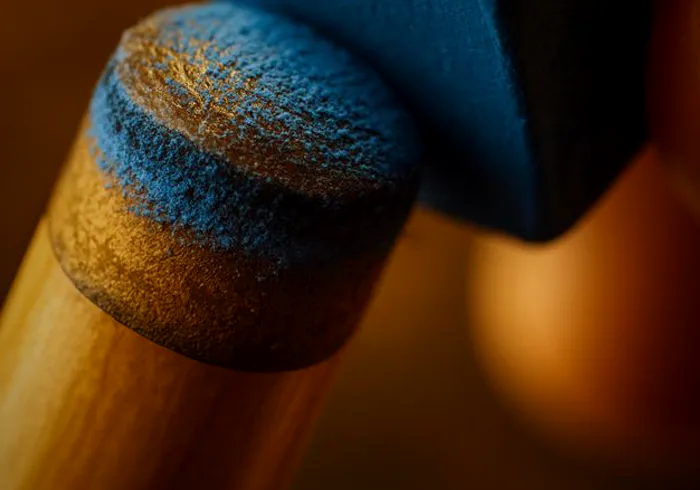
A cue ferrule is the short white (sometimes black) collar between the tip and the wood of the shaft. It caps the end grain so the shaft doesn't split, gives the tip a hard flat face to glue to, and, because it's the heaviest thing at the very front of the cue, it has a real say in how much the cue ball squirts when you use English.
Most players never think about it until it cracks. When it does, a cue shop replaces it for about $40 to $50 plus a new tip. Below: what ferrules are made of, how threaded and capped ferrules differ, how length and weight change the hit, how to tell a crack from a scratch, and what the replacement job involves.
What the ferrule on a pool cue is
Look at the top of your shaft. The tip is the leather on the end; the ferrule is the solid collar right below it, typically around an inch long, and the wood starts below that. On most wood shafts the ferrule sits over a tenon, a narrow stub turned into the end of the shaft, and is glued or screwed onto it. You can't see the tenon unless the ferrule comes off.
That arrangement explains most ferrule problems. The tenon is what actually holds the ferrule, so a ferrule that spins or clicks usually means the glue joint on the tenon has let go, and a hard knock that snaps the ferrule can break the tenon with it. For where the ferrule sits among the other parts, see pool cue parts explained.
What it actually does
Every shot drives the tip back into the end of the shaft. Maple is strong along its length but splits easily across the end grain, and a bare wooden shaft end would crack and mushroom quickly under real play. The ferrule takes that impact over its whole face and gives the tip a stable, flat platform. It also keeps chalk and moisture off the end grain at the spot that sees the most contact.
It matters for aim, too. Dr. Dave Alciatore's squirt tests at Colorado State showed that mass added near the tip increases cue ball squirt the most, while mass added more than about 7 inches back (on the Players cue he tested) made no difference. His conclusion: cue makers built low-squirt shafts by shrinking the diameter, hollowing out the end of the shaft, and using lighter ferrules, all of which reduce end mass. The ferrule is right in that zone, so its weight and length are part of why two shafts with the same taper can squirt differently. Our low-deflection shafts guide goes further into that.
Pool cue ferrule materials compared
Cue makers and repair shops use a short list of materials. Here's what you'll find and where.
| Material | Where you see it | What to know |
|---|---|---|
| Linen-based melamine (Aegis, Aegis II) | Production cues and repair stock | Suppliers describe Aegis II as a linen melamine thermoset, rolled and molded, in soft white to ivory. Machines cleanly and bonds with epoxy or CA glue. |
| Ivorine-type synthetics (Ivorine III and similar) | Many production cues | Ivory-look plastic. PoolDawg names Aegis and Ivorine as the common stand-ins for ivory. |
| Juma | Custom and mid-range cues; shop replacements | A synthetic some cue makers use in place of ivory. Monarch lists Juma ferrules at the same $40 as phenolic and fiber. |
| Linen fiber and black fiber | House cues, budget cues | Tough and cheap. PoolDawg suggests linen fiber if you want vibration damped. |
| Phenolic | Break and jump cues | Very hard resin, the same family Aramith uses for its balls. Often paired with a phenolic tip. |
| Horn (buffalo, buck) | Custom work | Natural material; $50 to $60 installed at the shops that list it. |
| Ivory | Vintage and older custom cues | Legal to own, but US federal rules have barred most commercial trade in African elephant ivory since July 6, 2016. Shops that still list ivory work price it at $125 plus the tip or "call." |
| Proprietary or capped ferrules | Low-deflection shafts such as Predator | Specific to the maker. Predator says outside work can void its warranty. |
| No ferrule (carbon shafts) | Carbon fiber shafts | Predator's REVO uses a thin Vault Plate under the tip; the white version exists for players who like a white ferrule to sight with. |
Which pool cue ferrule material plays best is mostly opinion. Cue makers argue about it endlessly, and the claims about hardness and "feel" don't line up from one source to the next. What's measurable is weight and length, covered below. If you're replacing a ferrule, matching what the cue came with is the safe default.
Threaded, glue-on and capped ferrules
How the ferrule attaches matters when it's time to replace one.
- Threaded: the bore is tapped and the ferrule screws onto a threaded tenon, then gets glued. Repair stock like Atlas's Aegis 2 tube comes with a 5/16-18 internal thread and a .562 inch outside diameter, in 1 inch or 1.25 inch lengths.
- Glue-on (unthreaded): a smooth bore glued over a smooth tenon. Simpler, and common on budget cues.
- Capped: the top of the ferrule is closed, so the tenon doesn't reach the tip. The tip glues to ferrule material only. Monarch prices Predator and capped ferrules at $50, a step above its $40 standard ferrules.
- Screw-on tip ferrules: cheap ferrules with a tip already attached that thread onto bar cues. They're a quick fix for a house cue, not a repair for a good shaft.
A replacement ferrule always starts oversize and gets turned down to match the shaft on a lathe, which is why the material and attachment type matter more than the exact diameter you buy.
Length, weight and deflection
Ferrule length and wall thickness are where a ferrule changes how a cue plays. A longer, solid ferrule puts more mass at the tip end, which means more end mass and, per the Colorado State tests above, more squirt. A shorter or thinner-walled ferrule cuts that. Predator's 314-3 maple shaft uses a hollowed front end for the same reason: less mass at the tip.
Two practical rules follow. First, don't let anyone swap a low-deflection shaft's ferrule for a heavier generic one without telling you; it can undo what you paid for. Second, if your shop asks how long you want a new ferrule, the answer that keeps the cue playing the same is "the same as the old one." Measure it before the job, or ask the tech to.
Felson and other "standard" ferrules
A lot of searches ask about Felson Billiard Supplies standard ferrules. We couldn't find a Felson ferrule spec published anywhere; the brand's retail listings we checked show balls, bridges, chalk holders and covers, while the generic screw-on ferrule packs sold alongside them come from other sellers. There isn't one industry "standard ferrule" size either.
If you're buying ferrules in a pack, check four things against your cue: outside diameter (it should be a little larger than your shaft so it can be turned down), the bore or thread (5/16-18 is common on threaded stock), length, and whether it's a screw-on tip ferrule for house cues or real ferrule stock for a shaft. A digital caliper settles the diameter question in seconds.
Signs a ferrule needs replacing
Ferrules fail a few ways, and some damage looks worse than it is.
- A hairline crack running lengthwise, often hidden under chalk. Wipe the ferrule clean and look in good light.
- A ferrule that rotates, clicks or buzzes on contact. The glue on the tenon has let go.
- A tip that keeps coming off despite careful gluing, which can mean the ferrule face is no longer sound.
- Chips or a split along the glue line where ferrule meets wood.
Fine surface scratches are not cracks. A crack has a definite line that doesn't polish out and often catches a fingernail. If you're not sure, a cue tech can tell at a glance.
Cracks don't heal, and they grow with play. Keep using a cracked ferrule and the damage can reach the shaft wood, which turns a $40 to $50 job into a new shaft at $145 or more.
How to replace a ferrule on a pool cue
This is what a cue tech does. It's worth knowing even if you never do it yourself, because it explains the price and why it's lathe work.
- Mount the shaft in a lathe and take off the old tip.
- Remove the old ferrule. Techs either turn it off with a cutting tool down to the tenon, or soften the glue with heat and work it off. Twisting it off with pliers risks snapping the tenon.
- Clean up the tenon: old glue off, threads chased if it's threaded, shoulder faced square.
- Fit the new oversize ferrule, glue it, and let it cure.
- Turn the ferrule down to the shaft's exact diameter and face the top dead flat and square.
- Install and shape a new tip.
If the tenon broke, the tech cuts it off flush, drills the shaft and glues in a new one before step 4. That's the $20 to $25 extra on the price lists.
Can you do it at home? Not well without a lathe. The ferrule has to end up concentric with the shaft and its face flat to the axis, or the tip sits crooked and the cue hits unevenly. Retipping is a fair home job (our retip guide); ferrules are for the shop.
Pool cue ferrule replacement cost
| Shop | Ferrule price | Tip included? |
|---|---|---|
| McDermott (factory) | $40 | No |
| Monarch Billiards | $40 Juma, phenolic or fiber; $50 Predator or capped | No |
| Southern Billiards, Atlanta | $40 and up | No |
| Prather Cue | $45 | No |
| Billiard Bill's | $45 non-ivory or phenolic | No |
| Predator (factory, wood shafts) | $50 | No |
| Proficient Billiards | $50 Aegis or synthetic ivory | No |
| Seybert's | $50 linen ferrule | Yes, Le Pro |
| Meucci (factory) | $60 | Yes |
| Joss (factory) | $85 | Yes |
A new tenon adds $20 to $25. Ivory, where offered, was $125 plus the tip. For the full picture of what cue work costs, see pool cue repair costs.
Cleaning a yellowed ferrule
White ferrules yellow from chalk, hand oil and time. For routine cleaning, a cloth barely dampened, or a cue tip and ferrule cleaner, lifts most of it. Dry it right after so no moisture sits against the wood.
For deeper staining, very fine micro-mesh pads used lightly around the ferrule bring back a lot of white. Keep your strokes on the ferrule and off the shaft finish. Then stop. Some materials are colored all the way through, and more sanding only thins the ferrule wall. A soft ivory tone on an older cue is age, not damage. How to clean a pool cue covers the shaft and wrap.
Break cues and phenolic ferrules
Break cues take the hardest hits in pool, so many pair a phenolic ferrule with a phenolic tip, and some combine the two into one piece. Phenolic resin is extremely hard (Aramith makes its balls from it) and passes energy to the cue ball with very little give. Shops price phenolic ferrule-and-tip combos at $45 to $60.
The bigger lesson for your playing cue: breaking with it is the fastest way to crack its ferrule. A separate break cue keeps those hits off. See phenolic vs leather break tips and our break cue picks.
Carbon fiber shafts
A carbon shaft is a hollow composite tube, and many skip a traditional ferrule. Predator's REVO, for example, uses a thin Vault Plate under the tip. Generic ferrule work doesn't apply, and Predator lists ferrule installs for wood shafts only. If the front end of a carbon shaft is damaged, contact the maker first. Our carbon shaft guide compares the main options.
Sources
- Dr. Dave Alciatore, "Squirt Part VII: cue test machine results," Billiards Digest, February 2008
- Cue Components: Aegis II ferrules
- Atlas Supplies: Aegis 2 threaded tube
- PoolDawg Academy: pool cue ferrules
- US Fish and Wildlife Service: elephant ivory FAQ
- Aramith: general specifications (phenolic resin)
- Predator REVO 12.9mm shaft listing (Vault Plate)
- Predator repairs information
- McDermott repairs and refurbishing
- Monarch Billiards cue repairs
- Seybert's pool cue repair
- Proficient Billiards repair prices
Our picks
Links open the current selection and price on Amazon so you can compare real reviews before buying.
Cue tip and ferrule cleaner
Routine whiteningA purpose-made cleaner lifts chalk stain and hand oil off the ferrule and the sides of the tip without abrasives, so the white parts stay white between deeper cleanings.
Check price on Amazon
Micro-Mesh Soft Touch Sanding Pads
Deeper stain removalNine grits from 1500 to 12000 on foam-backed pads. Used lightly on a yellowed ferrule, the fine end polishes stain off while taking almost nothing off the diameter.
Check price on Amazon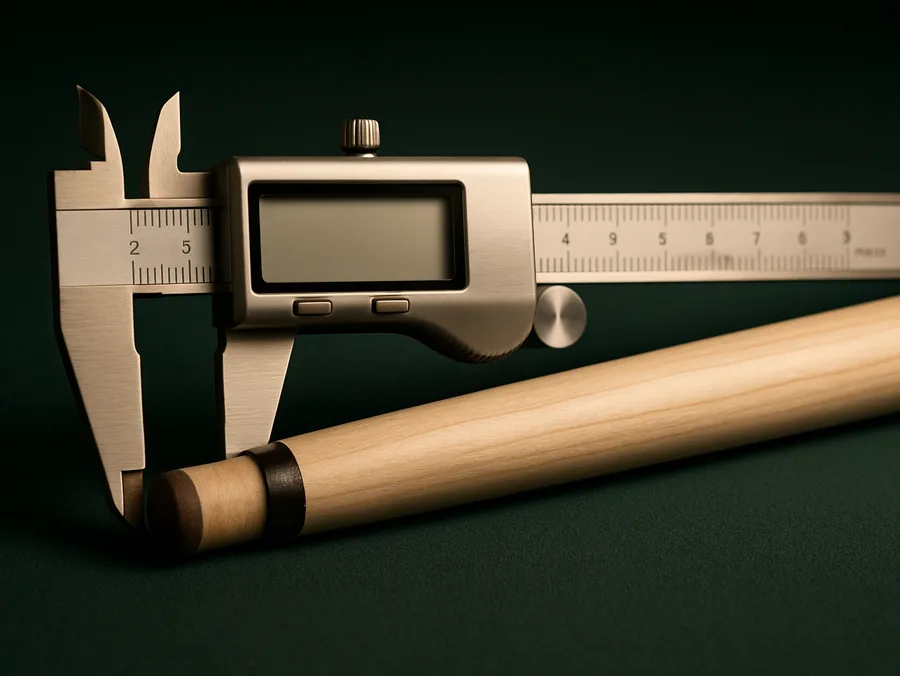
NEIKO 6-Inch Digital Caliper
Measuring before you buy ferrulesReads to a thousandth in inches or millimeters, so you know the real shaft diameter and ferrule length before ordering stock or sending the shaft out.
Check price on Amazon
Replacement ferrule stock
Cue techs and lathe ownersBlank ferrule material in common diameters, for anyone with the lathe and the skills to machine it concentric. Everybody else can hand these to a local cue tech along with the shaft.
Check price on Amazon
RAGE Heavy Hitter Jump/Break Cue
Saving your playing ferruleA stiff phenolic-tipped cue that unscrews into a jump cue. Let it take the break so the ferrule on your playing cue never has to.
Check price on AmazonFrequently asked questions
What is the ferrule on a pool cue?
It's the short collar, usually white, between the tip and the wood of the shaft. It protects the shaft's end grain from splitting and gives the tip a flat, hard surface to glue to.
What is the best pool cue ferrule material?
There's no single best. Linen-based melamine such as Aegis and Ivorine-type synthetics are the common choices on playing cues, phenolic on break cues. Weight and length affect play more measurably than material, so match what your cue came with.
How much does it cost to replace a cue ferrule?
On published shop price lists, $40 to $50 plus a new tip, since the tip comes off during the job. Bundled ferrule-and-tip prices run $50 to $85, and a broken tenon adds about $20 to $25.
Can I replace a pool cue ferrule myself?
Only if you have a lathe. The new ferrule has to be turned down concentric with the shaft and faced flat, which hand tools can't do reliably. Tips are a reasonable home job; ferrules belong at a shop.
Can I play with a cracked ferrule?
Briefly, but you shouldn't. The crack spreads with each hit and can reach the shaft wood, turning a ferrule job into a shaft replacement.
Does the ferrule affect deflection?
Yes. Squirt testing at Colorado State showed that mass near the tip increases cue ball squirt, and lighter ferrules are one way makers build low-deflection shafts. A heavier or longer replacement ferrule can add squirt.
Why do break cues have phenolic ferrules?
Phenolic resin, the material Aramith uses for its balls, is hard enough to take full-power breaks without deforming and transfers energy efficiently to the cue ball.
Do carbon fiber shafts have ferrules?
Many don't have a traditional one. Predator's REVO, for example, uses a thin Vault Plate under the tip. Damage at the front of a carbon shaft should go back to its maker.
Related guides
LeaguePool is reader-supported. When you buy through links on this site we may earn an affiliate commission at no extra cost to you. As an Amazon Associate we earn from qualifying purchases.