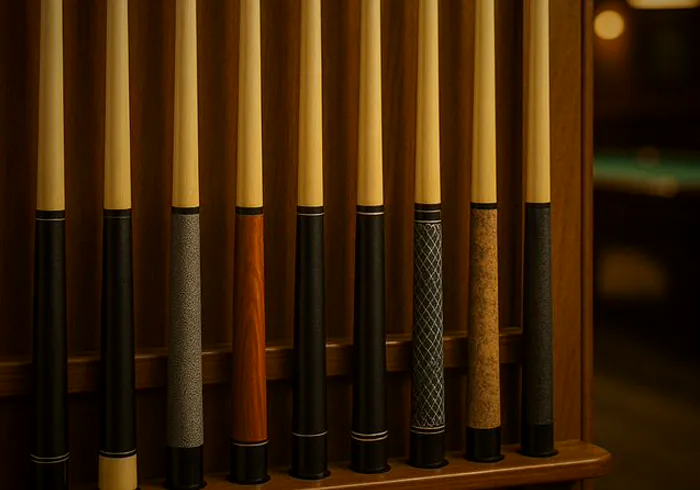
Best Jump Cues: Predator Air II, Cuetec Propel and More
A jump cue is a short, light, stiff cue with a very hard tip, built to pop the cue ball over a blocking ball with a legal downward hit. The best ones right now are the Predator Air II (the sensible all-rounder), the Cuetec Cynergy Propel and Predator Air Rush if you want a carbon shaft, and the Cuetec Avid Surge Jump if you want a real dedicated jumper for less.
All four tricks of a jump cue work toward the same thing. Dr. Dave Alciatore explains that a hard tip, a stiff shaft and a light cue shorten the time the tip stays on the ball, so the tip gets out of the way while the ball bounces off the slate. A heavy playing cue with a soft tip stays in the way, which is why the same stroke that jumps a ball with a jump cue just drives it into the table with your playing cue.
Best jump cues compared
| Jump cue | Length and weight | Tip | Shaft and joint | Warranty |
|---|---|---|---|---|
| Predator Air II | 40 in (2 pieces) or 47 in (3 pieces); about 10 oz; 29 in shaft | Phenolic | Carbon-reinforced shaft and collar; quick release (retailers list Mini Radial and Uni-Loc parts) | Predator limited lifetime against manufacturing defects |
| Predator Air Rush | 40.25 in at 8.1 oz, or 51.5 in at 12.1 oz | 14mm phenolic (per PoolDawg) | Air REVO carbon; Uni-Loc quick release | Predator limited lifetime |
| Cuetec Cynergy Propel | 11 oz standard; 29 in shaft, 15 in handle, 3.46 in extension | Kintrol composite (Taom 2.0 option) | Carbon shaft and handle; 3/8x14 Cuetec joint | Cuetec limited lifetime, register within 90 days |
| Cuetec Avid Surge Jump | 9.5 oz; 29 in shaft, 15 in butt | Power+ phenolic with glass pad | Glass fiber over maple; 3/8x14 Cuetec joint | Check with dealer |
| Lucasi Air Hog 2 and Air Hog 5 | Not published | 13.75mm Bakelite | Carbon ferrule and collar; Uni-Loc quick release | Check with dealer |
| McDermott Aviator AV1 | 51 3/4 in assembled; weight not published | Phenolic on a 13.75mm Defy carbon jump shaft | Carbon shaft and butt | Check; McDermott's lifetime warranty page names McDermott, Stinger and Sledgehammer |
| Meucci Pogo | Not published | G10 | Maple; 3/8x10 pin; 0.5 in phenolic ferrule | Meucci limited 1 year |
Specs are from each maker's page where it publishes them, otherwise from PoolDawg, Seybert's or Cue and Case listings. Dedicated jump cues from these brands listed from under $200 to about $700 in October 2026. The cheap end is maple with a Bakelite or phenolic tip; carbon shafts are what push the price up.
What is a jump cue?
A jump cue is a short cue, usually around 40 inches in its jumping setup, that weighs about 8 to 11 oz in that setup, with a very hard tip. You raise the butt, strike down through the cue ball, and the ball rebounds off the slate and over the blocker. That downward hit is what makes it legal: the WPA defines a legal jump as raising the cue and driving the cue ball down into the playing surface.
Four things make it jump better than your playing cue, per Alciatore's jump cue FAQ:
- Short: easy to hold at a steep angle and to throw with a dart stroke.
- Light: faster stroke, and the cue loses forward speed at impact so it's out of the way when the ball bounces.
- Stiff: more efficient hit and a shorter contact time.
- Hard tip: usually phenolic or a phenolic hybrid. Alciatore's efficiency testing puts phenolic tips at 0.81 to 0.87 on a coefficient-of-restitution test against 0.71 to 0.75 for leather playing tips.
He adds a fair warning: lighter isn't always better, because the best weight depends on your muscles and your technique.
Which jump cue to buy
For most league players: the Predator Air II. Short and long setups, about 10 oz, a phenolic tip, and Predator's lifetime warranty. It costs well under the carbon-shaft jumpers.
For carbon: the Cuetec Cynergy Propel or the Predator Air Rush. The Propel is 11 oz with its weighted extension and has carbon in the handle as well as the shaft. The Air Rush is lighter in its short setup (8.1 oz at 40.25 inches) and uses an Air REVO shaft. Pick the Propel if you shoot a Cynergy already; pick the Air Rush if you want the lightest short jumper here.
For the money: the Cuetec Avid Surge Jump, 9.5 oz with an extra-hard phenolic tip, or the Lucasi L-2000JC, a maple jumper with a Bakelite tip and a Turbo Lock joint. Both cost a fraction of the carbon cues and jump fine at league level.
Already need a break cue too? Don't buy two. A break/jump combo such as the McDermott Stinger or Poison VX Jump/Break gives you a breaker and a jumper in one case slot. Dedicated jumpers still win on very close, steep jumps because they're shorter and lighter in their jumping setup.
Jump cues by brand
- Predator: Air II (the default pick) and Air Rush (Air REVO carbon). More in Predator cues.
- Cuetec: Cynergy Propel (carbon) and Avid Surge Jump (budget). See Cuetec cues.
- Lucasi: the Air Hog 2 (three interchangeable pieces) and Air Hog 5, both with a 13.75mm Bakelite tip and Uni-Loc joints, plus the Launch, a three-piece carbon fiber jump cue with a Bakelite tip, and the cheaper maple L-2000JC. See Lucasi cues.
- McDermott: the new Aviator AV1 carbon jump cue, and Stinger break/jump cues that take a 12 inch jump handle. See McDermott cues.
- Meucci: the Pogo, with a G10 tip. Meucci's warranty is one year. See Meucci cues.
- KO Brothers and Infinity: we couldn't reach either maker's site to confirm a current jump cue or its specs, so we can't recommend one. If you're looking at a used one, check the tip material and that the short setup is at least 40 inches.
Best jump cue tip
For pure jumping, harder is better, which is why almost every jump cue ships with phenolic, Bakelite (a phenolic resin) or a hard composite like Cuetec's Kintrol. A hard leather break/jump tip, such as Samsara's nine-layer tip, is the choice if you want more grip or you're worried about a tournament director's ruling. Layered tips like the White Diamond, which its seller says is not phenolic, sit in between.
On the rules: CSI and WPA require a tip of leather, fibrous or pliable material and cap it at 14mm, and WPA bars a tip that can scratch or damage the cue ball. None of them names phenolic. Our phenolic vs leather break tips guide covers the materials, the rules and replacement in detail.
Are jump cues legal?
| Rules | Jump cues | Length |
|---|---|---|
| APA | Only in Masters divisions. Elsewhere you may jump only with your regular shooting cue, and you can't break it down to shorten it (General Rule 29) | No length figure in the Team Manual |
| CSI / BCAPL | Allowed in 8, 9 and 10-ball. One Pocket, 14.1 and Bank Pool require jumps with your playing cue (rules 5-15, 6-19, 7-9) | At least 40 inches (Equipment item 9c) |
| WPA | You may switch between break, jump and normal cues during a match (rule 1.4) | At least 40 inches (Equipment specification 17) |
That 40 inch floor is why jump cues stop where they do. The Air II's short setup is 40 inches and the Air Rush's is 40.25, right at the line, so don't trim one. House rules come first, too: APA's manual says a room that bans jump shots wins, and plenty of bars do to protect their cloth. Technique and the scoop rules are covered in how to jump the cue ball.
Can you jump with your playing cue?
Small jumps, yes. Alciatore notes a playing cue jumps poorly (softer tip, more flex, more weight), but carbon low-deflection shafts can still jump small amounts reliably, and a firm stroke with modest elevation gets over the edge of a ball. Full-ball jumps over a close blocker are where a jump cue earns its place. In APA play below Masters, your playing cue is the only cue you're allowed to jump with, so it's worth practicing.
Two pieces or three?
Buy three-piece. The short setup suits the dart stroke for steep, close jumps, and the longer setup suits the normal underhand stroke for longer, lower jumps, which Alciatore says is generally more accurate. A two-piece jumper locks you into one length. The Air II, Air Rush and Air Hog 2 are all three-piece; the Propel adds a short weighted extension instead.
What the Amazon jump cue listings are
Most cues that come up on Amazon for "jump cue" are break/jump combos, not dedicated jumpers. The best seller, the PODAYUDE Little Monster, is a three-piece carbon combo: 19 oz as a break cue and 11.5 oz at 109 cm (about 43 inches) as a jump cue. That jump setup is in the same weight range as the dedicated cues above, which makes it a reasonable budget way to try jumping. The cards below are the combos we've checked; for the full combo comparison see best break/jump cues.
Sources
- Dr. Dave Alciatore: jump cue FAQ
- Dr. Dave Alciatore: cue tip efficiency
- Dr. Dave Alciatore: jump technique FAQ
- Predator Air Rush specifications and Predator warranty
- Cuetec Cynergy Propel specifications and Cuetec warranty
- McDermott Aviator AV1
- Lucasi Air Hog, Launch and L-2000JC listings (Cue and Case)
- Meucci Pogo and Meucci warranty
- APA Official Team Manual (General Rule 29)
- Official Rules of CueSports International
- WPA Rules of Play and WPA Equipment Specifications
Our picks
Links open the current selection and price on Amazon so you can compare real reviews before buying.

PODAYUDE Little Monster Carbon Break Jump Cue
Cheapest carbon jump setupThe best-selling cue under "break cue" on Amazon, and its jump mode is the useful part here: 109 cm and 11.5 oz, in line with dedicated jumpers. Carbon fiber shaft, 12.9mm break/jump tip and a Uni-Loc style quick-release joint. As a breaker it's 147 cm and 19 oz.
Check price on Amazon
Poison VX Jump/Break Cue by Predator
Predator design for lessThree pieces, a Venom carbon low-deflection shaft, a phenolic tip and a Radial joint, with Predator's tacky GTX grip. Pull the butt section and you have a short jumper; the case and joint protectors come in the box.
Check price on Amazon
RAGE Heavy Hitter Jump/Break Cue
Budget jumper with a Bakelite tipHard rock maple with a stiff 14mm Bakelite tip and two Turbo Lock joints, so it goes from break cue to jump cue to a shortie. It's 25 oz assembled, heavy for a breaker, but the jump setup is what you'd buy it for at this price.
Check price on AmazonFrequently asked questions
What is a jump cue?
A short, light, stiff cue with a very hard tip (usually phenolic or a hard composite), used to jump the cue ball over a blocking ball by striking down so the ball rebounds off the slate. Most are about 40 inches in their short setup.
What is the best jump cue?
The Predator Air II for most players. The Cuetec Cynergy Propel and Predator Air Rush are the carbon picks, and the Cuetec Avid Surge Jump is the best value dedicated jumper.
What is the best jump cue for the money?
The Cuetec Avid Surge Jump or the Lucasi L-2000JC among dedicated jumpers. If you also need a break cue, a combo like the RAGE Heavy Hitter or Poison VX Jump/Break is better value than two cues.
How much does a jump cue weigh?
The ones we checked run about 8 to 11 oz in their jumping setup: 8.1 oz for the Predator Air Rush short setup, about 10 oz for the Air II, 11 oz for the Cuetec Propel.
How short can a jump cue be?
CSI and WPA require every cue to be at least 40 inches long, so legal jump cues stop at about 40 inches in their shortest setup.
Can you use a jump cue in APA?
Only in Masters divisions. In other APA play you can jump only with your regular shooting cue, and you can't take it apart to make it shorter.
What is the best tip for a jump cue?
A phenolic or very hard composite tip jumps best. Hard layered leather gives more grip and fewer rules questions but a little less pop.
Is the Predator Air 2 worth it?
For a league player who jumps where it's allowed, yes: three-piece, about 10 oz, a phenolic tip and Predator's limited lifetime warranty, at well under the price of the carbon jumpers.
Related guides
LeaguePool is reader-supported. When you buy through links on this site we may earn an affiliate commission at no extra cost to you. As an Amazon Associate we earn from qualifying purchases.