One-Piece vs Two-Piece Pool Cues: Which Should You Buy?
A one-piece pool cue is a single length of wood with no joint, usually 57 inches, and it belongs in a wall rack next to a home table or in a bar. A two-piece pool cue unscrews in the middle into two halves of about 29 inches, fits a case, and is what nearly every player who owns a cue carries to league night.
The joint does not make a two-piece cue less accurate. What separates the two in play is the taper, the tip and how well the cue has been looked after, and on all three a decent two-piece usually wins.
One-piece vs two-piece pool cues at a glance
| One-piece cue | Two-piece cue | |
|---|---|---|
| Typical length | 57 in (Viper, Empire) or 58 in (Players) | 58 in assembled |
| Length to store or carry | The full 57 to 58 in | Two halves of about 29 in |
| Case | Needs a full-length case, about 59 in inside | Any 1x1 or larger case; a 1x1 is about 31 in inside |
| Taper | One continuous taper, often a European taper on bar cues | Usually a pro taper on the shaft |
| Weak point | Warps if left leaning; tip and ferrule often cheap | The joint wears if it is cross-threaded or left loose |
| Upgrades | None. Retip it or replace it | New shaft, new tip, weight bolts on most cues |
| Single cue cost | Bar cues commonly under $50 | Decent ones from just over $70; most beginner cues $100 to $250 |
| Best for | Home table racks, bars, game rooms with guests | Your own cue, leagues, anything that travels |
Price ranges are from retailer listings and PoolDawg's beginner guide, checked October 2026. Wikipedia's cue entry and our pool cue parts guide cover the anatomy behind each row.
What a one-piece pool cue is, and where it belongs
A one-piece cue is turned from one length of wood (usually maple or another hardwood) with one continuous taper from butt to tip. There is no joint hardware at all, and usually no wrap or weight bolt. That simplicity is the whole point. A guest can't over-tighten a joint they don't have, can't cross-thread a pin, and can't wander off with the shaft and leave the butt on the rail.
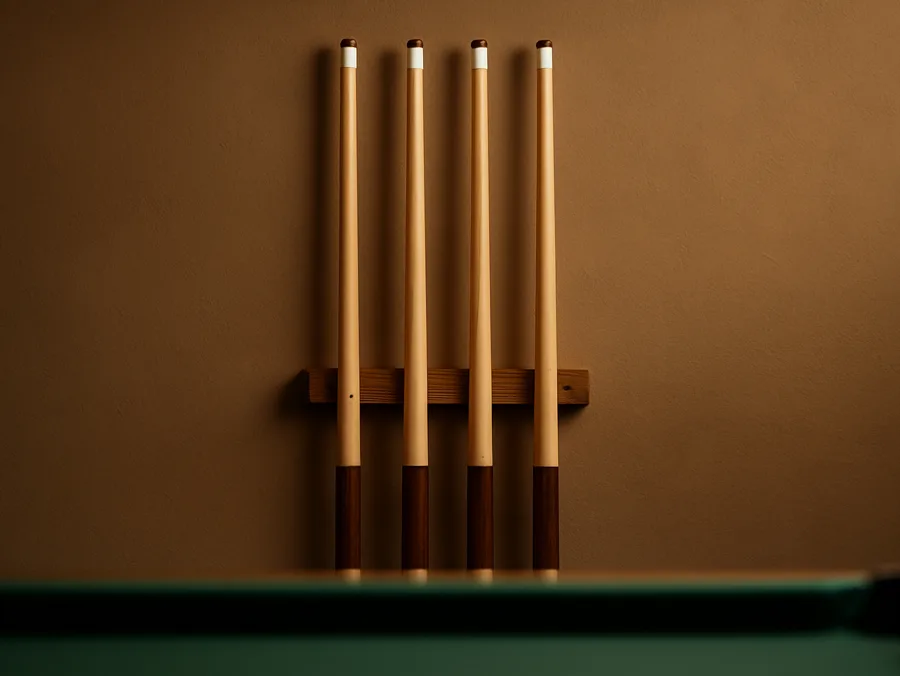
That is why bars and pool halls stock one-piece house cues, and so do most home game rooms, and why our pool cue sets guide recommends them for a wall rack. Buy them in a spread of weights (a set of four at 18, 19, 20 and 21 oz is the usual pattern) so every guest finds one that feels right.
Where one-piece cues fall down is anywhere outside that room. A 57-inch stick is awkward in most cars and won't go in a normal cue case. And because a one-piece can't be broken down, it is easy to store badly: leaned in a corner, it can take a bow over a few months.
What a 2 piece pool cue gets you
A two-piece cue splits at a joint near the middle into a shaft and a butt of roughly 29 inches each. The joint is a threaded pin in the butt that screws into an insert in the shaft. Common pins on beginner cues are 5/16x18 and 3/8x10, and our joint types guide explains the rest.
Breaking down is the obvious benefit, but the bigger one shows up a year later:
- When the shaft warps or you want a low-deflection or carbon shaft, you replace the shaft and keep the butt. With a one-piece you buy a whole new cue.
- Most two-piece cues have a weight bolt under the bumper, so 19 oz can become 18 or 20 without a new cue. Our cue weight guide shows how.
- A case keeps the cue out of hot cars and damp corners, which matters more for warp than anything else you do.
- The better two-piece cues carry warranties that name warpage. The Players sneaky pete listing, for example, promises a lifetime warranty on the cue and shaft, even against warpage.
If you play away from home even once a month, this is the format to buy. Our beginner cue guide lists two-piece cues built to the standard first-cue spec.
Does a one-piece cue play better? (1 piece pool cue performance)
No. A well-made two-piece cue is as accurate as a one-piece. The difference people notice is in feel, and most of what they blame on the joint comes from somewhere else.
The physics backs that up. Squirt, the cue ball pushing off line when you use side spin, comes from the mass in the last 5 to 8 inches of the shaft, according to Dr. Dave Alciatore's research (our low-deflection explainer has the numbers). The joint sits about 29 inches back from the tip, nowhere near that zone, so it doesn't change where the cue ball goes.
What the joint does change is feel and sound. A stainless steel joint gives a firmer, crisper hit. Wood-to-wood and radial-pin joints feel softer, and many players say they feel closer to a one-piece. Neither is better; it is a matter of taste.
When a one-piece house cue plays worse than someone's two-piece, the joint is rarely the reason. Look at these instead:
- Taper. Wikipedia's cue entry notes that most North American bar and house cues use a European taper, which thickens steadily from the tip. Two-piece playing cues usually have a pro taper, which stays slim for the first 10 to 15 inches and slides through a bridge hand more evenly.
- The tip. House cues often wear flat, glazed or mushroomed tips that won't hold chalk, and that causes miscues.
- Straightness. A bar cue that has leaned in a corner for years may be warped, and warp hurts accuracy far more than any joint. Our warp check takes a minute.
- Consistency. Grab a different house cue every visit and the weight and tip change every time. Your own cue removes that variable, which is the real performance case for owning one.
Durability: warp and joint wear
Each type fails in its own way.
One-piece cues have nothing to loosen, which is why bars buy them. Their risks are warp from bad storage and cheap tips and ferrules. A cracked ferrule is the usual way house cues get retired. Keep them upright in a wall or floor rack, never leaning, and away from heaters and damp floors. Our storage guide covers the details.
Two-piece cues add the joint as a wear point. Cross-threading, leaving the halves loose while playing, and banging an open pin against things in a bag all cause trouble over time. Screw the halves together straight and snug (hand tight, no tools), and cap both ends with joint protectors when the cue is apart. Once the cue lives in a case, a two-piece is usually better protected from warp than a one-piece in a corner.
Neither type is warp-proof if it is wood. If your table is in a damp basement, a fiberglass composite cue makes more sense in either format; our fiberglass vs graphite guide explains the trade.
Cue cases for one-piece cues
One-piece cue cases exist, but they are long and mostly sold for snooker. A normal pool case will not take a one-piece cue.
- A one-piece case has to be longer than the cue. Peradon's Halo Thin one-piece case, for example, is 59 1/4 inches inside (150.5 cm) and holds a single cue. Peradon also makes one-piece versions of its aluminum, attache, Clubman and leather cases.
- A 1x1 pool case holds one butt and one shaft. GSE's 1x1 hard case measures 31 inches inside and fits two-piece cues up to 58 inches, which shows the size difference: about half the length.
- Peradon still sells one-piece snooker cues, which is who most of those cases are for. 3/4 jointed snooker cues need their own longer cases too, because the shaft is so long. Our snooker cue guide covers snooker case sizes.
For a one-piece pool house cue, a case usually isn't worth buying. The cue costs less than a good case and was never meant to travel. If you find yourself wanting to carry one, that is the sign to buy a two-piece. Case types and sizes for two-piece cues are in our cue case guide.
Best one-piece pool cues for a home table
One-piece cues are house cues, so judge them as house cues: a real leather tip, a ferrule that won't crack, a straight roll and a smooth finish. The three sets in our product list below all meet that bar.
| Set | Length | Weights | Tip | Pick it if |
|---|---|---|---|---|
| Viper one-piece, set of 4 | 57 in | 18, 19, 20, 21 oz | Le Pro leather | You want the standard bar set at a fair price |
| Players one-piece, set of 4 | 58 in | Per listing | Elk Master, pre-shaped | You want the sturdiest ferrule (lifetime guarantee against cracking) |
| Empire USA one-piece | 57 in | Per listing | 13mm leather | You need more cues for a busy game room |
Searching for a Cuetec one-piece house cue? We couldn't find one in Cuetec's current online catalog in October 2026. Cuetec's plain-looking option today is the AVID Era sneaky pete, a two-piece cue built to look like a house cue. More on that type in the next section.
The Viper and Players brands each have their own page: Viper cues and Players cues.
The in-between options: sneaky petes, 3/4 jointed and shorties
A sneaky pete is a two-piece cue dressed as a one-piece house cue: four plain points, no wrap, nothing flashy. It gives you the look and the slim, unwrapped feel some players like about house cues, with a joint and a case-friendly length. If you like how a house cue feels but need to carry it, this is your cue.
A 3/4 jointed cue splits about 12 or 16 inches from the butt instead of in the middle. That is normal on snooker cues and keeps a long, unbroken shaft. It is rare on pool cues.
Break-jump cues go the other way with a second joint in the butt, so the back section comes off to make a short jump cue. Our break-jump cue guide compares them.
Short one-piece cues (30 to 52 inches) are useful for shots against a wall in a cramped room and for kids. See kids' cue sizes and what size cue you need.
Which should you buy?
- You're outfitting a home table and the cues never leave the room: a set of four one-piece house cues in 18 to 21 oz, plus a rack.
- You want your own cue for league night, a friend's table or the bar: a two-piece cue and a 1x1 or 2x2 case. Start with our how to choose a pool cue checklist.
- You do both: buy the house set for guests and keep your own two-piece out of the rack, so it never meets a guest's grip or a dropped butt.
- Your table is in a damp basement or the cues will be handled by kids: fiberglass composite house cues in either format.
- You love the plain look of a house cue but play away from home: a sneaky pete.
A decent two-piece now costs not much more than a good one-piece house cue, so for a personal cue the one-piece's price edge is gone. Its remaining edge is ruggedness in a shared rack, and there it is still the right call.
Sources
- Wikipedia: Cue stick (one-piece and jointed cues, house-cue taper, 3/4 jointed snooker cues, joint materials)
- PoolDawg: beginner guide to pool cues (two-piece prices, beginner pins, pro taper length)
- Dr. Dave Pool Info: how to select a pool cue (house-cue checks)
- Peradon Halo Thin one-piece case specifications (Home Leisure Direct listing)
- Peradon: one-piece cue cases
- Seybert's: one-piece house cues (checked October 15, 2026)
- Product specifications and warranties: the Amazon listings linked from each product card (checked October 15, 2026)
Our picks
Links open the current selection and price on Amazon so you can compare real reviews before buying.
Viper One-Piece House Cues, Set of 4
Best one-piece set for a home tableFour 57-inch one-piece maple cues at 18, 19, 20 and 21 oz, each with a genuine Le Pro leather tip and an even taper. Viper builds it as a commercial bar set, and with no joint there is nothing for a guest to loosen, cross-thread or misplace. Roll all four on the table the day they arrive.
Check price on Amazon
Players One-Piece House Cue Set, 4 Cues
Toughest one-piece house cues58-inch North American hard rock maple with true four-prong construction and an Elk Master tip pre-shaped to a dime radius. The fiber ferrule carries a lifetime guarantee against cracking or chipping, and the ferrule is the part house cues lose first.
Check price on Amazon
Empire USA 57-Inch One-Piece Hardwood Cues
Busy game roomsSolid hardwood one-piece cues at the 57-inch house-cue length, each with a 13mm leather tip. The listing describes a multi-cue set built for home, bar and commercial use, so check the pack size you pick before you order.
Check price on Amazon
Viking Valhalla 100 Two-Piece 58-Inch Cue
Best first two-piece cueA hard rock maple pro-taper shaft, stainless steel joint and resin ferrule, backed by Viking's lifetime warranty against warpage. That warranty is the reason it beats most cues at its level: warp is how cheap cues die.
Check price on Amazon
Joshmar 58-Inch Canadian Maple Cue with Hard Case
Budget two-piece with a caseA 19 oz two-piece Canadian maple cue with a 13mm multilayer leather tip, packed with a hard case, glove and chalk. It is a loud skull-art design, so buy it for the bundle and the price, not for a quiet look.
Check price on Amazon
Viper Sneaky Pete 58-Inch Two-Piece Cue
House-cue look, two-piece practicalityA sneaky pete looks like a plain one-piece house cue but unscrews at a joint, so you get the slim, unwrapped feel and still fit it in a case.
Check price on AmazonFrequently asked questions
Is a one-piece pool cue better than a two-piece?
Not for playing. A well-made two-piece is just as accurate, because squirt comes from the last few inches of the shaft, not the joint. A one-piece is better only as a house cue in a shared rack, where it has no joint for guests to damage.
Why are bar and house cues one-piece?
They are cheap to make, have no joint to loosen, cross-thread or lose, and never need to travel. In a rack that dozens of people use, that simplicity matters more than anything else.
How long is a one-piece pool cue?
Usually 57 inches, though some house cues, such as Players, are 58. Two-piece cues are usually 58 inches assembled. Short one-piece cues of 30 to 52 inches are made for cramped rooms and kids.
Can you put a one-piece cue in a case?
Only in a full-length one-piece case, which is mostly sold for snooker. Peradon's Halo Thin, for example, is 59 1/4 inches inside. A normal pool case such as a 1x1 is about 31 inches inside and only fits two-piece cues.
Do one-piece cues warp more easily?
Any wood cue can warp. One-piece cues are more often stored badly, leaning in a corner or a hot car, because they can't go in a regular case. Store them upright in a rack and they hold up well.
Does Cuetec make a one-piece house cue?
We found none in Cuetec's current online catalog in October 2026. Cuetec's closest option is the AVID Era sneaky pete, a two-piece cue made to look like a plain house cue.
Can you turn a one-piece cue into a two-piece?
Not practically. Adding a joint means cutting the cue and fitting a pin and insert, which costs more than a decent two-piece cue. Buy a two-piece instead.
Related guides
LeaguePool is reader-supported. When you buy through links on this site we may earn an affiliate commission at no extra cost to you. As an Amazon Associate we earn from qualifying purchases.