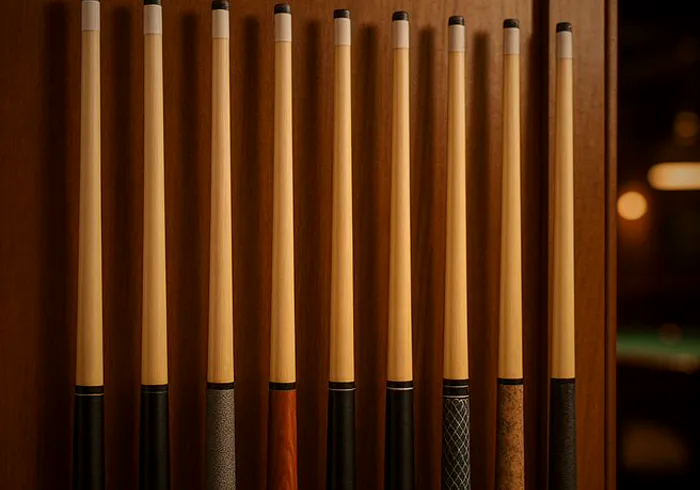
Pool Cue Weight Guide: 18, 19, 20 or 21 oz?
The standard pool cue weight is 19 ounces, and most playing cues are sold in 18, 19, 20 and 21 ounces. Start at 19 if you don't already have a preference. Dr. Dave Alciatore, whose pool physics FAQ is the standard reference on this, calls 19 ounces a good starting point and says that near your comfortable weight, an ounce either way makes little difference.
That last point matters, because people agonize over ounces. Below you'll find what weight actually changes on the table, a quick way to find yours, typical weights for every kind of cue, and how to change a cue's weight with a weight bolt instead of buying a new one.
Standard and average pool cue weight
Nineteen ounces is the most common pool cue weight, and Wikipedia's cue stick article puts the average professional cue at the same number. PoolDawg, one of the biggest cue retailers, gives 18 to 21 ounces as the normal playing range. McDermott's custom options say the same thing in a different way: it builds most models from 18 to 21 ounces in half-ounce steps.
| Cue weight | Grams | Who uses it |
|---|---|---|
| 17 oz | 482 g | Uncommon on adult pool cues; some light-cue and snooker players |
| 18 oz | 510 g | Players who want a quicker, lighter swing |
| 19 oz | 539 g | The default; most cues and most players |
| 20 oz | 567 g | Players who like a heavier, more planted hit |
| 21 oz | 595 g | The heavy end for a playing cue; common on break cues |
The weight on a cue is the whole assembled cue, shaft and butt together. Almost all of the difference between an 18 and a 21 ounce cue sits in the butt, usually in a weight bolt or core under the wrap, so the shaft feels the same in your bridge hand either way.
Pool cue weights by cue type
| Cue | Typical weight | Why |
|---|---|---|
| Playing cue | 18 to 21 oz, 19 most common | Balance of control and speed |
| Break cue | 18 to 25 oz | Built for speed and impact; see best break cues |
| Jump cue | Around 12 to 14 oz | A light cue jumps the ball more easily |
| Short cue, 36 in | 12 to 15 oz | Less cue, less weight |
| Short cue, 48 to 52 in | 15 to 18 oz | Same reason; see kids' cues |
| Snooker cue | 16 to 18 oz | Smaller, lighter balls |
The short-cue figures come from real listings: GSE's shorties run 12 oz at 36 inches up to 18 oz at 52, AB Earth's 15 oz at 36 inches to 18 oz at 48, and McDermott's shorty house cues 15 to 17 oz.
What cue weight actually changes
Less than the forum arguments suggest, but it isn't nothing. Dr. Dave's cue weight FAQ lays out the trade-offs.
A heavier cue
- Sends the cue ball faster for the same stroke effort, so power shots and long draw feel easier.
- Helps players who tend to slow the cue down at contact, since the extra mass keeps it moving.
- Can carry more weight near the tip end, which can mean a little more squirt with side spin.
- Makes double hits and miscues more likely on shots with a lot of tip offset, and on close shots where the cue ball is near the object ball.
A lighter cue
Is easier to accelerate and easier to stroke softly. Better touch on soft shots is the real reason to go light. You give up nothing in accuracy; accuracy comes from your stroke.
The numbers on the break
Dr. Dave's figures show why cue speed matters more than cue mass. Breaking power rises with the square of cue-ball speed, so 10% more cue speed gives about 21% more power. Going from a 17 to a 22 ounce cue at the same speed adds only about 6% cue-ball speed, roughly 13% more power, and most people swing a heavier cue a little slower, which eats into that. A harder tip does more than a heavier cue: switching from a medium leather tip to phenolic can add up to 17%.
What weight pool cue should I use?
Here's how we'd pick, by situation.
| You are | Weight |
|---|---|
| Buying your first cue, no preference | 19 oz |
| Struggling with speed on soft shots, or the cue feels like work to swing | 18 oz |
| A bigger player who likes a solid hit, or you break with your playing cue | 20 oz |
| Sure you like heavy, after trying 20 | 21 oz |
| A smaller adult or a player with small hands | 18 oz, with a slim grip (see cues for women and smaller players) |
| A child | Whatever the short cue weighs at the right length |
| Buying a break cue | Start at 19 and adjust; speed beats mass |
For beginners, 19 is also the easiest weight to live with while your stroke changes, and since it's the most common weight, borrowed and house cues won't feel strange. Our beginner cue guide uses the same starting spec.
Find your weight in one session
- Collect two or three cues of different weights. House cues work; check the butt for a printed weight, or weigh each cue on a kitchen or postal scale.
- Shoot the same three shots with each one: a soft lag to the far rail and back, a stop shot from a diamond away, and a medium draw shot.
- Score the lag by how far you finish from the rail. Note on the draw shot whether you had to force it.
- Pick the cue that wins the lag. Soft speed is where weight preference shows up first, and it decides more games than power does.
- If two weights tie, take the one closer to 19. House cues and spare parts at that weight are everywhere.
Give a new weight a week before you judge it. Dr. Dave's advice, and it's good advice: pick something and stick with it. Constantly changing weight costs you more than any single ounce.
Balance point: where the weight sits
Two 19 ounce cues can feel different because the weight sits in different places. A cue that is heavy toward the butt feels lighter at the tip and can feel unsteady in an open bridge; one with more weight forward feels solid and a bit slower. PoolDawg points out that house cues tend to feel butt-heavy, and that shorter players often prefer a cue balanced further forward.
Length changes balance too. Dr. Dave notes that a longer cue, or an extension, moves the balance point back and adds weight, and that even half an inch of balance change is something players feel. A weight bolt does the same in a small way: adding one puts mass at the very back of the cue. Grip a little behind the balance point and most of this sorts itself out.
Pool cue weight bolts: how to change a cue's weight
Most good cues have a threaded hole in the butt, under the rubber bumper, that holds a weight bolt. Swap the bolt for a heavier or lighter one and the cue's weight changes. McDermott's Lucky L1 listing gives a typical range: a 19 ounce cue can go down to about 18 or up to about 22 ounces by changing its bolt.
- Weigh the cue first so you know where you're starting.
- Remove the rubber bumper if it covers the bolt hole.
- Remove the existing bolt with an Allen wrench. McDermott specifies a 1/4 inch or 6mm Allen wrench.
- Screw in the new bolt, or no bolt at all to go lighter, then refit the bumper and weigh the cue again.
The catch is that bolts are not universal. PoolDawg sells separate bolts for Action, McDermott, Predator, Lucasi, Meucci, Cuetec, Pechauer, Mezz and others, and even within one brand the size varies: McDermott uses one bolt for its standard and Lucky cues, another for its D-Series and a third system for its H-Series. Predator's Uni-Loc cues use their own cartridge bolts; one aftermarket kit for them is a 16mm bolt with a 1.5mm thread pitch and won't fit the BK2 or the Predator Sport. Find your cue's model and buy the bolt made for it.
If your cue has no bolt hole, which is common on cheap one-piece cues, you can't adjust it at home. A cue shop can, but at that point it's usually cheaper to buy a cue in the weight you want. Our pool cue parts guide shows where the bolt sits.
Should you break with your playing cue?
You can, but it costs you. Seybert's lists what repeated breaks do to a playing cue: the tip compresses, hardens and mushrooms, the ferrule edge can crack or separate from the tip, and the shock loosens the joint over time. A separate break cue with a hard or phenolic tip takes that abuse instead. If you play once a week or more, it's worth it. Weight picks and models are in best break cues.
Sources
- Dr. Dave Alciatore: Cue weight FAQ
- Dr. Dave Alciatore: Cue length FAQ (balance)
- PoolDawg: Beginner's guide to pool cues
- PoolDawg: 5 things to consider when buying a pool cue
- PoolDawg: Pool cue weight bolts by brand
- McDermott: FAQ (weights and changing a weight bolt)
- McDermott: Weight bolts
- Seybert's: Why your playing cue shouldn't be your break cue
- Wikipedia: Cue stick
Our picks
Links open the current selection and price on Amazon so you can compare real reviews before buying.

McDermott Lucky L1 Pool Cue, 19 oz standard
One cue, any weightShips at 19 ounces, and McDermott's half-inch bolt system lets you take it to about 18 or up to about 22 by swapping the bolt (bolts sold separately, 1/4 inch Allen wrench). That's the cheapest way to test weights on a real playing cue: 58 inches, hard rock maple, 13mm tip, soft case included.
Amazon price: $135.00 as of 9:50 AM EDT. Price and availability can change; Amazon’s price at purchase applies.
Check price on Amazon
Players Classic Birds-Eye Maple Cue
Pick your exact weightSold in 18, 19, 20 or 21 ounces at the standard 58 inches, so you choose the weight at checkout. Grade A hard rock maple, Irish linen and a stainless 5/16x18 joint. Players backs the cue and shaft for life, warpage included.
Check price on Amazon
Viper Elite 2-Piece Maple Cue, 19 oz
Budget cue at a set weightEach Viper Elite is a fixed weight, sold as separate 18, 19, 20 and 21 ounce cues. Maple, an Irish linen wrap, a Le Pro leather tip and a pro taper. Get the weight right when you order, since this is the kind of cue you don't re-weight later.
Check price on Amazon
Cuetec 1 oz Cue Weight Bolts, 5-Pack
Re-weighting a CuetecOne-ounce weight bolts from Cuetec. Confirm your cue takes Cuetec bolts before ordering; bolts from other brands use different threads.
Amazon price: $26.35 as of 9:37 AM EDT. Price and availability can change; Amazon’s price at purchase applies.
Check price on Amazon
Weight Bolt Kit for Predator Cues
Fine-tuning a PredatorEight bolts from 0.1 to 2 ounces plus a stainless tool, so you can adjust in tenths of an ounce instead of whole ounces. Made for Predator cues except the BK2 and the Predator Sport playing cue.
Check price on AmazonFrequently asked questions
What is the standard pool cue weight?
19 ounces. It's the most common weight, and playing cues are usually sold in 18, 19, 20 and 21 ounces.
What is the average pool cue weight?
About 19 ounces, or roughly 540 grams. Most adult playing cues fall between 18 and 21 ounces.
What is the best weight for a pool cue?
For most players, 19 ounces. Go lighter if you struggle with soft speed, heavier if you like a solid hit. Within your comfortable range, one ounce makes little difference.
What weight pool cue should a beginner use?
19 ounces. It's in the middle of the normal range and it's the most common weight, so borrowed cues won't feel strange while you learn.
Do heavier cues break better?
A little. At the same stroke speed, going from 17 to 22 ounces adds about 6% cue-ball speed, per Dr. Dave Alciatore. Cue speed and a hard tip matter far more.
Does a heavier cue give more draw?
It gives more cue-ball speed for the same effort, which can make long draw feel easier. Good draw still comes from a low hit and a smooth, accelerating stroke, which any weight can do.
What weight cue do the pros use?
The average is around 19 ounces, but there's no published survey of individual pros' weights. See our guide to what cues the pros use for their setups.
How do I weigh my pool cue?
Put the assembled cue on a kitchen or postal scale. 19 ounces is about 539 grams. If it hangs off the scale, rest the middle of the cue on it and steady both ends without pressing.
Do weight bolts fit any cue?
No. Bolts are brand-specific and sometimes line-specific, with different threads and diameters. Buy the bolt made for your cue's maker and model.
Can I make my cue lighter?
If it has a weight bolt, yes: swap it for a lighter bolt or remove it. A cue without a bolt can't be made lighter at home.
Related guides
LeaguePool is reader-supported. When you buy through links on this site we may earn an affiliate commission at no extra cost to you. As an Amazon Associate we earn from qualifying purchases.