Pool Cue Racks: Wall Mount, Floor Stand and DIY Picks
A pool cue rack holds each cue upright, butt down and tip up, so the shaft hangs straight instead of bowing against a wall. For most home rooms the right pick is a wall-mounted wood rack with 6 to 8 slots, screwed into studs. If you rent or can't drill, a freestanding floor rack does the same job and moves with you.
Everything below is about getting that choice right: wall, floor or corner, how many slots, how high to hang it, what it should cost, and when a DIY rack makes sense.
Wall rack, floor stand or corner rack
| Type | Pick it when | Watch out for |
|---|---|---|
| Wall-mounted pool cue rack | You have 2 or 3 feet of open wall near the table and want the floor clear | Needs studs or proper anchors; drilling is a problem for renters |
| Two-piece wall rack | You want the cheapest wall option or a custom spacing | The top and bottom pieces have to line up exactly or the cues lean |
| Floor stand (freestanding) | You rent, can't find studs, or want balls and chalk in the same unit | Takes floor space; a light stand can tip if bumped |
| Corner rack | The only free space is a corner | Check that a full cue lifts out without hitting the ceiling or the side wall |
| Folding or portable holder | You want somewhere to rest cues at the table during play | It's a resting spot, not storage |
Our default for a home game room is a wall rack. It keeps cues out of the walkway, where most knocked-over cues get chipped, and it costs less than a comparable floor stand at most billiard retailers. The floor stand wins in rentals and in rooms where the only open wall is an outside wall (more on that below).
How many slots you need
Count the cues you own, then add two. Guests need somewhere to put a cue down, and most players pick up a break cue or a jump cue within a couple of seasons.
| Slots | Who it suits |
|---|---|
| 1 to 2 (clip holder) | One player, one cue, tight wall |
| 6 | A couple who each own a cue, plus house cues for guests |
| 8 | Most home rooms: two players' cues, break and jump cues, and four house cues |
| 10 to 12 | Families, frequent hosts, or a basement that doubles as the league team's practice room |
| 12 and up | Bars, clubs and rec rooms that stock house cues |
If the rack will also hold a bridge stick, look for a dedicated bridge clip; bridge heads don't sit well in a cue slot.
How a rack holds the cue: cups, holes and clips
Almost every wall rack has two contact points. The bottom piece supports the butt in a cup, notch or groove. The top piece catches the shaft, either with a spring clip that pinches it or a hole or notch the shaft drops into. Floor stands usually skip clips entirely: the butt sits in a recess at the base and the shaft passes through a hole in an upper shelf.
- Clips hold a cue firmly against bumps, which matters near a busy table. Check the tension when it arrives: a clip that squeezes hard can mark a finish over time, and one that's too loose lets the cue rattle.
- Holes and notches never squeeze anything, so they're kinder to shafts. The cue can lift out, though, if someone hooks it while walking past.
- Lined contact points (felt, rubber rings or a smooth rounded edge) protect the finish. Bare plastic clips are the first part to crack on cheap racks.
The detail most buyers miss is slot spacing. Butts are much thicker than shafts, so a rack with tight spacing can hold eight cues on paper and only six in practice once the wraps and bumpers rub each other. Look at the product photos for a full rack, not an empty one.
Pool cue rack wall mount height
There's no standard height. None of the rack makers or billiard retailers we checked publishes one, and the right answer depends on your ceiling and your longest cue. Work it out instead of guessing:
- Measure your longest cue assembled. Most pool cues are 57 to 59 inches; a jump cue is shorter, and an extended cue for a tall player can be longer.
- Decide where the butt cups go. Keep them high enough to clear baseboards, outlets and a vacuum, and low enough that a seated guest's chair won't hit the butts.
- The top clip or hole should catch the shaft well below the tip and ferrule, never on them. On a two-piece rack this sets the gap between the pieces.
- Add lift-out room. You raise the cue an inch or two to clear the bottom cup before tilting it out, so the tip needs that much space below the ceiling, plus a few inches so the tip never scrapes it.
- Tape the pieces to the wall, stand a real cue in them and try lifting it out before you drill anything.
On a two-piece rack, the bottom and top pieces have to be level and directly above each other. A bottom piece an inch off to one side tilts every cue in the rack, which is the leaning you bought the rack to stop.
Mounting it so it stays on the wall
Screw into studs where you can. A loaded rack is light, but it gets yanked sideways every time someone grabs a cue in a hurry, and drywall anchors loosen under that. If the studs don't line up with the rack's holes, use anchors rated well above the rack's weight, or screw a painted board across two studs and mount the rack to that.
Plan on replacing the hardware in the box on cheap racks. A BestReviews look at a popular budget two-piece rack found the included screws weak enough to replace. Use a level, and check every cue stands straight once it's up.
Where it goes matters as much as how. McDermott's cue care page says to avoid wall racks installed on an outside wall, most likely because an exterior wall runs colder and damper than an interior one through the seasons. Keep the rack out of direct sun, away from heating vents, and out of the line of fire at the table (a rack right behind a corner pocket gets hit by butts on every shot from that end).
Floor stands: pool cue rack floor options
A pool cue rack floor stand needs no drilling and can move with the table. The good ones are wide at the base, have rubber or felt feet, and carry their weight low. Combination stands add a ball tray, a hook or bar for the triangle, a shelf for chalk and a slot for the bridge, so the whole kit lives in one spot.
The trade-off is stability. A tall, narrow stand with eight cues in it is top-heavy, and in a house with kids or a dog it will get knocked. Put it in a corner or against a wall, away from the walkway and the shooting area. Retailers sell floor stands from under $100 to over $200 for deluxe versions with drawers, and furniture-grade freestanding racks reach about $600.
Materials and finishes (including black cue racks)
Solid wood is the standard for home rooms. Oak, ash, walnut and mahogany finishes are common, and plenty of racks come in black to match black-cabinet tables. Look for a smooth, rounded edge wherever a cue touches the rack.
Metal racks suit modern rooms and commercial spaces and clean easily. Plastic and composite racks are the cheapest; check the clips and screw holes, since that's where they crack. There are also clear acrylic (Lucite) wall racks for a modern room, and high-end wall racks from furniture makers like American Heritage that are priced like furniture.
Match the finish to the table's legs or cabinet, not the walls. A rack that matches the table looks like it came with it.
Extras worth having (and one to skip)
Worth paying for: a ball shelf or ball tray, a triangle hook, a bridge clip, and a chalk ledge. They clear the table rails, which is where chalk cubes and the rack otherwise end up.
A built-in score counter is nice in a bar or a league practice room and mostly decoration at home. Drink holders on a rack are a good idea for one reason: drinks on a holder aren't on the rail, where a spill soaks the cloth.
Skip the cheapest all-plastic combination racks. They try to do everything, and the clips go first.
What a pool cue rack costs
| Type | Typical range at billiard retailers |
|---|---|
| Two-piece clip wall rack, 6 to 12 cues | about $14 to $40 |
| One-piece wood wall rack with extras (score counter, bridge clip) | about $35 to $130 |
| Deluxe solid wood wall rack, 8 to 10 cues | about $230 to $250 |
| Floor stand or corner floor rack | about $90 to $220 |
| Furniture-grade wall or floor rack | about $350 to $700 |
Ranges come from PoolDawg, Game Room Gorilla, Ozone Billiards and American Heritage listings checked October 15, 2026. The Amazon picks below show live prices on each card.
DIY pool cue rack ideas and plans
A pool cue rack is one of the easier woodworking projects, and a DIY rack lets you set the spacing for your own cues. The simplest plan is two boards:
- A bottom board with shallow cups or notches for the butts. Drill with a Forstner bit sized a little wider than your widest butt, and only partway through so the bumper rests on wood.
- A top board with open notches for the shafts, cut a little wider than a shaft and lined with felt.
- Space the slots by the butts, not the shafts. Lay your cues side by side on the floor first and mark where they sit without touching.
- Mount the top board directly above the bottom one, using the height steps above.
Other ideas we like: a single shelf with drilled holes and a matching base strip (the classic floor-stand layout, built into a closet or alcove), or a rack built into the back of a bar cabinet. Avoid anything that stores cues horizontally on two pegs. A cue supported at two points sags in between, slowly, and that's a warp.
Vintage Brunswick, Olhausen and other brand-matched racks
Table makers sell racks finished to match their tables, mostly through their dealers. If you bought an Olhausen or a Brunswick, ask the dealer for the matching rack before buying a generic one, since stains rarely match across brands.
Vintage Brunswick racks turn up at estate sales and on resale sites. Check for cracked slots, missing or mismatched clips, and loose joinery before paying collector money; a rack that has been on a basement wall for forty years may need regluing. Our guide to Brunswick pool tables covers the tables themselves.
Display cases for collectible cues
A pool cue display case is a closed, usually glass-front cabinet or wall case for cues you want to show off rather than grab. It keeps dust and hands off a custom or collectible cue. Two cautions: glass near a window lets sun fade the wraps and finish, and a sealed case in a damp room traps moisture. Keep display cases on an interior wall in a room with steady humidity. For carry cases, see our pool cue cases guide.
Looking for a billiards ball rack or how to rack?
A billiards rack can also mean the triangle or diamond that sets up the balls. For those, see our pool ball racks guide, and for template racks, template racks explained.
The proper way to rack for pool depends on the game: 15 balls in a triangle with the 8 in the middle for 8-ball, a diamond with the 9 in the middle for 9-ball. Our how to rack pool balls guide has the full rack order for every game, including APA and CSI league racking rules, and cutthroat rules covers that game's setup.
Where the rack fits in cue care
A rack solves the leaning problem. It doesn't solve heat or humidity. Cue makers aim for a steady room around 70 degrees with humidity in the 40 to 50 percent range (McDermott) or 45 to 50 percent (Predator), so the room the rack hangs in matters too. The full routine is in how to store a pool cue, and if a cue already looks bent, start with how to tell if a cue is warped.
Sources
- McDermott: cue maintenance tips (wall racks, outside walls, temperature and humidity)
- Predator: warranty and cue care FAQ (storage humidity, leaning)
- Wikipedia: Cue stick (cue lengths)
- PoolDawg: pool cue racks
- Ozone Billiards: pool cue racks
- American Heritage Billiards: cue racks
- Product specs: the manufacturers' Amazon listings for the racks below, checked October 15, 2026.
Our picks
Links open the current selection and price on Amazon so you can compare real reviews before buying.
EXTCCT Wall-Mount Cue Rack, 8 Cues
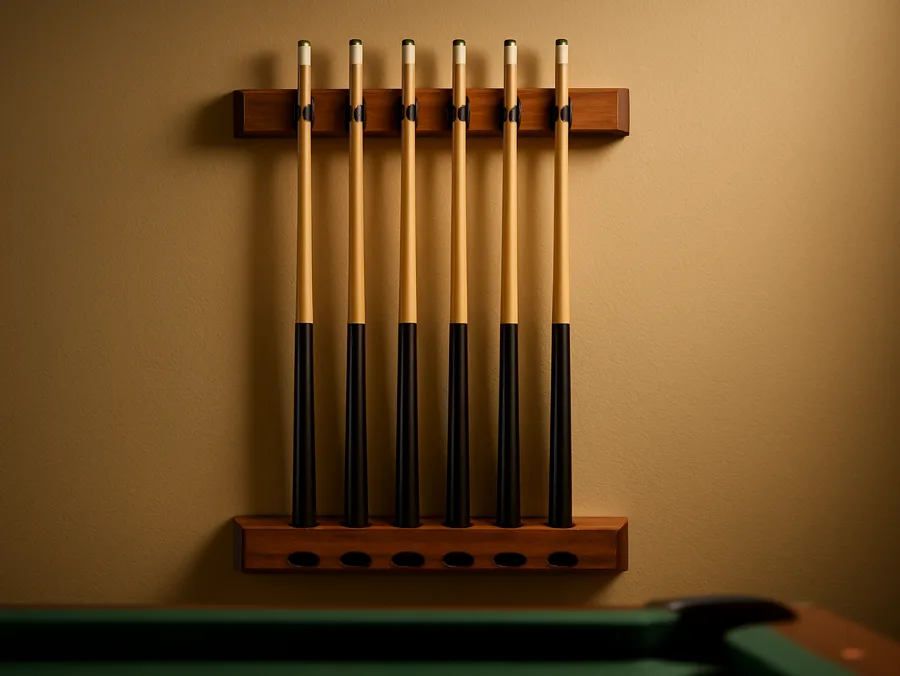
Best wall rackSolid oak, eight cue slots, and mounting hardware in the box. It comes in brown or black, and there's room on it for chalk and a brush, so the rails stay clear. Eight slots is the number that fits most home rooms: your cues, a break cue, and house cues for guests. It's a cue rack only; the balls and accessories in the photos aren't included.
Check price on Amazon
GACCO Freestanding Wooden Cue Rack, Holds 8 Cues
Best floor standA two-level freestanding rack in 18 mm solid wood, 24 inches tall on a 12 by 12 inch footprint, with rubber feet screwed to the base so it won't slide or mark the floor. The butts sit in smooth grooves and soft rings guard the shafts. No drilling, which makes it the renter's answer to a wall rack.
Check price on Amazon
Lnmuzm Floor-Standing Cue and Ball Rack
Cues and balls in one unitTen cue slots, five bottom slots that hold two sets of standard balls, a center bar for a 15-ball or 9-ball rack, and a top shelf for chalk. It's wood rather than plastic, assembles in about five minutes per the maker, and carries a one-year warranty. It's a newer listing with only a couple dozen ratings, so check recent reviews before you buy.
Check price on Amazon
Wall-Mounted Wooden Cue Rack
Small rooms and displayA one-piece wood rack that holds several cues vertically with a shelf for the ball set and chalk. One piece means no lining up a top and bottom section on the wall.
Check price on Amazon
Two-Cue Wall Clip Holder
Minimal setupsA compact clip holder for one or two cues. Good for a tight wall, or a hallway spot by the door where your league cue lives between nights out.
Check price on AmazonFrequently asked questions
Is it bad to lean a pool cue against the wall?
Yes. Predator's care guidance says wood cues should not be leaned or propped against a wall, because an unsupported shaft can bow over time. Leaning cues also get knocked over, which chips tips and ferrules.
How high should a pool cue wall rack be mounted?
There's no standard height. Put the butt cups above the baseboard and outlets, catch the shaft well below the tip, and leave a few inches between the tip and the ceiling so you can lift the cue out. Tape it up and test with a real cue before drilling.
Should cues go in the rack tip up or tip down?
Tip up, butt down, is how nearly every rack is built, and it keeps weight off the tip. What matters most is that the cue hangs straight and vertical.
How many slots should a cue rack have?
Count your cues and add two. Eight slots covers most home rooms: your own cues, a break cue and four house cues.
Wall rack or floor rack?
A wall rack if you can drill into studs and want the floor clear. A floor stand if you rent, can't find studs, or want the balls and chalk stored in the same unit.
Can I hang a cue rack on an outside wall?
Better not. McDermott specifically advises against wall racks on an outside wall. Pick an interior wall if you have one.
Can I build my own pool cue rack?
Yes. Two boards do it: a bottom board with shallow cups for the butts and a top board with felt-lined notches for the shafts, mounted directly above each other. Space the slots by the butts so the wraps don't rub.
What is a billiards rack?
Usually the triangle or diamond used to set up the balls. If you meant that, see our pool ball racks guide and how to rack pool balls guide. A cue rack is wall or floor storage for cues.
Related guides
LeaguePool is reader-supported. When you buy through links on this site we may earn an affiliate commission at no extra cost to you. As an Amazon Associate we earn from qualifying purchases.