Are Carbon Fiber Cue Shafts Worth It?
A carbon fiber shaft is worth it if your cue lives somewhere that wrecks wood (a car, a bar, a damp basement, airports) or if you play weekly, use side spin a lot and already have a repeatable stroke. It isn't worth it for beginners, center-ball players, or anyone hoping a shaft will fix their misses. Dr. Dave Alciatore, who measures shaft squirt for Billiards Digest, put it bluntly in a 2019 column: "A different cue will not make you a better player."
That still leaves plenty of players for whom carbon is money well spent. The trick is knowing which of its benefits you're paying for, because each one can also be bought another way.
The short verdict, by player
| You are | Worth it? | Why |
|---|---|---|
| A beginner, or your first year of regular play | No | Your misses come from the stroke. Buy a maple cue with a warpage warranty and spend the rest on table time. |
| A center-ball player who keeps the cue indoors | No | Squirt barely affects you, and a case solves warping. |
| A weekly league player who uses english on many shots | Often yes | Less squirt means less aim compensation on spin shots. |
| Someone whose cue rides in a car or flies | Yes | Carbon doesn't warp or ding. This is its clearest win. |
| A player who hates shaft maintenance | Yes | A damp towel replaces cleaning, burnishing and sealing. |
| A player who loves the feel of wood | Probably not | Try one first. Low-deflection maple may give you what you want. |
| Curious but unsure | Try budget carbon | Under $200 limits the cost of a wrong guess. |
What the money actually buys
Strip away the marketing and a carbon shaft gives you three things.
1. Less squirt, usually
Squirt is the cue ball pushing off your aim line when you hit off center. It comes from the mass in the last 5 to 8 inches of the shaft, and carbon makers keep that mass low. Dr. Dave's numbers keep it in proportion: a typical low-deflection shaft squirts about 1.8 degrees near maximum tip offset against about 2.5 for a typical regular shaft, roughly 30% less. That helps, but it's a refinement of aim on spin shots, not a new game. Carbon also isn't uniform; in his 2019 test, the Cuetec CT-15K carbon shaft squirted more than the Revo and more than a Predator Z-2 maple shaft.
2. A shaft that never changes
Carbon doesn't absorb moisture, warp in a hot trunk or ding against a table edge. Dr. Dave, who plays a Revo, says he doesn't think it makes him play better, but he likes that it stays clean, smooth and straight with almost no care. For many owners that is the real reason to buy one.
3. Almost no upkeep
No sanding, sealing or burnishing; a damp towel does it. Over years, that also means no wood lost to cleaning.
Notice that only the first is about performance. If you shoot center ball in a climate-controlled room, you're paying $425 or more for benefits two and three, and a hard case delivers most of those for far less.
Each benefit, bought the cheaper way
| If what you want is... | The carbon way | The cheaper way |
|---|---|---|
| Less squirt with wood feel | Carbon shaft, about $425 to $570 | Low-deflection maple: Predator lists the 314-3 from $359; Cuetec's AVID shaft is $179 list for Cuetec butts |
| A cue that survives a garage or bar | Carbon shaft | A fiberglass or graphite composite house cue for well under $100 |
| A straight shaft for years | Carbon shaft | Maple in a hard case, stored upright and out of cars, ideally under a warpage warranty |
| Carbon itself, to see if you like it | Name-brand shaft | A budget carbon shaft, about $140 to $200 |
| Better results on spin shots | Carbon shaft | A fresh, well-shaped layered tip and practice with english |
Low-deflection maple is the option most people skip. In Dr. Dave's test, the Predator Z-2 maple shaft squirted about the same as the Revo; he played the Z-2 for years and didn't have to change his aim when he moved to the Revo. If squirt is your reason, compare maple LD shafts in our low-deflection shafts guide first. If you want carbon but not the price, our budget carbon shafts guide covers the sub-$200 options and how to inspect one.
A quick test: where do your misses come from?
Set up ten straight-in or near-straight shots at medium distance and shoot them center ball. Then shoot the same ten with moderate side spin.
- If you miss several of the center-ball shots, the problem is stroke or aim. A new shaft won't touch it. Our how to get better at pool guide is the better spend.
- If center ball goes in but the spin shots miss consistently to the side opposite your english, squirt is costing you, and a lower-squirt shaft (carbon or LD maple) addresses a real problem.
- If the spin shots miss in both directions, it's inconsistent tip placement. Practice before buying.
Dr. Dave's own conclusion is that a low-squirt shaft gives only a small accuracy gain to a player who already compensates well, and a small but real one to a newer player who doesn't know to compensate. Seybert's, which sells carbon shafts, says much the same: the players who gain most are those whose fundamentals are already solid enough that squirt compensation is the limiting factor.
Our beginner guide says to skip carbon until your stroke is consistent, and we stand by it. Predator's own buying guide argues beginners should start on low-deflection carbon; that's a defensible view if money is no object, but the misses a new player makes mostly aren't squirt.
The feel risk
The most common reason people sell a carbon shaft isn't performance; it's that they never liked the hit. Carbon is stiffer, so it sounds brighter and feels crisper, and players who love wood often call it harsh or less communicative. That isn't nostalgia. Strong players sit on both sides of it.
Give a new shaft a couple of weeks before judging it, because part of what feels wrong is your aim adjusting to less squirt. Better still, hit a rack with a friend's shaft or a pool room demo before you buy. Our wood vs carbon comparison explains the feel and switching differences in detail.
Hidden costs before you order
- Fit. The shaft must match your butt's pin and thread. Name-brand carbon shafts aren't sold in the 3/8x8 pin that many import cues use, so some players have to buy a new butt too. Check our joint types guide.
- Tips. Carbon tip work needs someone who does it regularly, and budget shafts often ship with a tip worth replacing right away. Budget about $25 to $50 for a good tip and installation.
- Warranty paperwork. Viking and Cuetec require registration (Viking within 30 days), and sanding voids McDermott's Defy warranty.
- Resale. Name-brand carbon holds value on the used market, so a shaft you dislike can be sold. Import shafts barely resell.
- Joint protectors and a case. Carbon won't warp, but threads still collect grit.
Shaft only or a complete carbon cue?
If you already like your butt's weight and wrap and it takes a common pin, a shaft is the cheaper route. A complete cue makes sense when your butt is a house cue or an odd pin. Name-brand complete cues cost far more than a shaft: Cuetec's cheapest complete Cynergy cue lists at $899. Cuetec's AVID cues are a middle path, since an AVID butt takes a Cynergy shaft later; our Cuetec guide explains it. Budget complete carbon cues on Amazon are usually 58 inches with a 3/8x8 joint, fine as a cue but a dead end for later shaft upgrades.
Why the pros switched, and why that's a different question
Predator says more than half of the top 20 professional players now use carbon shafts, and gives their reasons as consistency from venue to venue and travel. Those reasons are real, and they're about a cue that flies to a different climate every few weeks. A league player whose cue goes from a closet to the same bar every Tuesday gets far less of that benefit. Copy the pros' reasons, not their equipment.
If you only buy one thing
Under $100 to spend: a good layered tip, installed and shaped, plus a case. That does more for most players' week than any shaft.
About $200: a budget carbon shaft if your cue suffers from heat or humidity, or an LD maple shaft if you love wood and use english.
$450 or more, weekly play, english on most shots: a name-brand carbon shaft in your exact pin, 12.4 to 12.5mm if you're coming from 13mm maple. Our best carbon fiber shafts guide covers which one fits your cue.
Sources
- Dr. Dave Alciatore: The Carbon Fiber Shaft Craze (Billiards Digest, Jan 2019)
- Dr. Dave Alciatore: Pool Myths Part 4, LD Shafts (Billiards Digest, Sept 2017)
- Dr. Dave Alciatore: can a low-squirt shaft help my game?
- Dr. Dave Alciatore: carbon fiber shafts
- Dr. Dave Alciatore: shaft endmass and squirt
- Predator: shaft materials and starting prices
- Predator: why professional players use carbon fiber
- Seybert's: carbon fiber shaft prices (checked October 15, 2026)
Our picks
Links open the current selection and price on Amazon so you can compare real reviews before buying.

RHINO 3/8-10 Carbon Fiber Pool Cue Shaft
The low-risk trialA 30-inch pro-taper carbon shaft on a stainless 3/8-10 joint, with tips offered from 10.5 to 12.9mm. Costs a fraction of a name brand, so finding out you prefer wood isn't expensive. Inspect it the day it arrives.
Check price on Amazon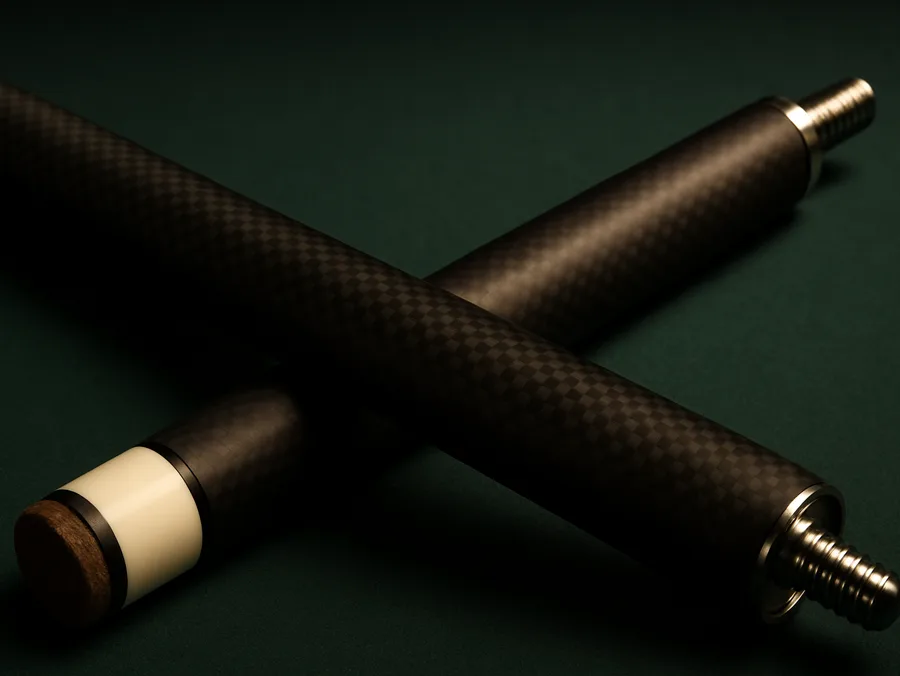
Cuetec Cynergy CT-15K Carbon Shaft
When you've decided on carbonCarbon over a foam core with a Tiger Sniper tip, sold in more joint pins than any other name-brand carbon shaft. Name-brand carbon also resells, which takes some of the sting out if the hit isn't for you. This link is the 12.5mm in 3/8x10; Cuetec lists other pins separately.
Check price on Amazon
Lucasi Zero Flexpoint Shaft, 12.75mm Uni-Loc
Less squirt, still woodA solid-core low-deflection shaft with a 12.75mm Everest laminated tip. If squirt is the only reason you were looking at carbon and you like how maple hits, start here.
Check price on Amazon
Kamui Clear Black Soft Layered Tip, 13mm
The upgrade to make firstA layered soft tip that gets trimmed to your ferrule. A fresh, well-shaped tip changes how a cue plays more than shaft material does for most players, and it's the first swap on a budget carbon shaft too.
Check price on Amazon
McDermott Joint Protector Set
Protecting the threadsCarbon won't warp, but its joint threads still pick up grit and dings in a case. Protectors matched to your pin are cheap insurance on an expensive shaft.
Check price on AmazonFrequently asked questions
Are carbon fiber pool cues good?
Yes, for what they do well: they don't warp, ding or need maintenance, and most squirt less than standard maple. They don't improve a stroke, and some players never like the stiffer hit. Budget carbon cues vary more in quality than name brands.
Do carbon fiber shafts really improve your game?
Only on shots with side spin, and only if squirt was costing you. Dr. Dave Alciatore puts a typical low-deflection shaft at roughly 30% less squirt than a regular one. If you miss center-ball shots, a shaft won't help.
How much does a carbon fiber shaft cost?
Name-brand shafts such as the McDermott Defy, Cuetec Cynergy, Viking Siege and Predator Revo run about $425 to $570 at major retailers. Budget import shafts run about $140 to $200.
Is a carbon shaft worth it for a beginner?
No. A beginner's misses come mostly from stroke and aim, which no shaft fixes. A maple cue with a warranty that covers warpage, plus table time, is the better spend. Revisit carbon once your stroke is consistent.
Is low-deflection maple as good as carbon?
On squirt, the best can be. In Dr. Dave's 2019 test, a Predator Z-2 maple shaft squirted about as little as a Predator Revo. Maple still needs care and can warp, which is where carbon wins.
Do carbon shafts break or wear out?
They don't warp, swell or need refinishing, and they hold up to normal play. Serious damage, such as a crushed or cracked end, usually means replacing the shaft rather than repairing it.
Should I buy a cheap carbon fiber shaft first?
If you're unsure, yes. A budget shaft under $200 shows you whether you like carbon's hit. Measure the tip end and check the joint fit the day it arrives, and plan on a better tip.
Do carbon fiber shafts hold their value?
Name-brand shafts sell on the used market, which lowers the real cost if you change your mind. Budget import shafts barely resell.
Related guides
LeaguePool is reader-supported. When you buy through links on this site we may earn an affiliate commission at no extra cost to you. As an Amazon Associate we earn from qualifying purchases.