
Replacement Pool Cue Shafts: Fit, Ferrules and Costs
A replacement pool cue shaft has to match five things on your butt: the pin size, the thread style (full thread or quick release), the joint face (flat or piloted), the collar diameter and, ideally, the length. Get the pin wrong and it won't thread on at all; get the collar wrong and it threads on with a visible step at the joint.
The safest replacement is a shaft from the company that made your cue, ordered for your model. Name-brand plain maple replacements list for roughly $130 to $270, low-deflection wood shafts about $290 to $380, and name-brand carbon about $425 to $570. If the real problem is a cracked ferrule rather than the whole shaft, a ferrule replacement at a cue shop usually runs $40 to $85 and saves the shaft.
The five things a replacement shaft must match
| Check | What can differ | How to confirm it |
|---|---|---|
| Pin size | 3/8x10, 3/8x11, 3/8x14, 5/16x14, 5/16x18, Radial, Uni-Loc and branded pins | Look up your brand and model, then count the threads with a thread gauge |
| Thread style | Full thread or quick release on the same pin size (a Viking QR and a full-thread 5/16x18, for example) | Count the turns to assemble: a quick release seats in far fewer turns than a full thread (Predator says about one and a half for its Uni-Loc) |
| Joint face | Flat-faced or piloted (a raised collar the shaft seats over) | Look at the butt's face from the side; a shaft for one won't seat right on the other |
| Collar diameter | A few thousandths of an inch between makers and models | Measure with a caliper and compare with the maker's listed joint diameter |
| Length | 29 inches is standard; some shafts come in 30 or 31 | Measure your old shaft from the joint face to the tip |
Predator's joint guide makes the key point plainly: a pin is identified by its thread pattern and diameter, not by a ruler. If you aren't sure, send the shaft seller a clear photo of the pin and the butt's face before you order. Most dealers will identify it.
Which pin does my cue use?
From Predator's and CuesPlus's brand-to-pin charts. Makers change joints between models and years, so treat this as a starting point and confirm on the cue.
| Brand | Pin |
|---|---|
| Predator | Uni-Loc quick release or Uni-Loc Radial since 2002; 5/16x14 or 5/16x18 before |
| Lucasi | Uni-Loc quick release or Uni-Loc Radial |
| McDermott | 3/8x10, or McDermott quick release on some models |
| Viking | Viking quick release or 5/16x18 |
| Cuetec | 3/8x14, 3/8x10 or 3/8x11, depending on model |
| Meucci, Players, Action, Dufferin | 5/16x18 |
| Schon | 5/16x14, piloted |
| Joss | 5/16x14 |
| Pechauer | Pechauer Speed Joint on current cues; older and custom-ordered ones vary |
| Jacoby | 5/16x14, Radial or 3/8x10 |
| Mezz | United, Wavy or Wavy 2 (all different) |
| Southwest | 3/8x11 |
Our joint types guide shows what each one looks like.
Pins that look alike but don't fit
These are the mix-ups that send shafts back, per CuesPlus's compatibility notes:
- 3/8x10 and 3/8x11. Southwest uses 3/8x11; a 3/8x10 shaft won't do.
- Uni-Loc quick release and Uni-Loc Radial. Same brand, different systems.
- Uni-Loc quick release, McDermott quick release and Viking quick release. All quick, none interchangeable.
- 5/16x14 and 5/16x18. Easy to confuse by eye; count the threads.
- Pechauer Speed Joint and a standard 5/16x14. Don't assume one fits the other.
- Mezz Wavy, Wavy 2 and United. Order the exact one.
Never force a shaft that binds partway on. Mismatched threads can feel snug at first and strip the insert later, which turns a shaft purchase into a butt repair.
Best replacement route for your situation
You want the cue to play exactly as before
Order the maker's own shaft for your model. McDermott, Pechauer, Schon, Meucci, Mezz, Predator and Viking all sell shafts for their cues, and a factory shaft matches the collar, rings and taper. Seybert's listed McDermott's plain maple 3/8x10 shafts at about $130 to $135, Pechauer's standard shafts at about $153 to $176 and Schon's maple shaft at $270 on October 15, 2026. Pechauer notes that cues made before 2019 take flat-faced shafts only, which is the kind of detail only the maker will know.
Your shaft is damaged and you use side spin
This is the moment to step up to a low-deflection shaft, because you're paying for a shaft either way. The Predator 314-3 comes in every common pin; McDermott, Pechauer, Mezz, Meucci and Jacoby each make LD shafts for their own joints. Our best low-deflection shafts guide compares them, and LD shafts explained covers whether you'll benefit.
You want a shaft that never warps
Carbon. It doesn't warp or ding and cleans with a damp towel, at roughly $425 to $570 for name brands or under $200 for budget imports. See best carbon fiber shafts and budget carbon shafts.
You want rings and collar to match a custom or older cue
Ask about a partial shaft: a finished shaft without the joint end, which a cue maker fits to your pin and finishes with matching rings. Seybert's lists partials from Predator (314-3), McDermott (G-Core) and Lucasi (Hybrid). Viking, for one, has built matching performance shafts for its cues from partial blanks, with matching collar rings. Budget a few weeks for the work.
What a replacement cue shaft costs
| Type | Typical price | Examples |
|---|---|---|
| Plain maple from the cue's maker | About $130 to $270 | McDermott maple, Pechauer standard, McDermott Classic, Schon maple |
| Fiberglass | About $160 | Cuetec AVID (3/8x14) |
| Maple with a carbon core | About $215 to $280 | McDermott G-Core (by joint) |
| Low-deflection wood | About $290 to $380 | Predator 314-3, Z-3, Vantage; McDermott i-shafts; Mezz WX-Sigma; Meucci The Pro; Pechauer Performance Plus; Jacoby Ultra Pro |
| Hybrid or Kielwood | About $450 to $480 | Predator Centro, Pechauer Torch+ |
| Budget carbon | Roughly $200 or less | Linc, Rhino and similar |
| Name-brand carbon | About $425 to $570 | Cuetec Cynergy, McDermott Defy, Viking Siege, Predator Revo |
Ranges come from makers' sites and Seybert's, Cue & Case and Mezz USA listings, checked October 15, 2026. Cheap no-name maple shafts exist too, but we couldn't verify enough of them to recommend one; most of the budget market has moved to carbon.
Pool cue ferrule replacement vs a new shaft
A cracked, loose or clicking ferrule is the most common reason people think they need a new shaft, and usually they don't. Shops replace ferrules on a lathe: the old ferrule comes off, the tenon gets cleaned up, a new oversize ferrule is glued on and turned to the shaft's diameter, and a new tip goes on top. The shop prices in our ferrule guide run about $40 to $85, with some including the tip, plus $20 to $25 if the tenon broke and needs replacing.
Three points from the shaft owner's side:
- Fix it early. A crack left in play can spread into the shaft wood, and then you're buying the shaft anyway.
- On a low-deflection shaft, ask for the original ferrule length and material, or send it back to the maker. A longer, heavier generic ferrule adds mass at the tip and raises squirt. Predator lists its own ferrule work for wood shafts and says outside work can affect its warranty.
- Carbon shafts are different. Many have no traditional ferrule at all, so talk to the maker before a shop touches the front end.
Ferrule replacement is lathe work. The new ferrule has to end up concentric and square to the shaft or the tip sits crooked, so it's a shop job, not a kitchen-table one. Retipping you can do yourself; see how to replace a cue tip.
Repair or replace?
| Problem | Usual answer |
|---|---|
| Worn or mushroomed tip | Retip. Cheap, and you can do it yourself. |
| Sticky, dirty or rough shaft | Clean and burnish. See our cleaning guide. |
| Cracked or loose ferrule | Replace the ferrule ($40 to $85). |
| Slight warp | Roll the shaft on a flat table. A wobble you can barely see is playable; a visible one means a new shaft, and Predator, for example, doesn't cover warping on its wood shafts. |
| Bad warp, a crack into the wood, or a damaged insert | Replace the shaft. |
| Sanded too thin | Replace. Predator, for one, sets minimum turn-down diameters on its wood shafts (12.25mm for the 314-3, 11.40mm for the Z-3, 12.50mm for the Vantage). |
Our pool cue repair costs page has the shop prices for each of these jobs.
Matching diameter and length
Measure the old shaft at the tip with a caliper before you order. Wood shafts lose diameter every time they're sanded, so a shaft that started at 13mm may now be 12.6mm, and a fresh 13mm replacement will feel thicker than what you're used to. Order the size you actually play with, or one small step thinner if you've been meaning to try it. Big jumps, say 13mm to 11.8mm, take weeks to feel normal. Our tip size guide explains what diameter changes.
Length matters less, but check it. Most shafts are 29 inches. Pechauer, Mezz, Jacoby and some Predator shafts come in 30 inches, and McDermott's Defy goes to 31. A longer shaft changes the cue's balance and total length, which some tall players want and most don't.
Buying a second shaft
A spare shaft on the same butt is cheap insurance. If your only shaft cracks a ferrule the night before a tournament, you play with a house cue; with a spare, you swap and keep going. Some players also keep a stiffer shaft with a harder tip for breaking, which keeps the hard hits off their playing shaft without carrying a full break cue.
Two shafts need somewhere to live. A 2x2 case holds two butts and two shafts (see best 2x2 cases), and the shaft in the case needs a joint protector matched to its pin so the threads don't collect grit or get knocked out of round.
Old, discontinued and import cues
- Predators made before 2002 used 5/16x14 or 5/16x18, not today's Uni-Loc or Radial. Order by pin, not by brand.
- Many import and bar cues use a 3/8x8 pin that the name-brand shaft makers don't sell. Budget shafts sometimes come in 3/8x8, but on a cheap butt a new complete cue often makes more sense than a shaft.
- For a discontinued or custom cue, a cue maker can fit a partial shaft to your pin and match the rings. It costs more than an off-the-shelf shaft and takes longer, but it's the only way to keep an older cue's look.
- One-piece cues have no joint, so there's no shaft to replace.
Buying a used cue to get a spare shaft? Our used pool cue guide covers what to check.
Sources
- Predator: joint types by manufacturer
- CuesPlus: shaft pin compatibility by brand
- Predator: wood shafts, turn-down limits and warranty notes
- McDermott: shaft lineup and prices
- McDermott: Defy lengths, joint diameters and care
- Pechauer: maple shaft options
- Seybert's: replacement shaft listings and prices (checked October 15, 2026)
- Seybert's: McDermott shafts
- Billiards.com: performance shafts for Viking cues
- Jacoby: performance shafts and wrong-pin returns
Our picks
Links open the current selection and price on Amazon so you can compare real reviews before buying.
Predator 314-3 Maple Shaft, 3/8x10
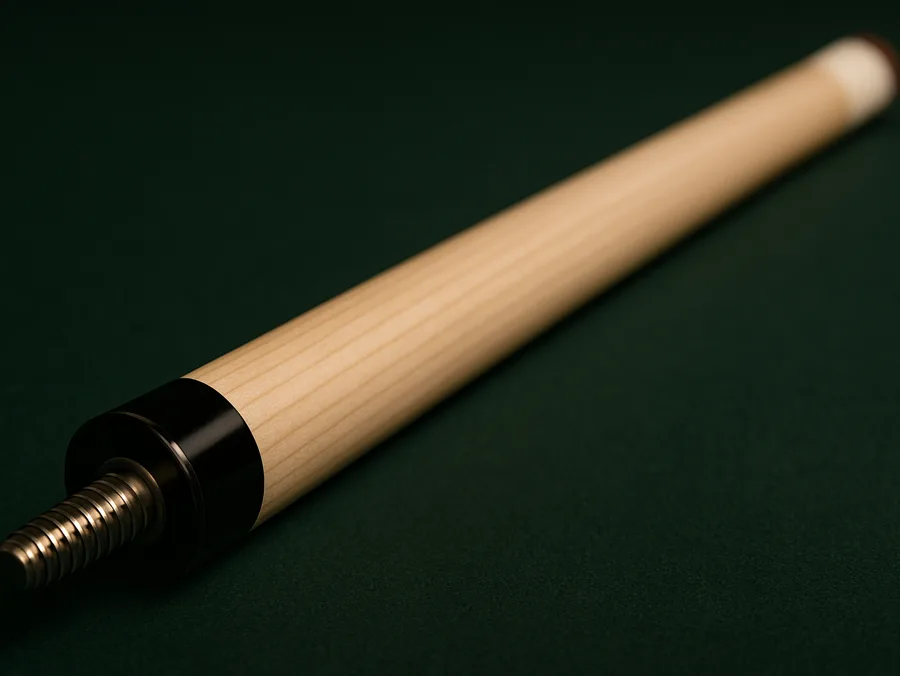
Upgrading while you replaceIf you're replacing a maple shaft on a 3/8x10 butt anyway, this is the low-deflection step up: 10 pieces of matched maple and a lightened front end that cuts squirt on side-spin shots. Predator also makes it in Uni-Loc, Radial and 5/16 pins.
Check price on Amazon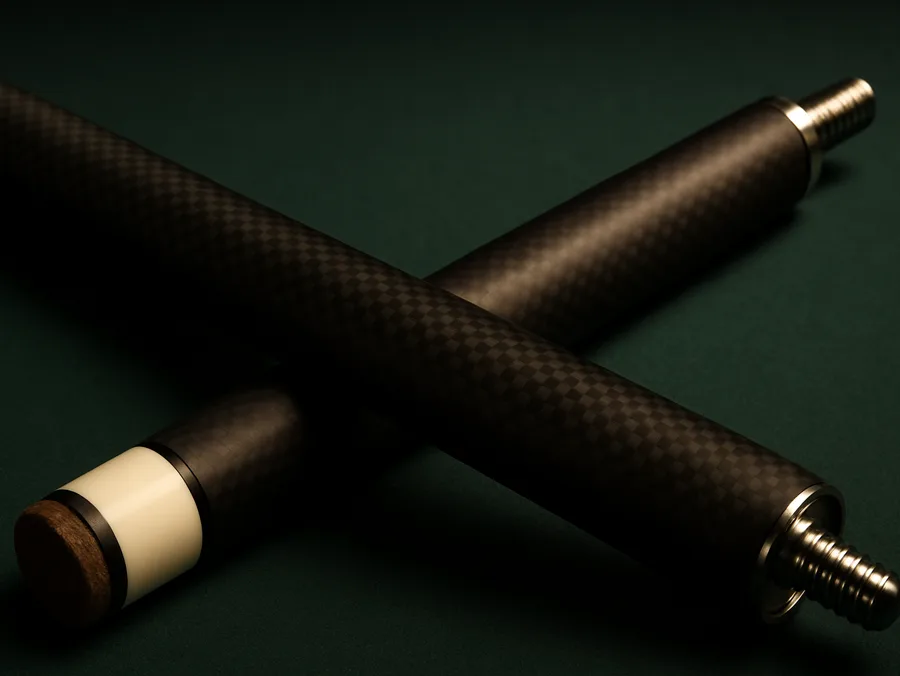
Cuetec Cynergy CT-15K Carbon Shaft
Carbon for the most jointsCarbon composite with a light front end and a ding-resistant, low-friction finish. It's offered in more pins than any other name-brand carbon shaft, which makes it the likeliest carbon fit for an unusual butt. Choose your exact pin on the listing. This link is the 12.5mm in 3/8x10; Cuetec lists other pins separately.
Check price on Amazon
RHINO Carbon Fiber Shaft, 3/8-10
Budget carbon replacementA 30-inch carbon shaft, about 4 oz, with a pro taper, a Time Crystal tip and a 3/8-10 stainless joint with a collar of roughly 21.5mm. Tip sizes run from 10.5 to 12.9mm. Measure your butt's collar first, and note that it's an inch longer than a standard 29-inch shaft.
Check price on Amazon
McDermott Joint Protector Set, 3/8
Protecting a spare shaftA two-piece heavy-duty plastic set made for McDermott cues with a 3/8 joint. It keeps grit out of the threads of the shaft riding in your case. Other pins need protectors made for them.
Check price on AmazonFrequently asked questions
Will any shaft fit my pool cue?
No. The shaft must match your butt's pin size, thread style (full thread or quick release), joint face (flat or piloted) and, for a clean fit, collar diameter. Look up your brand's pin, confirm it on the cue, and send the seller a photo if in doubt.
How much does a replacement pool cue shaft cost?
Name-brand plain maple replacements list for about $130 to $270, maple with a carbon core about $215 to $280, low-deflection wood about $290 to $380, and name-brand carbon about $425 to $570. Budget carbon shafts run roughly $200 or less.
How much does pool cue ferrule replacement cost?
Cue shops typically charge about $40 to $85, some with a new tip included, plus $20 to $25 if the tenon under the ferrule is broken. It's far cheaper than a new shaft.
Can I replace a ferrule myself?
Not well without a lathe. The new ferrule has to be turned down concentric with the shaft and faced square, or the tip sits crooked. Retipping is a reasonable home job; ferrules are shop work.
How do I find out what pin my cue has?
Start with the brand and model in a pin chart such as Predator's or CuesPlus's, then check the cue itself: count the threads with a gauge, note whether it's a quick release, and see whether the joint face is flat or piloted.
Can I put a carbon fiber shaft on my wood cue?
Yes, if the carbon shaft is made in your butt's pin and the collar diameters are close. Many carbon shafts are sold in several pins, including 3/8x10, 5/16x18, 5/16x14, Radial and Uni-Loc.
Should I get the same diameter as my old shaft?
Get the diameter your old shaft measures now, or one small step thinner. Wood shafts get thinner with sanding, so a new shaft at the original size can feel thick.
Is it better to replace the shaft or buy a new cue?
If the butt is straight, the joint is sound and you like its weight, a shaft is cheaper. If the butt is a cheap import with a 3/8x8 pin, a new cue often makes more sense, because few name-brand shafts are made for that pin.
Can a warped shaft be fixed?
A slight warp can sometimes be corrected, but it may return. A badly bowed, cracked or over-sanded shaft should be replaced, and that's a good time to consider a low-deflection or carbon shaft.
Related guides
LeaguePool is reader-supported. When you buy through links on this site we may earn an affiliate commission at no extra cost to you. As an Amazon Associate we earn from qualifying purchases.