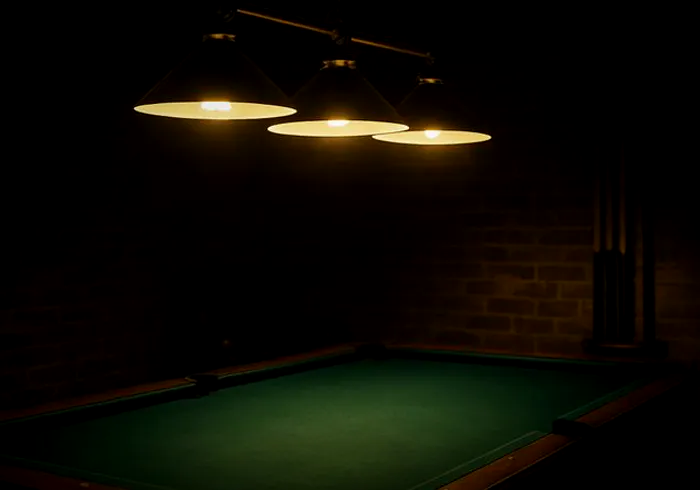
Pool Table Light Height: How High to Hang It
On a home table, hang the light so the bottom of the shades sits 30 to 36 inches above the cloth. With a playing surface about 30 inches off the floor, that puts the shades roughly 60 to 66 inches from the floor, close to the nose height of a standing adult. Start at 33 or 34 inches and adjust from there.
Tournament rooms use a different number. The WPA equipment specification says a fixture that can be moved aside should be no lower than 40 inches above the bed, and a fixed fixture no lower than 65 inches. Both numbers are right for their rooms, and the reason they differ tells you how to set your own.
Pool table light height at a glance
| Measurement | Home table | WPA tournament spec |
|---|---|---|
| Playing surface (bed) to bottom of the shades | 30 to 36 in | At least 40 in (movable fixture) or 65 in (fixed fixture) |
| Floor to bottom of the shades | About 60 to 66 in | About 69 in or more (movable) |
| Floor to playing surface | 29-1/4 to 31 in | 29-1/4 to 31 in |
| Light on the cloth | Even, no dim pockets | At least 520 lux at every point of the bed and rails |
Measure to the bottom edge of the shade, not to the bulb, and from the cloth, not from the top of the rails. On an LED panel, measure to the light-emitting face.
Why the tournament number is higher
The WPA spec is written for event venues, and its own first section says it doesn't necessarily apply to tables made for home use. Tournament fixtures are long and bright, often with reflectors, and the spec wants them high enough that a referee can move them and nobody's view of the table is blocked. A light that is 40 inches up has to be strong to still put 520 lux on the corners.
A home fixture is usually three shades with ordinary E26 bulbs. Hang that at 40 inches and the corners go dim and the shadows soften into gray patches. Bring it down to the low 30s and the same bulbs put far more light on the cloth, because light falls off quickly with distance. That's why table makers and installers settle on 30 to 36 inches for home lights. Table maker A.E. Schmidt gives 31 to 33 inches from the playing surface to the bottom of the shade.
The practical rule: the brighter and longer your fixture, the higher it can go. A strong LED panel can go higher, toward 40 inches, if the corners still read bright on a meter. A three-shade bar with modest bulbs belongs at the low end of the range.
How high is a pool table?
The WPA spec puts the playing surface (the bed) 29-1/4 to 31 inches above the floor. Most home tables land around 30 inches. The rails sit a couple of inches higher than the cloth, and the overall height on a spec sheet usually measures to the top of the rails, so don't use that number for your light math.
To measure your own table, run a tape from the floor to the cloth at a corner and at the middle of a long rail. Different readings mean the table is out of level, and that's worth fixing before you hang anything (our leveling guide covers it). For the full table of bed sizes and other dimensions, see pool table sizes explained.
Here is how bed height and light height add up to the number you'll set from the floor:
| Bed height | Shades 30 in above | 33 in above | 36 in above |
|---|---|---|---|
| 29-1/4 in | 59-1/4 in | 62-1/4 in | 65-1/4 in |
| 30 in | 60 in | 63 in | 66 in |
| 31 in | 61 in | 64 in | 67 in |
Height by table size
Over 7 and 8 foot tables, installers commonly hang lights 30 to 36 inches above the bed. Over a 9-footer the range stretches to about 40 inches, because the longer fixture needs a little more height to spread light to the far corners. Fixture length matters more than these few inches: a light that is too short for the bed leaves dim corners at any height. Our pool table light buying guide has a size chart (about 44 to 59 inches of fixture for an 8-foot table).
Will the light fit under your ceiling?
Work it out before you buy. Add the bed height, your target clearance and the fixture's own height, then compare with the ceiling. A worked example with the Wellmet 59-inch three-shade light, whose body is 13.62 inches tall, hung with the shades 34 inches over a 30-inch bed:
| Ceiling | Top of the fixture | Room left for chain and canopy | Verdict |
|---|---|---|---|
| 9 ft (108 in) | about 78 in | about 30 in | Plenty; the 35.4-inch chain covers it |
| 8 ft (96 in) | about 78 in | about 18 in | The usual case, easy |
| 7.5 ft (90 in) | about 78 in | about 12 in | Works with short chain |
| 7 ft (84 in) | about 78 in | about 6 in | Tight; a low-profile LED panel is the better choice |
A thin panel changes the math. An LED panel about 4 inches tall (the YEPOLI we measured from its listing is one) at the same 34-inch clearance its top sits near 68 inches and it fits under almost any finished ceiling. The other limit in a low room is the cue. A shade at 30-something inches over the cloth is where a raised butt goes on a jump or masse shot, so in a low basement play those shots with care or skip them. For basement-specific planning, see pool table basement ideas.
How to hang a pool table light
- Set up and level the table first, or at least mark exactly where its center will be. Moving a table six inches after the light is wired puts the light off center.
- Find the center of the table: measure each side and mark the midpoints, or run strings corner to corner. Transfer that point to the ceiling with a plumb line or a laser level.
- Find the ceiling joist nearest the mark. Billiard lights are heavy and long, and the weight belongs on framing or on a box rated for the load, never on drywall anchors alone.
- If the electrical box isn't over the table's center, leave it where it is and swag the fixture: screw two swag hooks into joists over the table and run the chain and cord from the box to the hooks.
- Turn off the breaker, then wire the fixture to the box. If you aren't comfortable with house wiring, this is the step for a licensed electrician.
- Hang the fixture and set the chains. Angle the chains out in a V, around 45 degrees, rather than running them straight up to one point. Installers set them this way to keep the fixture from swinging and to take strain off the hardware.
- Measure from the cloth to the bottom of the shade at both ends and adjust one link at a time until both ends read the same.
- Bulbs in, power on, then run the tests below before you trim any chain.
Plug-in fixtures skip step 5 but not step 3. The ceiling hook still has to go into a joist.
Test the height before you call it done
Two checks, both at night with the room lights off.
First, the five-ball test. Put a ball near each corner pocket and one on the center spot. All five should look equally lit, and the shadows under them should be short and soft. Long shadows fanning out toward the rails mean the fixture is too low for its length. Dim corner balls mean it's too short, too high or underpowered. If you have a lux meter (or a phone light-meter app for a rough comparison), the corners should read close to the center.
Second, the glare test. Have the tallest regular player stand at the table in a normal stance, then stand up straight after a shot, at every rail. Nobody should see a bare bulb. If someone does, raise the fixture an inch or two or change to frosted bulbs.
| Symptom | Likely cause | Fix |
|---|---|---|
| Bright center, dark corner pockets | Fixture too short, or hung too high | Lower it 1 to 2 inches, or buy a longer fixture |
| Bulb glare when standing | Too high for the shade depth, or clear bulbs | Lower it slightly or switch to frosted bulbs |
| Glare when bent over the shot | Too low | Raise it 1 to 2 inches |
| Cue hits the shade | Too low for your shots or ceiling | Raise it, or use a slim LED panel |
| Light spilling across the floor around the table | Too high | Lower it toward 32 to 34 inches |
Problem ceilings
Under a 7-foot ceiling, a slim LED panel hung on short cable is the cleanest answer. Recessed cans can work too, but only with several of them placed over the table's edges so their beams overlap on the cloth; a single can over the middle gives a hot spot and hard shadows.
For sloped or vaulted ceilings, look for a fixture whose canopy is made for a slope (several billiard and island lights list this) and use the chains to bring both ends to the same height over the cloth. For an off-center box, swag as in step 4 above rather than moving the table to suit the box.
Bulbs affect glare as much as height. Use frosted LED bulbs in neutral white (4000K to 5000K) and put the light on an LED-rated dimmer, so you can run it bright for play and low the rest of the evening. The buying guide covers bulbs and fixture choice in detail, and pool table room ideas covers lighting the rest of the room.
Sources
- WPA Recommended Equipment Specifications, section 2 (table bed height) and section 15 (lights)
- A.E. Schmidt Billiards, pool table room design (31 to 33 inch shade height)
- Wellmet and YEPOLI Amazon listings (fixture height, chain and cable length), read October 2026
Our picks
Links open the current selection and price on Amazon so you can compare real reviews before buying.
Wellmet 3-Shade Billiard Light
Classic look over 7 to 8 foot tablesA 59-inch, three-shade bar on a 35.4-inch adjustable chain. That much chain covers ceilings from about 7.5 to 9 feet with the shades in the 30 to 36 inch band, and you set the final height one link at a time. Hardwired; bulbs are E26 and sold separately.
Check price on Amazon
vivihobb 50W Dimmable LED Pool Table Light
Low ceilingsA slim 45-inch LED bar on suspension wires that hang up to 60 inches, so it still lands in the right band under a 7-foot basement ceiling. The remote dims it and changes the color temperature, which also helps when a light feels glary at a given height.
Check price on Amazon
Lutron Diva LED+ Dimmer Switch
Dimming a bar-style fixtureMade for dimmable LED bulbs, with a trim adjustment to set the low end, so the table can run bright for play and soft the rest of the night, with less of the flicker and buzz LEDs get on old dimmers. Works single-pole or 3-way. Use dimmable LED bulbs in the fixture.
Check price on AmazonFrequently asked questions
How high should a pool table light be above the table?
For a home table, the bottom of the shades should be 30 to 36 inches above the playing surface; 32 to 34 inches is a good starting point. WPA tournament rooms use at least 40 inches for a movable fixture and 65 inches for a fixed one, with much brighter lights.
How high should a pool table light be from the floor?
About 60 to 66 inches from the floor to the bottom of the shades, assuming a playing surface around 30 inches high. Add your table's actual bed height to your chosen clearance to get the exact number.
How high is a pool table?
The playing surface should be 29-1/4 to 31 inches above the floor per the WPA specification; most home tables are about 30 inches. The rails sit slightly higher than the cloth.
Do you measure to the bulb or the shade?
To the bottom edge of the shade, measured from the cloth. On an LED panel, measure to the light-emitting face.
What ceiling height do I need for a pool table light?
An 8-foot ceiling makes a hanging three-shade light easy. At 7.5 feet it works on short chain. At 7 feet, a slim LED panel is the better choice because a 13 to 14 inch tall fixture leaves almost no room above it.
Can a pool table light be too high?
Yes. Too high and the corners go dim, shadows soften into gray patches, light spills on the floor and players can see bulbs when they stand. Lower it an inch at a time until the corners light up.
How high should the light be over a 9-foot table?
Usually a little higher than over a 7 or 8 foot table, up to about 40 inches above the bed, with a longer fixture so the light reaches all six pockets.
How do I hang a pool table light without a box over the table?
Swag it. Put two swag hooks into ceiling joists over the table, hang the fixture's chains from them and run the cord along the chain to the existing box or an outlet. Never hang the weight from drywall anchors.
Related guides
LeaguePool is reader-supported. When you buy through links on this site we may earn an affiliate commission at no extra cost to you. As an Amazon Associate we earn from qualifying purchases.