
Ring Game Pool: How Money Games Work (Is It Gambling?)
A ring game in pool is a money game for three or more players who shoot in a fixed order on one rack, usually 9-ball, with every other player paying whoever pockets the money ball. Head-to-head money play works differently: two players bet on a set or a race, often with a handicap called a spot.
Is pool a gambling game? No. Pool is a game of skill, and most of it is played for nothing at all. It turns into gambling when players put money on the result, and it has done that for a long time: the word pool itself comes from the pot of stakes players paid into. This page covers how ring games and money sets work, the terms you'll hear, the etiquette, and a plain look at the legal side (no legal advice: gambling law depends on where you are).
Is pool a gambling game?
Pool is a game of skill. Wikipedia's article on games of skill lists billiards among them, and nothing about the rules of 8-ball or 9-ball involves a wager. Leagues, tournaments and home tables run without any money changing hands between players.
The gambling reputation comes from history. As our guide to why pool is called pool explains, the name comes from the pool of stakes players put up, and 19th-century American poolrooms were horse-race betting parlors that happened to keep billiard tables. Money games, hustlers and films such as The Hustler (1961) and The Color of Money (1986) kept the link alive.
So the honest answer: pool isn't gambling, but betting on pool is gambling, and the law treats it that way in many places even though skill decides most games. More on that below.
What is a ring game in pool?
The term comes from poker, where it means a cash game rather than a tournament. In pool it covers two kinds of game:
- Open ring games, where players can join or quit between racks. Three-ball, killer and kelly pool are usually played this way.
- Fixed-roster ring games, where the lineup is set when play starts. Cutthroat is one by nature, and so is a ring 9-ball game that runs with the same players all night.
Whether a new player can buy in is up to the players already in the game. Bob Jewett, writing in Billiards Digest, puts it as a decision for the majority of the ring.
Ring 9-ball rules
| Point | Usual ring game practice |
|---|---|
| Players | Three or more |
| Order | Drawn at random, then fixed |
| Break | Winner of the last rack breaks |
| Turn | Shoot until you miss or foul, then the next player takes the table as it lies (or with ball in hand after a foul, if that's the agreed rule) |
| Safeties | Not allowed in the traditional game |
| Money balls | Usually two: the 5 and the 9, with the 9 paying more |
The no-safety rule is the one newcomers miss. The logic: with four or five players, a safe hurts only the next player in line and hands the others a better table, so the traditional game bans it and everyone shoots at the ball.
How a ring game pays
Each money ball is paid by every other player in the ring to whoever legally pockets it. Liz Ford's example at PoolDawg: everyone pays $1 to the player who makes the 5 and $2 to the player who makes the 9. Here's what that means at different ring sizes:
| Players | Making the 5 collects | Making the 9 collects | One player's worst rack |
|---|---|---|---|
| 3 | $2 | $4 | Pays $3 |
| 4 | $3 | $6 | Pays $3 |
| 5 | $4 | $8 | Pays $3 |
| 6 | $5 | $10 | Pays $3 |
Your cost per rack stays the same no matter how many players join, but your payday grows with every player. That's why strong players like big rings and why you should size the stakes to what you can lose over a long night, not over one rack.
Agree before the first break on a few details: whether a 9 made on the break pays, whether a combination on the 9 pays, whether the 5 pays if it goes in on the same shot as the 9, and what happens to a money ball pocketed on a foul.
Other ring games
- Kelly pool. Secret numbered peas decide each player's ball, which hides the targets and levels out skill. See kelly pool rules.
- Killer. Lives instead of money balls; the last player standing takes the pot.
- 3-ball. Everyone antes, the fewest strokes to pocket three balls wins, and ties play off with another ante. Our bar rules guide has the rules.
- Fargo Flip. A team version of ring 9-ball that Jewett describes from Fargo Billiards: a coin flip sets Heads against Tails each rack, and each losing player pays each winner one unit. A player alone on a side risks much more than the others, so count heads before you flip.
- Bank pool ring. The Derby City Classic in southern Indiana has run a six-player bank pool ring game, winner take all, since 2004.
For the non-money versions of these and other group games, see pool games for groups.
Sets, races and spots
One-on-one money pool is played in two formats. A set is a fixed number of games for an agreed amount. A race is first to a fixed number of wins, such as a race to 7 in 9-ball. Some players bet per game instead, where every rack pays; that rewards a hot streak and punishes a slow start.
When two players aren't equal, the stronger one gives a spot (also called giving weight). The common forms:
- Games on the wire. The weaker player starts with games already counted, so they need fewer wins to take the set. The name comes from the scoring wire over the table.
- Ball spots. The weaker player gets an extra money ball, so pocketing it also wins the game.
Negotiating the spot is part of the game, and a bad spot can decide a set before anyone breaks. If you can't win a single rack against someone even, a small spot won't change the outcome.
Money pool terms
| Term | Meaning |
|---|---|
| Action | Gambling, or the chance of a money game |
| Money ball | The ball that wins the game or triggers a payment, such as the 5 and 9 in a ring |
| Set | A fixed number of games played for an agreed amount |
| Race | First to a fixed number of wins |
| On the wire | Games given as a head start |
| Weight | A handicap given to a weaker player |
| Stakehorse (backer) | Someone who puts up a player's money in exchange for a share of the winnings |
| Road player | A strong player traveling to gamble |
| Sandbag | Hiding your real level, for example by losing early, cheap games |
| Lemonade stroke | A deliberately clumsy stroke used to look worse than you are |
| Let out | Letting a losing opponent stop a set early for a reduced amount |
| Rob / have the nuts | To play a game you're very unlikely to lose |
Hustling: what it is
Hustling is playing for money while making a weaker opponent believe they can win, then raising the stakes until they've lost more than they would ever have bet at the start. The classic moves are hiding your speed with a house cue or a plain-looking cue, dumping a few cheap early games, missing easy shots while making hard ones look lucky, and waiting to raise the bet. Professionals sometimes play with a stakehorse who funds the bets for a substantial share of the winnings.
Knowing the pattern is the protection. Be wary of a stranger who loses a couple of small games and then wants to raise the stakes, and of anyone who suggests a money game at a gimmick (one-handed, opposite-handed, trick shots). Liz Ford's advice at PoolDawg on one-handed games is blunt: don't accept a money offer from a stranger, because they're probably a specialist.
Money game etiquette
- Settle the terms out loud before the break: the stakes, what pays, the rules (call shot or not, push-outs, three-foul), when you pay, and when the session ends.
- Pay when you lose, right away, without being asked.
- Don't change the stakes or the spot in the middle of a set.
- Don't hide your speed. Sandbagging is a form of hustling, and in leagues it counts as cheating.
- No sharking: no talking, moving or standing in a shooter's line during their stroke. See pool etiquette.
- Respect a stated quitting time, yours and theirs.
League night is different. CSI's rules (used by BCAPL leagues) name offering to gamble with opponents or spectators during your match as unsportsmanlike conduct. Keep side bets out of league matches.
Protecting yourself
- Watch a stranger play a few racks before you match up.
- Set a limit for the night before you start, and leave when you hit it.
- Never chase losses by raising the bet while you're playing badly.
- Get the payout rules for every money ball agreed, especially breaks, combinations and fouls.
- If someone else is backing you, agree on the split and on who decides when to quit before you hit a ball.
- Use a visible score: a bead string or a counter beats memory in the eighth rack.
If betting has stopped being fun, that's worth taking seriously. The National Problem Gambling Helpline, listed by the National Council on Problem Gambling, is 1-800-MY-RESET (1-800-697-3738) in the US, by call or text.
Is betting on pool legal?
It depends on where you are, and nothing here is legal advice. In the US, each state is free to regulate or prohibit gambling within its borders, so the answer depends on your state and local law and on the place you're playing.
A concrete example shows why "it's a skill game" doesn't settle it. Texas Penal Code section 47.02 makes it an offense to bet on the result of a game or contest, and section 47.01 defines a bet as an agreement decided "solely or partially by chance." Texas allows a defense when the gambling happens in a private place, nobody gets an economic benefit beyond their own winnings, and the risks and chances are equal for everyone apart from skill or luck. Its definition of a private place excludes taverns, restaurants and nightclubs. The definition of a bet also leaves out a prize offered to the actual contestants in a bona fide contest of skill. That's one state; other states draw these lines differently.
Three practical points hold everywhere:
- Check your state and local law if you plan to play for money.
- The room's house rules apply on its tables, and a room can ban betting outright.
- Real-money pool apps and online betting on pro matches raise the same legal question, under rules that differ from state to state.
Sources
- Wikipedia: Glossary of cue sports terms (ring game, set, race, spots, money terms)
- Wikipedia: Hustling
- Bob Jewett, "More the Merrier III," Billiards Digest, February 2011 (PDF)
- Wikipedia: Derby City Classic
- Texas Penal Code section 47.02, Gambling and section 47.01, Definitions
- CueSports International Official Rules, rule 1-45 (PDF)
- Wikipedia: Gambling in the United States
Our picks
Links open the current selection and price on Amazon so you can compare real reviews before buying.

Predator Sport 2 Playing Cue
A cue you know for serious setsIn a long set, the house cue is one more variable you don't need. A playing cue of your own hits the same way every rack, so a miss is your stroke and not the equipment.
Check price on Amazon
Casemaster Q-Vault Classic 2x2 Hard Case
Carrying two cues between roomsA full-length hard resin shell holds two butts and two shafts, with two pockets for chalk, tips and a shaper and a shoulder strap for the walk in. A playing cue plus a break cue in one case is the usual kit for a night of action.
Check price on Amazon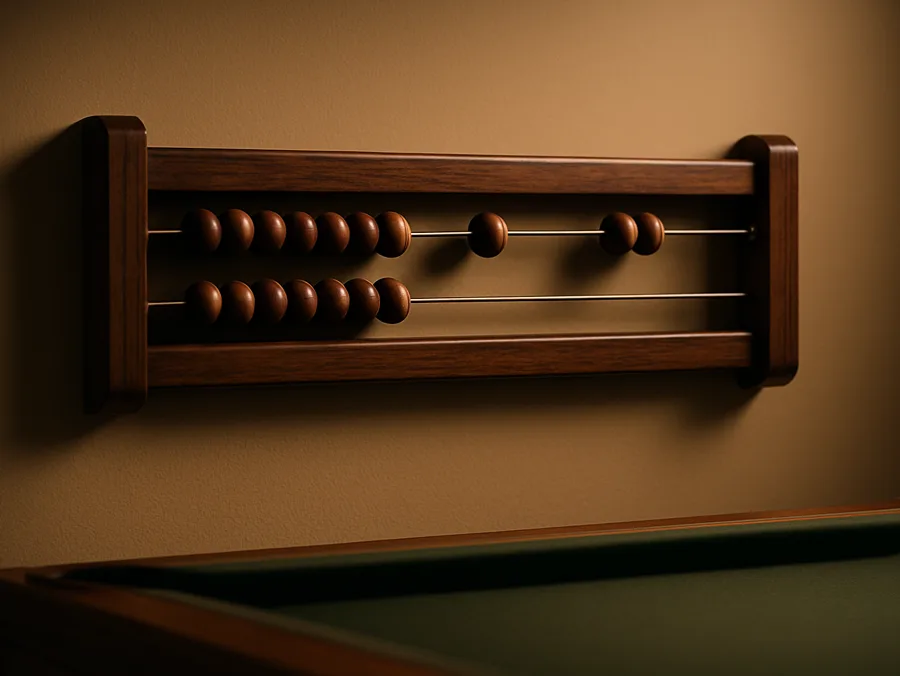
Wooden Bead Score Keeper
Keeping score in a raceA 63-inch string of wooden scoring beads for the wall over the table. When there's money on a race to 9, a score everyone can see from the rail settles the count before it becomes an argument.
Check price on Amazon
The Hustler by Walter Tevis
The money-pool novelWalter Tevis's novel about Fast Eddie Felson, a road player, is the book the 1961 film was made from. If you want to know what the money-pool world of that era felt like, start here.
Check price on AmazonFrequently asked questions
Is pool a gambling game?
No. Pool is a game of skill, and most games are played for nothing. It becomes gambling when players bet on the result, which is a long tradition: the name pool comes from the pot of stakes players paid into.
What is a ring game in pool?
A money game for three or more players who shoot in a fixed order, usually at 9-ball. Every other player pays whoever pockets a money ball, typically the 5 and the 9, and safeties are traditionally not allowed.
How many players are in a ring game?
At least three, and there's no fixed upper limit. Because each player pays the same amount per money ball while the winner collects from everyone, bigger rings mean bigger paydays per rack.
What does it mean to give someone a spot?
A spot, or weight, is a handicap the stronger player gives: games on the wire or an extra money ball. It's agreed before play.
What is a stakehorse in pool?
A backer who puts up a player's gambling money in exchange for a share of the winnings.
Is betting on pool legal?
It depends on your state and local law and on the place you play. Some state laws treat a bet on any game or contest as gambling even when skill decides it. Check local law and the room's rules; this isn't legal advice.
Can you gamble in a pool league?
Not during league matches under CSI rules, which call offering to gamble with opponents or spectators during your match unsportsmanlike conduct. Check your own league's rules.
Related guides
LeaguePool is reader-supported. When you buy through links on this site we may earn an affiliate commission at no extra cost to you. As an Amazon Associate we earn from qualifying purchases.